This copy is for your personal, non-commercial use only. Distribution and use of this material are governed by our Subscriber Agreement and by copyright law. For non-personal use or to order multiple copies, please contact The Epoch Times Reprints.
CPR director Donald Smith drives home the last spike for the Canadian Pacific Railway in Craigellachie, B.C., on Nov. 7, 1885. The Canadian Press/National Archives of Canada
Was the Canadian Pacific Railway built by Chinese labourers? The short answer is yes, some of it was. But all 4,800 kilometres of it? Certainly not. Why, then, do some people say, “The Chinese built the Canadian Pacific Railway” or even that “Canada was literally built by Chinese.” It’s not just posting and trolling. The Canadian Labour Congress states, “Over 17,000 Chinese immigrants built the Canadian Pacific Railway.” And B.C.’s NDP Parliamentary Secretary, Mable Elmore, said in 2023: “Between 1881 and 1884, more than 17,000 Chinese railroad workers came to build the Canadian Pacific Railway.”
While it is true that thousands of Chinese “coolies” did some of the most dangerous work on the railway, their role is often inflated, without qualification or context. Yes, at least 600 died on the job. Of the rest, about half returned to China, and others were, or became, immigrants.
A Canadian Pacific Railway crew lays tracks in B.C.’s Lower Fraser Valley on Dec. 1, 1881. Public Domain
But in fact, Chinese contractors were hired only to build the segment spanning 400-500 kilometres through the Fraser Canyon to the Rocky Mountains. Bear in mind that the CPR, completed in 1885, stretched about 4,800 kilometres from Port Moody in B.C. to Montreal. Chinese were hired for the difficult sections from Hope and Yale through the Fraser Canyon, and from Savona Ferry to Eagle Pass. So it is accurate to say that Chinese labour participated in building about 10 percent of the CPR.
That’s a significant share. But in their eagerness to praise a minority group, some forget that the labour force for the other 90 percent of the epic length of the CPR were English, Irish, and Scots navvies (a “navvy” was a manual labourer). Many of them were Canadians with experience building canals in Ontario and Quebec, some from the Maritimes, even a large number of Americans who had worked on U.S. railroads, and probably some Italians, Scandinavians, and Germans. At any given time in the B.C. mountains, about 6,000 out of 9,000 were Chinese. So they were 70 percent of the labourers, and the rest were Canadian, British, and American.
Another claim one hears is that the Chinese suffered more because they worked on “the most challenging and dangerous terrain,” or “Chinese workers were given the most dangerous tasks, such as handling the explosive nitroglycerine used to break up solid rock.” These are from a B.C. government website promoting multiculturalism.
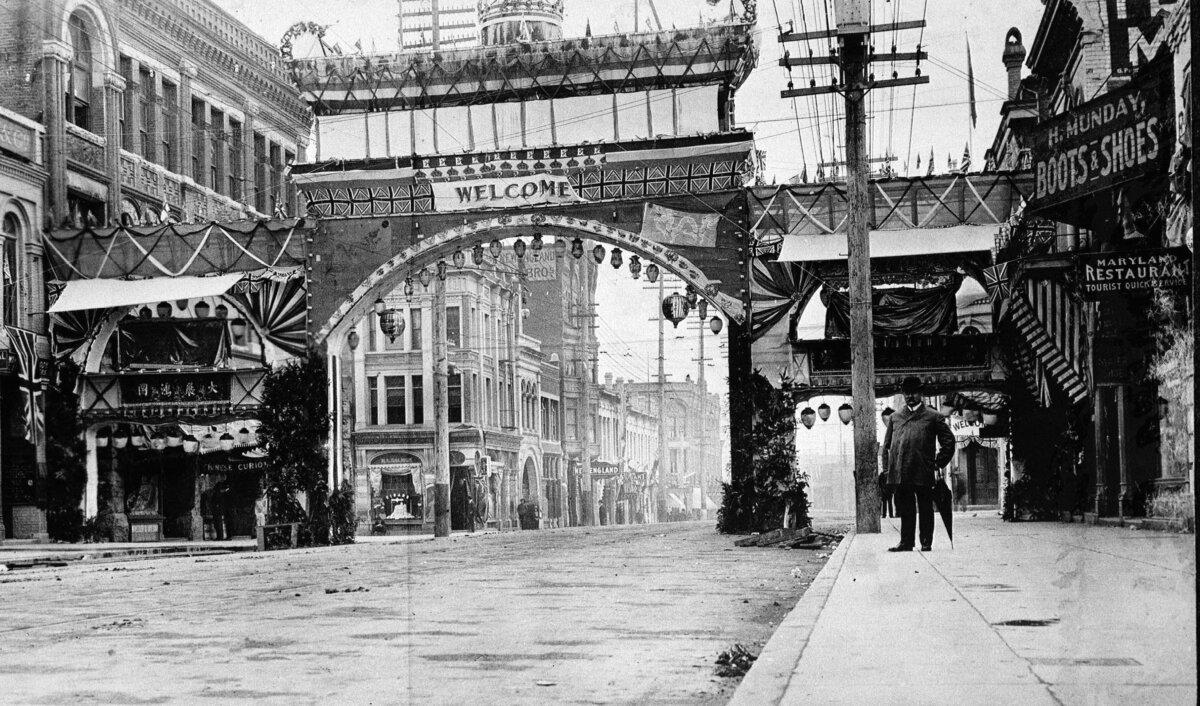
The Chinese Arch at the entrance to Chinatown in Victoria, B.C., in September 1906. CP Photo
However, building across the vast Canadian Shield terrain of the Great Lakes region was extremely dangerous, too. There was plenty of blasting with nitroglycerine. On one occasion in 1878, when the explosive was set and did not go off, a foreman named Mackenzie went back to check. “Suddenly the charge exploded, blowing away the foreman’s left hand, both eyes and a part of his nose.” The Ottawa Citizen reported: “At such a distance from civilization, the services of a surgeon could not be had, and the wounds were bandaged up as best the navvies knew how.” He survived, though you could see through his eye socket out the side of his head—a man without a face.
Another man, Thomas McCaugly, at Hawk Lake, east of Kenora (then called Rat Portage), tried to chisel a nitroglycerine can out of frozen snow when it “exploded and blew him to fragments.” In a flash he was gone, “there not being a hundredth part of him obtainable in one piece. In fact, in the surrounding debris there were only occasional spots of blood and grease and minute fragments of flesh and bones.”
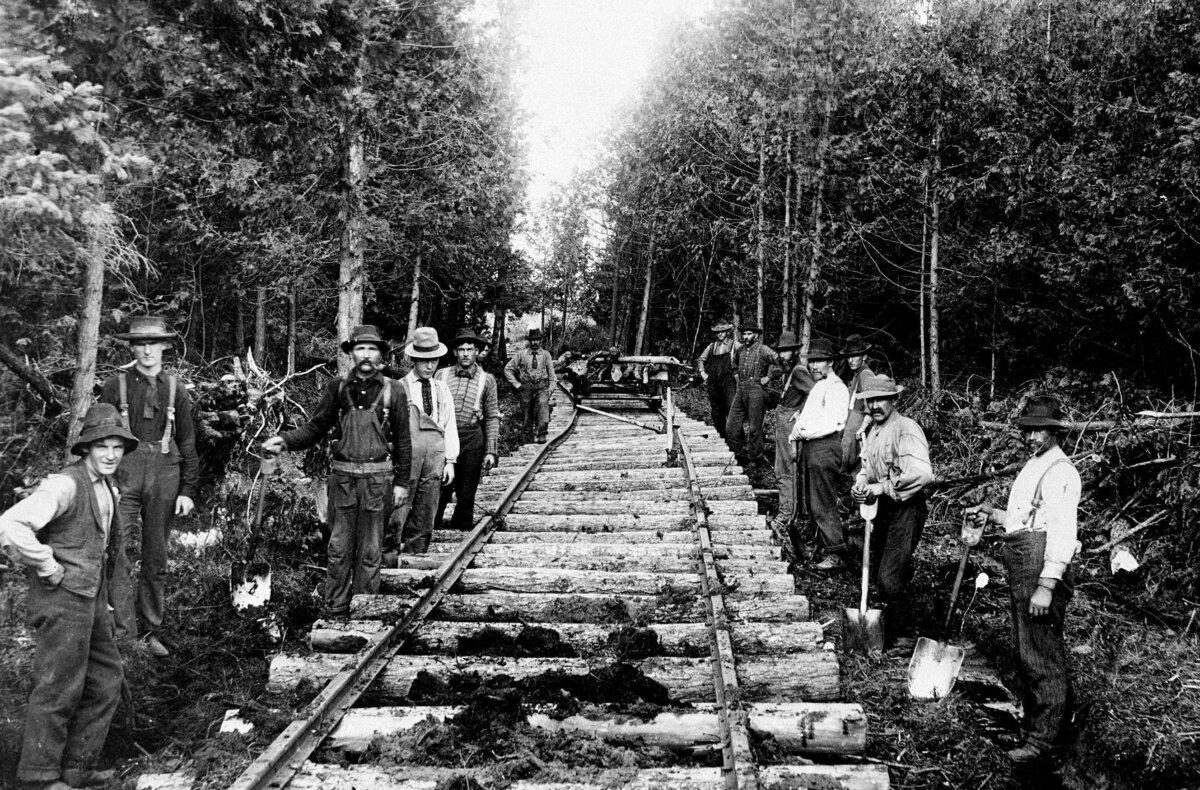
Men work at Bell’s gravel pit during the building of the CPR’s railway bridge over the Ottawa River, circa 1880. CP Photo
These were great horrors—comparable to terrible war deaths and injuries—that adumbrate the history of man as builder, warrior, and risk-taker. We take modern conveniences for granted, but many of them exist because someone suffered in the past to provide the infrastructure we have inherited. The suffering fell disproportionately on poor, unskilled men who needed work badly enough to accept these jobs. Travelling along a stretch of the Canadian Shield, surveyor and engineer Sir Sandford Fleming saw many graves of men who mishandled nitro or had bad luck.
Across the British Empire and in America, unskilled Chinese men saw their share of degradation. They reached Australia in the 1840s as indentured farmworkers, and by the 1850s more than 40,000 toiled in Victoria’s goldfields. By the 1860s, 18,000 Chinese worked in the British West Indies. Chinese workers came to America to work on the Transcontinental Railroad in the 1860s.
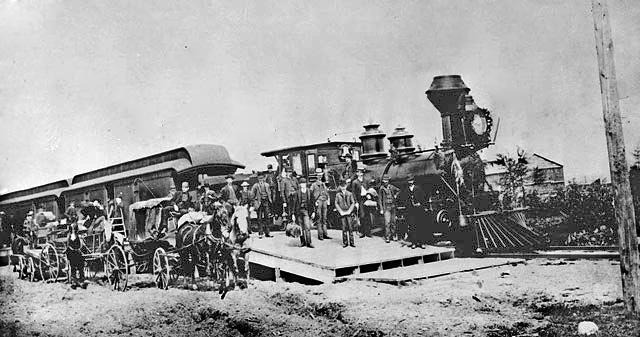
The first train to travel from the Atlantic to the Pacific arrives in Port Arthur, Ont., on June 30, 1886. Public Domain
Immediately there was a movement in Britain against using indentured Asian labour, which the Anti-Slavery Society called “slavery by another name.” Most indentured labour ended by the mid-1860s. But even after 1882 when migration was voluntary, there were Chinese agents such as Lee Chuck Co. and Lian Chang Co., known as “crimps,” who lured men experienced from gold rushes and earlier migrations into working overseas.
When the railway across the Prairies and in the lower Fraser Valley was complete, contractor Andrew Onderdonk, the American railwayman hired to finish the B.C. sections, found it impossible to hire Canadians. The danger was notorious and there were plenty of other jobs. That is why Onderdonk turned to the Chinese, some of whom had previous experience on U.S. railways but were now pushed out by Washington’s 1882 Chinese Exclusion Act. They were paid $1 a day compared to $1.50 to $2.50 for whites.
The influx often became unpopular. In Australia, the Colony of Victoria imposed a £10 poll tax (head tax) in 1855 and a restriction of one Chinese passenger per 10 tonnes of cargo. New Zealand’s Chinese Immigrants Act of 1881 (£10 poll tax per Chinese entrant, raised to £100 in 1896) was effective, as Chinese arrivals declined. In Canada, the head tax of 1885 followed the completion of the CPR.
Despite head taxes, about half those who worked the railroad stayed on as immigrants after their contract was over, typically opening a restaurant or laundry, and often forming ghettos (“Chinatown”).
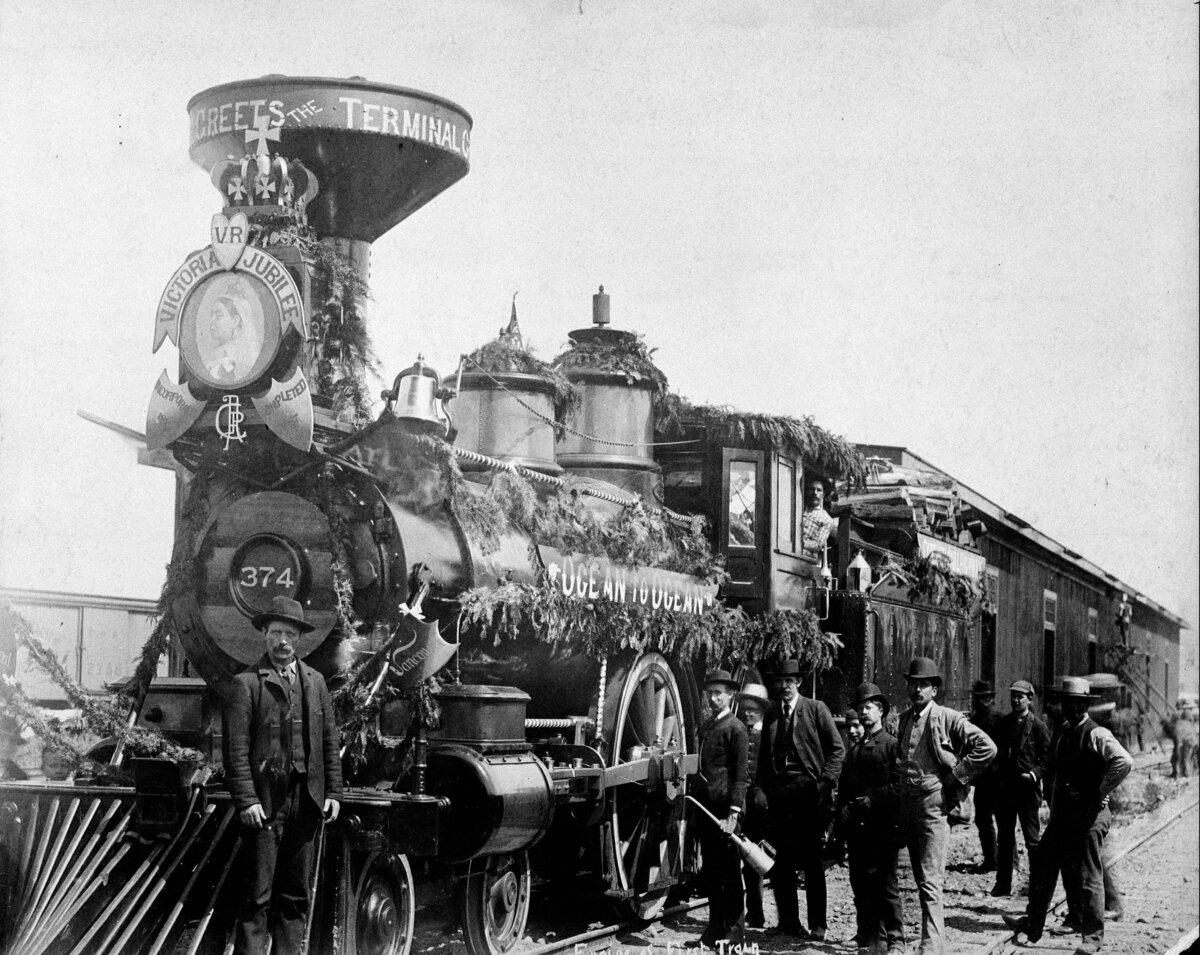
Canadian Pacific Railway locomotive 374, the first passenger train to Vancouver, arriving on May 23, 1887. CP Photo
Another myth is that the Chinese were “excluded” from the famous photograph of the last spike taken on Nov. 7, 1885. The Knowledge Network, for example, says, “In the historic ‘last spike’ photo in Craigellachie, B.C., on Nov. 7, 1885, CPR officials posed for the camera, surrounded by railway workers. None of them, notably, were Chinese.” The B.C. government states that the Chinese were “left out,” indeed they were “all” “cleared from view” and “there is not a single Chinese Canadian worker in the photograph” though they “suffered, toiled and died.” The Toronto Railway Museum pontificates about the missing Chinese. Toronto even has a monument to the CPR Chinese, though they had nothing to do with Toronto, which is not on the CPR route.
There is a recent legend that at least one Chinese man, Wing Chung, later a notable citizen of Revelstoke, was present but hidden by the crowd. The Revelstoke Museum asserts this as fact, to the surprise of Chung’s descendants, as reported by the CBC. Actually, there is no evidence that Mr. Chung himself claimed to be there. Rather the second- or third-hand assertion appears in his obituary, published in 1956.
The obvious explanation for the absence of Chinese faces at Craigellachie is that almost all Chinese contractors had already been laid off in September, when the crews reached the western slope of Eagle Pass. Most had gone back to the coast or found work elsewhere. The last 69 kilometres were, in fact, completed by railway construction manager James Ross using an “eastern” crew of Canadian navvies.
Since there probably weren’t any Chinese at Craigellachie, they couldn’t be in the photograph.
The most prominent figures in the picture are senior CPR officials, engineers, government men, and VIPs. There may be a few navvies. Driving the spike is CPR director Donald Alexander Smith, ennobled as Lord Strathcona; near him are Sir William Cornelius Van Horne, the CPR general manager (an American); Sir Sandford Fleming; and James Ross. Among the workers, some jostling would be expected: the “Craigellachie Kid” photobombed himself into the middle.
But the man who organized and masterminded the 500-kilometre B.C. stretch and with difficulty secured the workforce for it—Andrew Onderdonk himself—was not in the picture. Nor were the financiers and engineers whose backing and genius were essential to the job.
Views expressed in this article are opinions of the author and do not necessarily reflect the views of The Epoch Times.
C.P. Champion, Ph.D., is the author of two books, was a fellow of the Centre for International and Defence Policy at Queen's University in 2021, and edits The Dorchester Review magazine, which he founded in 2011.