This copy is for your personal, non-commercial use only. Distribution and use of this material are governed by our Subscriber Agreement and by copyright law. For non-personal use or to order multiple copies, please contact The Epoch Times Reprints.
The first thing to know about the July 1 holiday is that it does not celebrate Canada’s independence. The first of July is the anniversary of Confederation in 1867, the refounding of the Province of Canada and two older provinces as a federal union of four provinces—a Dominion that would expand from sea to sea.
The name of “Dominion” to describe the very first self-governing member state within the British Empire reflected a status unique to Canada initially. Then followed Australia, New Zealand, the Irish Free State, Newfoundland, and the Union of South Africa, as well as India, Pakistan, and Ceylon in due course. Canada had blazed the trail. Accordingly, Canadians celebrated “Dominion Day” from the 1870s until the holiday was hijacked by ideologues in a certain shady episode in Parliament in 1982.
What happened in 1982 was a notorious moment when a few MPs forced a name change to “Canada Day” without a valid vote and without consulting Canadians. Their avowed goal was to get rid of “Dominion” because they insisted (even in 1982, when it was nonsense to say so) that it held Canada back as a colonial state.
And so a handful of Liberal MPs chose a somnolent moment at 4:30 p.m. on a summer Friday, July 9, in the House of Commons when only 13 members were present. MP Hal Herbert, along with Deputy Speaker Lloyd Francis and MP David Smith, seized the moment to rush Herbert’s private member’s bill through second reading, committee stage, report stage, and third reading, all in a matter of minutes. The NDP silently let it go by. When Conservative MP David Baker said, “What’s going on?” it was too late. The instigators “immediately adjourned the House,” as historian James Bowden has written in The Dorchester Review, noting, “the transcript of this incident takes up only one page” in Hansard’s Debates.
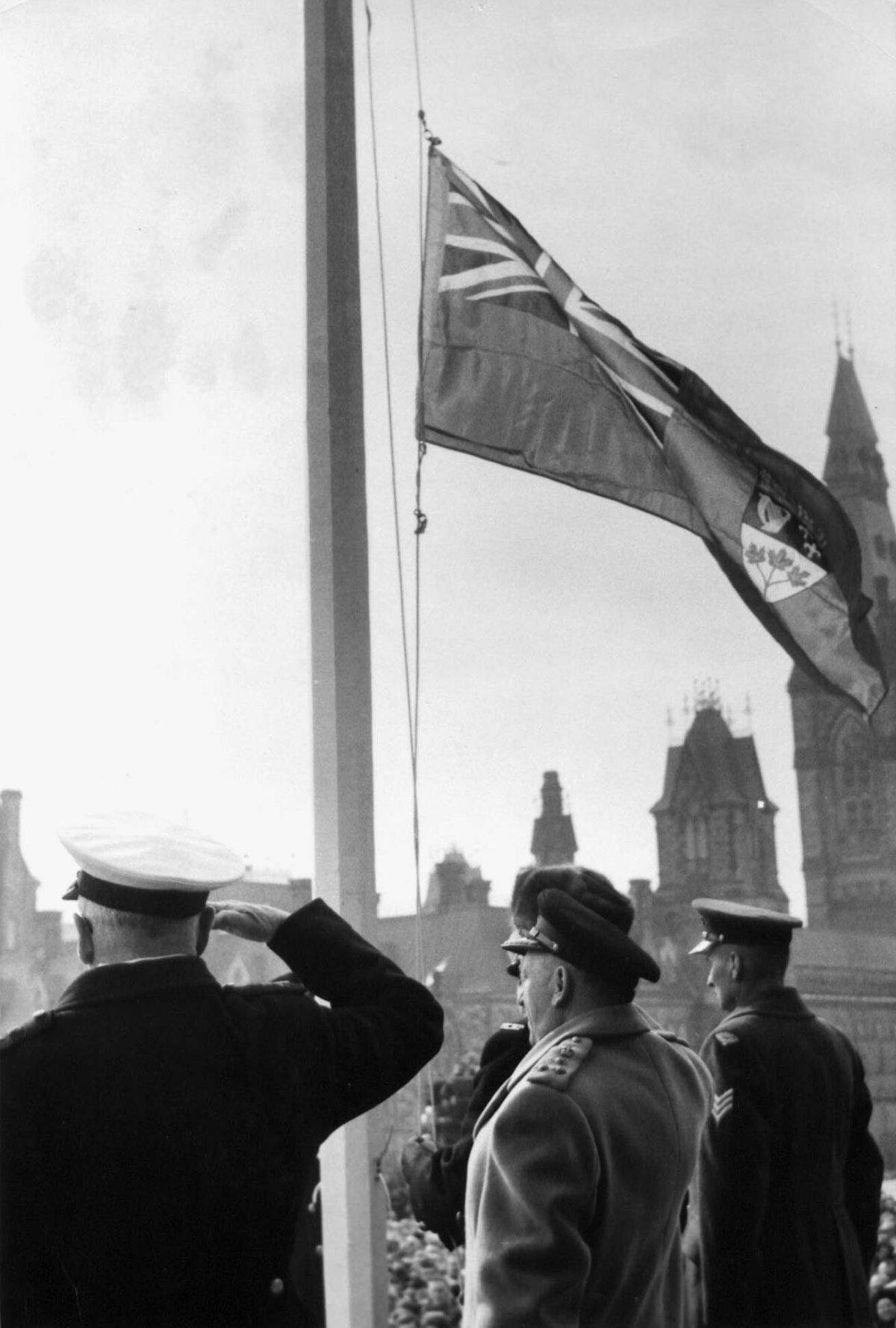
The Red Ensign comes down to make way for Canada's new maple leaf flag at a ceremony on Parliament Hill in Ottawa on Feb. 15, 1965. Public Domain
Their coup was both unconstitutional and invalid because, under Section 48 of the Constitution, the House quorum was 20 members. The Speaker, Liberal MP Jeanne Sauvé, ignored that in blatant violation of her oath as an MP. The Senate ignored the malfeasance, too, though Sen. Ernest Manning (Social Credit Party) accused Pierre Trudeau’s Liberals of “a long series of deliberate steps to chip away at all those things which pertain to the rich heritage of this country’s past.”
“It had obviously been orchestrated,” Bowden concluded. Those involved were rewarded. Francis was made Ambassador to Portugal. Sauvé became governor general. Herbert enjoyed committee chairmanships, which bring higher pay. And Smith was named to the Senate, where he sits today.
In spite of the Liberals’ anti-British doctrine to purge the Dominion out of Canada, there is no trick that can make July 1 into “independence day.”
The doctrine I refer to is the “Canadian ideology,” a term coined by the late McGill historian Hereward Senior. The ideology, espoused mostly by leftists, excludes, as a matter of precept and prejudice, large parts of Canada’s history and inheritance as if they were foreign and alien. In reality, Canada since 1760 is an achievement of the forward-looking liberal imperialism of the British Commonwealth and people in the widest sense, an English-speaking open society with a large, protected French enclave, a sheltered indigenous population (though 82 percent now live off-reserve), and a growing population of more or less integrated minorities from elsewhere. Canadian ideology pretends that history and all its signs and symbols are colonial relics.
The main purpose of Canadian ideology was and is to eliminate signs and symbols of Britishness from Canadian life—the Royal Mail, Commonwealth military heritage, the distinctively Canadian Red Ensign (1965), and, crucially, every trace of the “Dominion.” Another name for this is the “cult of pure Canada” so named by John Farthing in the book, “Freedom Wears a Crown.” A key part of the Canadian ideology is to show that Canada won its “independence” from Great Britain no less than did the United States.
But even if Canada “won” independence, it was not on July 1.
So when did it happen? It’s a deceptively simple question. There is no single moment when Canada exercised full autonomy. So there is no parallel between July 4, Independence Day, and July 1, the date set by the British Parliament for the birth of the Dominion of Canada and, in time, Canadians gained control over both internal and external affairs.
That’s the key point. In colonial times, long before Confederation in 1867, Canadians were in many ways internally self-governing. They were externally dependent on Great Britain, British diplomats, and the Royal Navy.
It is usually described this way after 1867: “Like the colonial governments that had preceded it, the new Dominion government was responsible for domestic affairs, while the Imperial government in London retained responsibility for foreign affairs,” as the Historical Society of Ottawa puts it. The story is told as a rise “from Colony to Nation” in stages from active acquiescence in the Washington Treaty (1871) to junior signature of the Treaty of Versailles (1919), then independent signature of the Halibut Treaty (1921), refusal to sign the Lausanne Treaty (1923), and constitutional equality in the Balfour Report (1926), leading to the Statute of Westminster (1931).
The declaration of war (Sept. 10, 1939) was delayed by a week after Great Britain’s. It took a while to get embassies. By 1929, despite Liberal Prime Minister Mackenzie King’s autonomy rhetoric, Canada had only three embassies (Washington, Paris, Tokyo) plus the High Commission in London. Even these are fuzzy dates because Canada had a commissioner in Paris from 1882. Later still, a ruling by the Supreme Court of Canada could no longer be appealed to the High Court in England (1949).
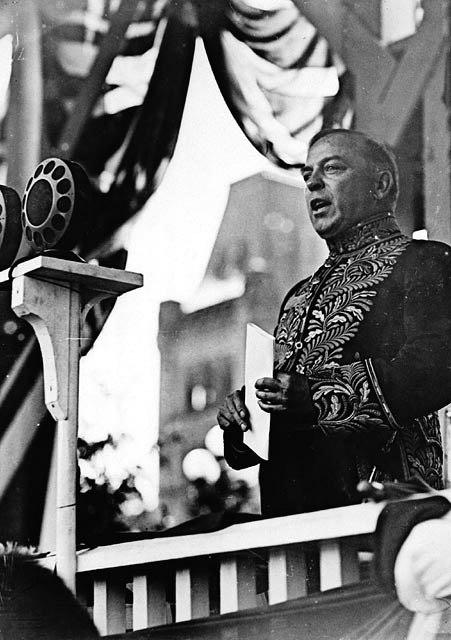
Prime Minister Mackenzie King speaks during a ceremony celebrating the Diamond Jubilee of Confederation on Parliament Hill on July 1, 1927. Public Domain
Actually, the Canadian dichotomy of domestic autonomy with external dependence has deep roots. The Governor of Quebec in the 1760s acted at his own discretion. When Sir Guy Carleton accommodated French language, law, and religion in Quebec (1760s–80s), he was acting in the Canadians’ interest against his official instructions from Britain. In the 1840s, Sir James Douglas negotiated with Mexico and Russia independently of Britain’s Colonial Office to secure the interests of the future Vancouver Island (1849) and British Columbia (1858).
There was no time between 1867 and 1940 when Canada did not depend on Great Britain for its defence and the protection of its sea commerce.
Apart from wartime, Ottawa’s defence spending was low and defence planners were ignored. As the British Empire became weaker through disarmament and unwise policy in the 1930s—brutally exposed by Japan and Germany between 1940 and 1943—Canada, doing little to compensate for its own great vulnerability, possessed nothing to mitigate the growing power of the United States. Winston Churchill predicted in 1914 that if Britain were defeated in war, Canada would “of necessity live” only “by leave of the strongest navy within striking distance of its shores.” Fortunately (for the most part), that meant the U.S. Navy.
And that is the case today. Without the massive U.S. Navy and Air Force, Canada’s sovereignty would be easy pickings for a hostile power like Russia or China.
A warning about U.S. dominance was sounded in 1944 by Lord Halifax, British ambassador to the United States, in a speech in Toronto. As reported in Time magazine, Halifax encouraged Canada to prepare for a world in which the United States and Soviet Union would dominate world affairs unless Britain and the Dominions acted together as a counterweight. He did not mean that Canada and the Commonwealth should revert to control by Great Britain—far from it. He said there must be voluntary cooperation to prevent subordinate status. “Not Great Britain only,” he said, “but the British Commonwealth and Empire, must be the fourth power.” He proposed “that the Dominions assume equal responsibility with Great Britain in the making of a common foreign policy.” Either that, or accept a world dominated by America and Russia.
Federal Conservative Leader George Drew lauded Halifax’s speech. Mackenzie King, who was prime minister almost without interruption since 1921, hated it, saying, “with what is implied I am unable to agree.” What was King implying? Actually, in 1940 he had orchestrated, in the Ogdensburg Agreement with President Franklin Roosevelt, that Canada would depend on the United States. That made official the president’s presumptuous statement at Queen’s University in 1938 that America would guarantee Canada’s security. After all his supposed gains in autonomy (mostly rhetorical anyway since Britain posed no threat), King’s Canada chose subordination to the United States of America.
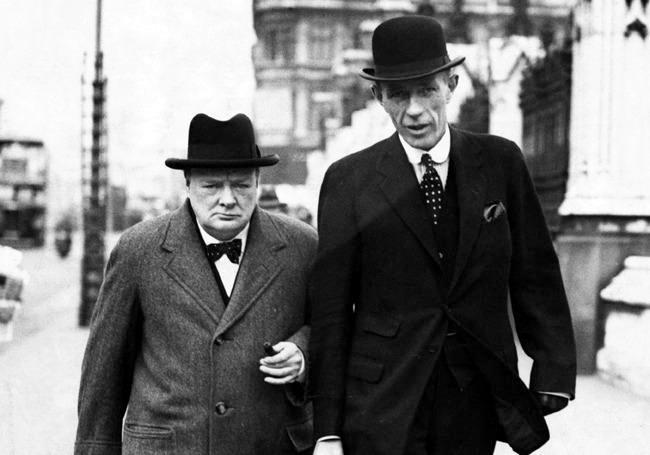
Lord Halifax and Winston Churchill in London in 1938. Public Domain
To this day, Canadians daily surrender their sovereignty to the United States in the North American Aerospace Defence Command and NATO. Our defence supply chains are integrated, as is the security of our airspace. We have no way to keep foreign (or U.S.) vessels out of the Canadian Arctic. Canada is economically dependent, too, owing to structural asymmetry, though Canadians pretend otherwise. With 75 percent of our exports going to the United States, we depend on America for one-quarter of our GDP.
Robert J. Sutherland (1921–1967), Canada’s greatest defence thinker, said Canadian defence would always be governed by unchanging realities called “invariants.” The first is geography—our vast space, lengthy coastline, and tiny population. Moreover, “the United States is bound to defend Canada from external aggression, regardless of whether or not Canadians wish to be defended.” Sutherland called it “a sort of involuntary guarantee.” Given the alternatives, we are lucky it is the United States and not someone else.
Still, as the great British Liberal William Ewart Gladstone said in 1868, “No one is free who relies on another for his own defence.” By that definition, Canadian independence never existed, except perhaps briefly in 1945 when Mackenzie King set about dismantling the world’s fourth-largest navy.
There is every reason for future generations to change July 1 back to Dominion Day, which actually means what it says. Its reassuring alliteration is much better than the clunky consonance of “Cana-da-Day.”
So, Happy Dominion Day!
Views expressed in this article are opinions of the author and do not necessarily reflect the views of The Epoch Times.
C.P. Champion, Ph.D., is the author of two books, was a fellow of the Centre for International and Defence Policy at Queen's University in 2021, and edits The Dorchester Review magazine, which he founded in 2011.