The second Trump administration is the first in 100 years to raise fundamental questions about government economic data. It’s a bold move and very necessary, especially following the past five years. During this time, government-generated numbers have been implausible at best, and that raises legitimate questions about a range of methodological and managerial issues.
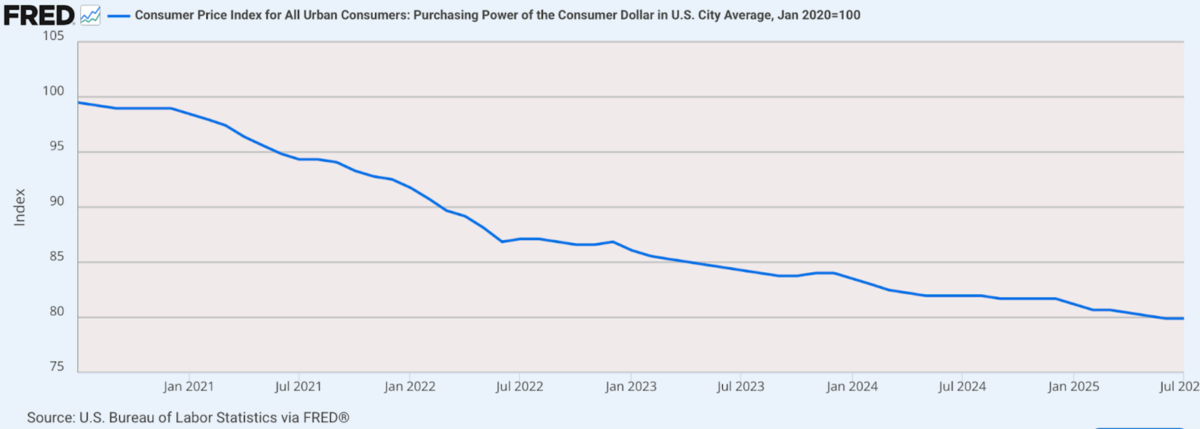
Let’s just look at the purchasing power of the dollar. According to the official statistic, the value of the dollar in January 2020 is now reduced to 79 cents today. That implies a 21 percent overall inflation from then to now.
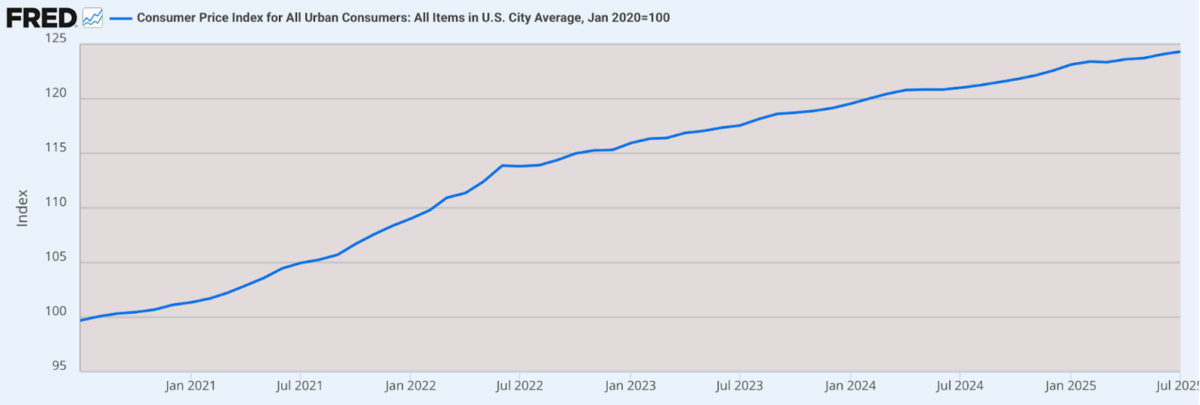
The Consumer Price Index itself estimates the change more severely than the purchasing power index. The change over 5 1/2 years comes in at 24 percent in total. Just think of this as a quarter knocked off the value of the dollar.
Let me just ask you: Does this fit with your experience at all? If you are like everyone else, your personal estimate of inflation over five years is closer to 30 percent or much higher, depending on what you buy. That fits with private data from industry. You can look at groceries, meat, cars, or housing and see much higher numbers. The Truflation data alone gets us to an overall rate of 30 percent.
Again, from your own point of view, inflation over five years is likely much higher. I can easily hear people yelling that their personal inflation rate is close to 50 percent or 75 percent. Indeed, it has been for some goods and services.
One factor that affects your calculation is the appearance of sudden new fees for everything. Whether it is restaurant dining, plane tickets, or hotels, industry is sneaking in all sorts of service fees that did not previously exist. Without a preexisting item, there can be no way to calculate a stable index. It is treated as a new product.
There are additional factors. For example, government data collectors like to assume that improved quality is the same as a lower price. So that if your car has all sorts of new features that did not previously exist, they want to factor that into the price. This is called hedonic adjustment from the Greek word for pleasure.
It’s a very clever way to cover up inflation.
Then there is the problem with housing, which affects a quarter of these price adjustments. After the great inflation of the 1970s, government bean counters completely changed the way inflation was rendered. Instead of looking at house prices, interest rates, and maintenance costs, they came up with what is called “Owners Equivalent Rent,” which purports to impute rental costs to the entire housing sector for a measure that means more.
But there is an obvious problem here. Rents are on a lag of at least 12 months because of contracts and highly sensitive (elastic) demand schedules. It’s nearly impossible for landlords to get away with a 10 percent or 20 percent increase in rents for fear of tenant revolts. Instead, they tend to eat inflation in other ways: cost-cutting on the service and maintenance side. Eventually, rents do reflect housing costs but with a great lag that buries changes along the way.
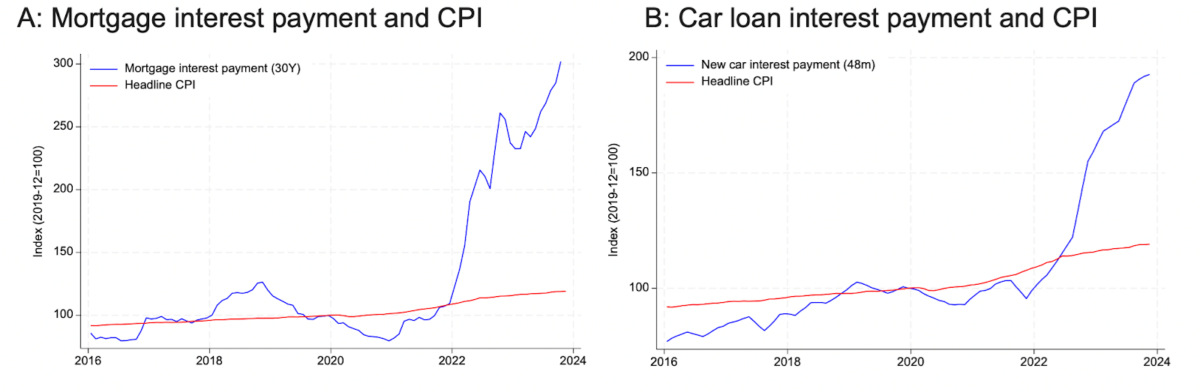
The viability of conventional CPI data has been under fire for many years but never more so than the last five, when average people have experienced devastating inflation even as government numbers are showing it not to be so terrible.
This problem is ongoing. Even today, the CPI came in at 2.7 percent while private economic data is registering inflation at 1.8 percent. It is not inconceivable that all of this is driven by politics in part, which is a chilling speculation.
This is about much more than prices. When the national output is collected into the gross domestic product (GDP), it is conventionally and correctly adjusted by the inflation rate. The GDP adjustment uses a special category called the deflator. With enough manipulation of the data, the numbers can make recessions appear or disappear.
The major critic of all these has been E.J. Antoni, an expert number cruncher who has been a relentless critic of the inflation numbers, the GDP numbers, and all labor data. Each time the Bureau of Labor Statistics (BLS) comes out with headline numbers, he digs deep into the data and offers alternative statistics.
For example, only because of Antoni’s work do we know that the job growth of the Biden era was illusory. There were major problems with the nativity of the workers: foreign-born versus domestic. He demonstrated that the job growth did not affect native-born workers. He also documented the holding of multiple jobs that were being rendered as job growth. Highlighting the huge gaps between the establishment and household services, he showed how the BLS had been manipulating both data and messaging for political reasons.
This study came as a great relief to everyone who had been gaslighted for years. For example, in the data of early releases from 2020, the first two quarters were down, which suggested a recession. At the time, the government stated that it could not really be a recession because the labor data looked good, even though it did not. As time went on, the BLS finally just adjusted the real GDP data itself to make the negative numbers go away!
The Brownstone study had a huge impact because it tapped into good sense instead of statistical fakery. But now that Antoni is headed to become the director of the BLS itself, the study has come under fire. The critiques state that the housing data is guilty of double-counting, even though it is counted exactly as it was back before 1983. Indeed, there is a huge range of adjustments that Antoni did not make because he wanted his calculation to be as conservative as possible.
What can Antoni do at the BLS? He might be able to adjust press releases to make sure that they genuinely reflect the actual data. He might be able to propose some alternative measures of inflation. He might even be able to trigger some methodological changes to increase accuracy. It’s hard to say because these bureaucracies are enormous and extremely difficult to move on fundamentals.
That said, his appointment is an exciting opportunity. Of course, mainstream economists are already extremely upset about his appointment to this position. This is because professional economists in academia are linked at the hip with career civil servants who treat all data coming from government as true, like religious doctrine. It’s always been this way, and they do not welcome disruption.
But as with most official institutions these days, the incredulity surrounding the bean counters has grown as their reportings diverge ever more from reality. This appointment is the beginning of a much-needed change. The implications are huge for government, industry, retirees, and many other sectors that depend on accurate data.