Prices up, prices down. Markets up, markets down. Jobs up, jobs down. Recession, stagflation, inflation, recovery, and blithering amounts of data. What is the meaning of all of this? For many people, the economic news is white noise that makes no sense with no coherent plot. But for those who take the time, the news is a narration of the story of our times.
The study of economics bears something in common with mathematics or reading words or music. Once you possess the skill, it feels like intuition. It’s just something you know, part of your mental apparatus for understanding how the world works. If you do not have that knowledge, many features of life swirl around you in ways that seem mysterious.
It’s for this reason that everyone should spend time with economics as a discipline. The topic has long been at a disadvantage in philosophy and the social sciences generally. This is because it was so late in history in developing in any formal sense. You won’t find robust economic thought to any great extent in the writings of the ancients, for example. Even the great Aristotle stumbled over the topic in ways that are obvious now.
It wasn’t until the late Middle Ages when the urge to formalize economics even took shape. The trigger was the gradual end of feudalism as the dominant economic arrangement of most people. Once money came into the hands of the average person, economic forces began to operate in ways that cried out for explanation. The increased sophistication of banking led to loan markets, currency trading, and more travel.
All these new experiences raised certain questions. Why does a piece of silver buy more of a good in one area than in another? What causes these valuations to change? What does the effect of new discoveries of precious metals have on the purchasing power of each unit? And above all else, what exactly is the cause of what seemed to be growing amounts of wealth? And who can explain it?
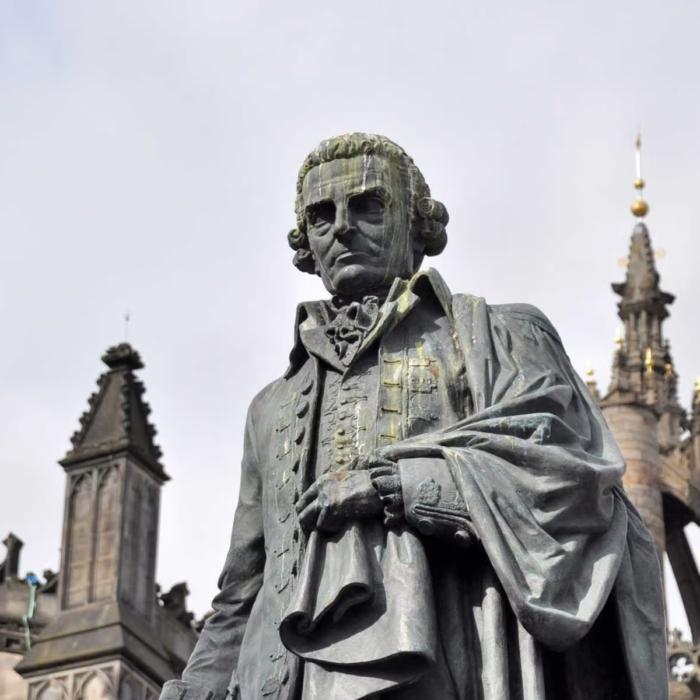
Much of this work appeared in Latin, Spanish, Italian, and French. None of these writings were comprehensive and systematic in ways that would constitute an organized or empirical work. What was missing was a treatise in English. That was left to the Scottish philosopher Adam Smith. His great work “The Wealth of Nations” made its appearance in 1776, the year of America’s founding.
The core question of the book is in the title: How does wealth come to be created? The question alone is interesting; many centuries, back to the beginning of recorded history, did not give rise to it being created at all. It was widely assumed, based on all evidence, that there was no such thing as new wealth. All wealth that exists has always existed and can only be redistributed mostly through war and conquest.
What was happening in England and Scotland, and in most of Europe, was something different and obviously so. More people had money to spend. More manufacturers were popping up everywhere. They saw cities expanding and rising with more houses, apartments, markets, and availability of everything. More people than ever before had access to material goods and, with them, a greater degree of choice. People were moving to the city, striving to make a better life, and living longer with great access to goods and services.
This is evidence of wealth creation. And it raises the question: Where does this new stuff come from? Smith, in classic English style, took an empirical approach. He examined life in the factory and how it worked. He looked at the ways in which people were choosing industrial life and how it came to be that rich people began to put so much value in the labors of people far beneath them in social status.
This book is commonly called the founding document of capitalism, but Smith never used that term. In fact, this word has mostly been a source of tremendous confusion about the system it describes. Smith’s answer was not about ideology but about the description of a certain phenomenon. He called it the division of labor. The old slogan that more hands make lighter work is true. The more people with skill can cooperate together, the more their own efforts are amplified in productivity. In short, Smith was describing how greater circles of human cooperation—not just on the factory floor but over larger geographic regions—are the ultimate cause of wealth.
The crucial insight here concerns the value of a human person regardless of advantages in life. One man might have enormous talent in building a machine. He could possess absolute advantages in every area over anyone else. But there is scarcity of time. To scale up production, he gains productive capacity by employing people who lack his mastery, thus benefiting everyone. The math here checks out—the more the labor is divided, the more everyone benefits from the work of everyone else.
Smith’s answer was not the final one, of course, but it was a wonderful beginning. There are other factors, including the security of private property—not just personal property but accumulated property for purposes of investment for longer terms. The more security and peace there are, the more entrepreneurs can plan. And free floating prices serve to coordinate action without explicit instructions. It is the same with interest rates, which serve as signs for investment and risk-taking.
Another factor, too, contributed to growing wealth: the sharing of knowledge that comes with more human communication through human contact. The gradual move to the city improved this as well. Ideas are arguably the ultimate source of wealth: new thoughts on how to combine resources, new formulas and recipes, new observations on sources for funding and raw materials, new speculations on what consumers mostly need, and so on. In isolation, all these insights are lost. Coming together creates a broader community that is wiser than the sum of its parts.
This is a short version of how we obtained that which is called the discipline of economics today. There are fundamental insights you miss if you have not taken the time to study it. A short list includes the division of labor, supply and demand, the equation of exchange that reveals the purchasing power of money, comparative advantage in trade, the gains that accrue from exchange, the necessity of private property in scarce goods, the source of value that traces to decisions on the margin, the building of the structure of production via capital markets, and so much more. It’s a wonderful world of ideas here.
Smith’s book today remains an important read, but other engaging tutorials include Henry Hazlitt’s “Economics in One Lesson,” Thomas Sowell’s “Basic Economics,” and Per Bylund’s “How to Think about the Economy.” All these books require a certain level of maturing because they are manipulating abstract concepts. This is why I recommend against imposing them on people who are too young.
None of these books will show you how to predict the future, make you rich, or show you the best ways to run a big company. They do something more important than that. They make sense of what otherwise would seem like random cycles and movement, prices going this way and that, jobs appearing and disappearing, societies rising and falling. There is an economic explanation for how the material world responds to changes in politics and culture, and these books help reveal that.
The discipline of economics is a lens that clarifies and sharpens your understanding of the world around you. That’s a humble claim, but the value is incalculable. Once you understand it, the economic way of thinking becomes part of how you understand the world, and you wonder how you ever got by without it.