“Home is a name, a word, it is a strong one; stronger than magician ever spoke, or spirit ever answered to, in the strongest conjuration.” (Charles Dickens, “Martin Chuzzlewit”)
During the Enlightenment, an English mythographer by the name of Jacob Bryant disputed the Trojan War as a historical event, much as it did Biblical stories. The absence of what scientific materialists deem historical evidence, what archeologist can dig up, was seen as the evidence of absence.
Heinrich Schliemann’s excavation of the ruins of Troy on a mound in Hisarlik, in northwest Anatolia, Turkey, put an end to Bryant’s fabrication about a fabrication. It rescued Homer’s works from being confined to mythology and put them back into the realm of history.
They could have just read Herodotus.
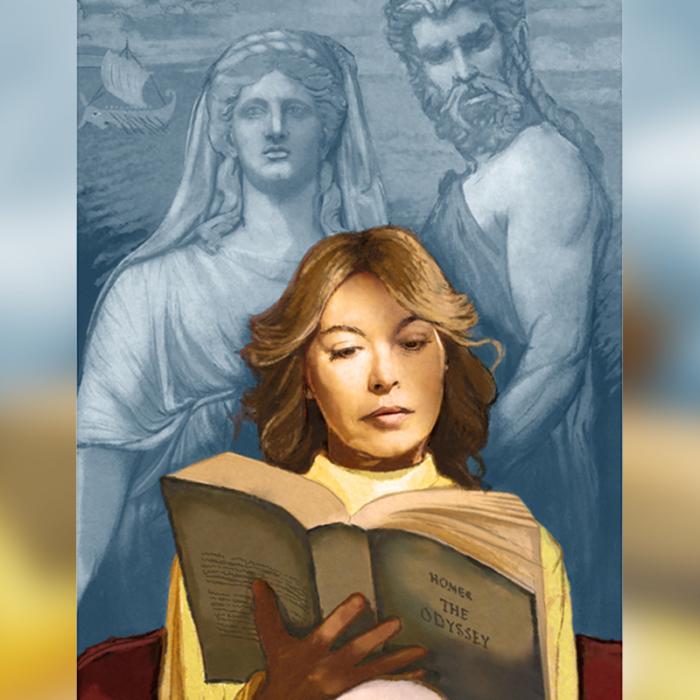

However, the only thing worse than being dismissed by modern historicism is to be embraced by it. Homer’s epic was thereby traduced from being a great literary work and a psychagogy that educated all Greece into a new form of legend: a legend “based on history.” Being a historical text in the hands of progressives means being a historian’s text. It means whatever historians say it means. It is never a model of wisdom and virtue.
From Historicism to New Historicism
A worse indignity still has been perpetrated by the so-called New Historicists since the 1980s. These “post-modernists” subjected Homer to a variety of neo-Marxist approaches, which they justified as a moral enterprise of culturally sensitive contextualization. That means casting aspersions upon Homer’s intentions and feeling sympathy for his monsters.
Emily Wilson’s recent translation of “The Odyssey”—which Christopher Nolan found helpful—is only the latest representative of the recovery of the “voices” that Homer allegedly marginalizes. She interprets Odysseus to be a “complicated man,” the Greeks to be colonialists, and the monsters misunderstood.
Historicist approaches, whether old or new, are always pedantic and rather silly. The envy of the old historians has simply given way to the fashionable guilt of the new.
Homer’s great text yet remains.
What Does ‘Home’ Actually Mean?
Homer’s use of the term “nostos” has the implications of a supreme act of heroism and a sign of divine favour. Most people remember the “Odyssey” as the greatest travelogue ever written. But in truth, Homer tells us surprisingly little about geography. His sense of place and time are highly uncertain. Years can pass in a few lines.
By contrast, he spends extraordinary amounts of time describing households, meals, marriages, the relations of fathers and sons, husbands and wives, acts of hospitality, conversations around hearths, heroic songs, recognition scenes, and the restoration of proper relationships.
His emphasis reveals the imbalance of our historicism. “The Odyssey” is not really about a journey of conquest across the Mediterranean. It is a journey through competing visions of the good life. It is not spatial journey but a moral and spiritual metaphor.
Nostos Is the Recovery of Right Order
For Homer, home is not where someone lives, it is the place where everything belongs. A properly ordered household contains a faithful marriage, relationships of honor between generations, reverent sacrifice to the gods, hospitality to foreigners, a remembrance of the past, an inheritance for the future, and a political order devoted to justice.
When Odysseus returns to Ithaca, he is restoring an entire moral cosmos. In his absence, his house has become a picture of the disordered soul.
Every Temptation Offers a Different Home
This, I think, is the organizing principle of Odysseus’s wanderings and what explains the mythological creatures he encounters. Every major episode asks the same question:
Where will you choose to settle down?
It is not a geographical question, it is a moral and spiritual question. Where should your affections be harbored?
The Lotus-Eaters
The first temptation Odysseus faces is forgetfulness. Those who consume the lotus petals do it to dull the pain of their suffering. The Lotus givers do not torture anyone. They do not delight them. They simply remove desire altogether.
The consequences are terrible. Memory disappears. Purpose disappears. The future disappears. The traveler loses any longing for home.
Homer implies something we know very well. A drug addict does not need to become wicked to lose himself. He only needs to cease caring. Sometimes the opposite of virtue is not vice but indifference.
The Lotus-Eaters represent the modern escapism that Neil Postman described in “Amusing Ourselves to Death.” Infinite entertainment. Passive consumption. Chemical escape. Virtual worlds. Anything that makes us forget what we were made for.
Circe
Odysseus alone resists because his reason (assisted by Hermes) governs his appetite. The episode illustrates Plato’s tripartite soul before Plato ever wrote it.
Calypso
Yet the great-hearted Odysseus weeps. Every day.
Why?
Calypso can satisfy every appetite except one. She cannot give him his own life back, with all of its tears and challenges, and all its perishable beauties, and all its responsibilities, and all of its purpose.
She cannot replace Penelope. She cannot replace Ithaca. She cannot replace the pathos of mortality itself.
Ironically, immortality becomes a prison. The greatest temptation in Homer is not suffering.
It is a counterfeit paradise.
The Sirens
The Sirens are perhaps the most misunderstood episode in Homer’s “Odyssey.” People usually imagine that they tempt sailors with sensual pleasure. But Homer says their promise lies in knowledge, or more precisely, immortal fame. They claim to know everything that happened at Troy and everything about Odysseus’s heroism.
Odysseus wants to hear them but does not trust himself to do it without restraint. He commands his crew to bind him, stop up their own ears, and temporarily ignore his orders in the presence of the Siren-song.
He passes the test as Homer’s exemplary man.
How?
Firstly, because he wishes to know but distrusts his own pride. It is not knowledge that Homer condemns (as per Eastern philosophies) but detached contemplation without moral commitment. Secondly, because he recognizes how seductive knowledge without moral consequences is.
The Sirens sing endlessly. Their listeners never arrive anywhere. To remain with the Sirens is to become a legend in your own mind, the object of a story, rather than the head of a household.
He listens, then sails on.
Wisdom requires hearing the song without abandoning the real voyage.
Penelope
Penelope is the real thing.
She offers nothing extraordinary. She has no magic, offers no immortality, no ecstasy, no prophetic knowledge.
All Penelope offers Odysseus is home.
That and her faithfulness. Their marital bed is built on a tree stump that cannot be moved, whose roots sink deep into the earth. She is a wise woman.
The Moral Geography of the Odyssey
The Mediterranean thus becomes a map of the soul.
There are many places that falsely answer the question of what the good life is. Only Ithaca gives us the correct answer.
Odysseus chooses Ithaca over Ogygia, mortality over immortality, Penelope over Calypso, and the burdens of kingship over perpetual ease, because it is the place where justice, memory, fidelity, sacrifice, family, political responsibility, and rightly ordered love can flourish together.