This copy is for your personal, non-commercial use only. Distribution and use of this material are governed by our Subscriber Agreement and by copyright law. For non-personal use or to order multiple copies, please contact The Epoch Times Reprints.
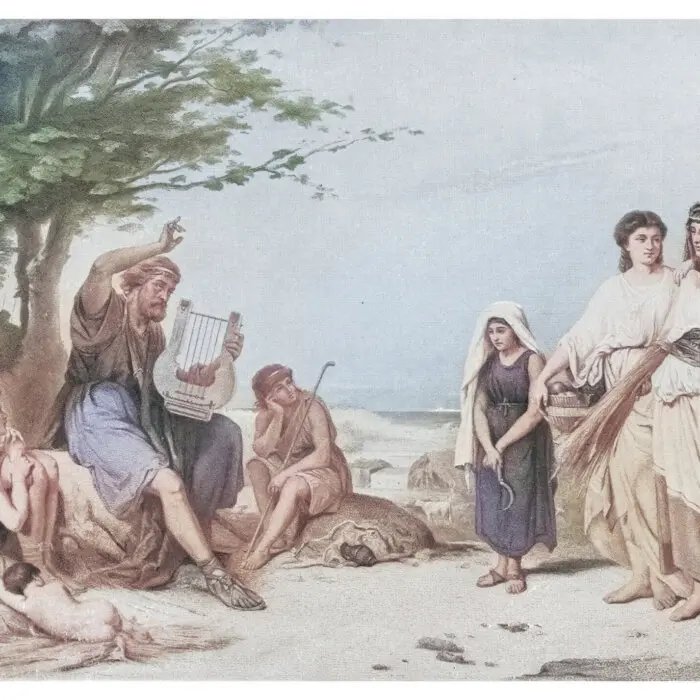
Odysseus meets the gracious and modest princess Nausicaa. “Odysseus and Nausicaa,” 1619, by Pieter Lastman. Oil on panel. Alte Pinakothek, Munich. Public Domain
One of the simplest tests of civilization in Homer’s “Odyssey” is what happens when a stranger arrives at the door.
The Greek institution of xenia—the reciprocal bond between host and guest—is not merely good manners. It is a sacred obligation protected by Zeus himself, Zeus Xenios, guardian of strangers.
Throughout “The Odyssey,” Homer asks his audience to judge individuals and societies by how they treat those who arrive dependent, unknown, and even incapable of repaying kindness. The stranger’s claim upon the host is simply that he is in need.
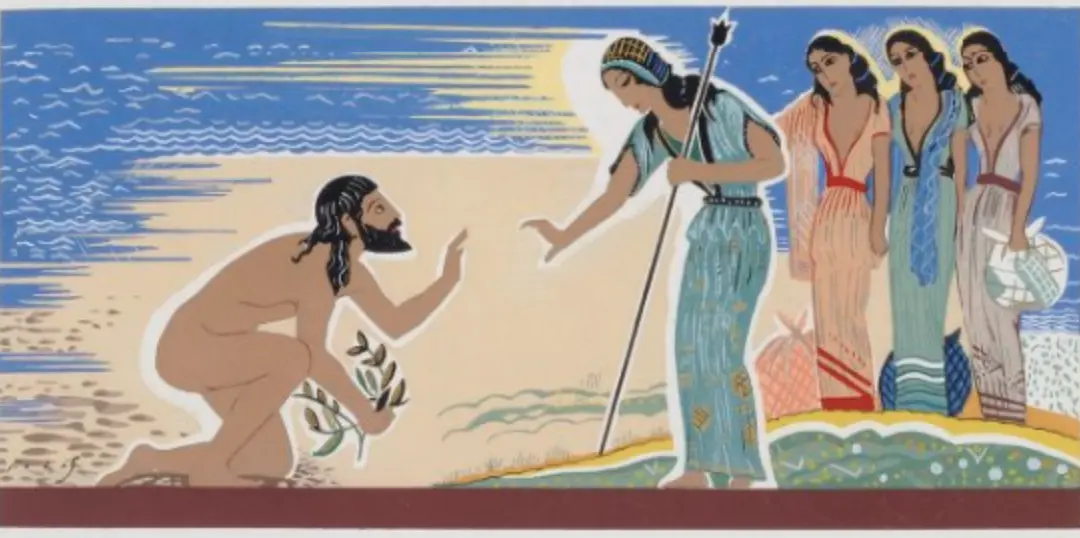
The Phaeacians that Odysseus visits from the end of Book 5 to the beginning of Book 13 represent xenia in its most elaborate form. When the shipwrecked Odysseus first appears among them, he possesses nothing. King Alcinous nevertheless welcomes him, feeds him, entertains him with games and song, gives him gifts, and ultimately provides the ship that carries him home. Although his tears ultimately reveal Odysseus’s identity, there was no calculation involved in the Phaeacians’ hospitality.
The proud Cyclops Polyphemus represents the opposite principle in action. When Odysseus enters his cave, he explicitly appeals to Zeus as protector of suppliants and strangers. Polyphemus contemptuously replies that the Cyclopes care nothing for Zeus. Instead of feeding his guests, he devours them.
Homer makes cannibalism the grotesque inversion of hospitality: The civilized man feeds the stranger; the barbarian feeds upon him.
The suitors commit a subtler version of the same offense. They are technically guests in Odysseus’s house, but they have transformed hospitality into exploitation. They consume his livestock, drink his wine, threaten his son, abuse other guests, and seek possession of his wife and household.
Xenia requires reciprocity and restraint; the suitors recognize neither. The destruction the gods demand is, therefore, connected to a larger restoration of civilized order.
Homer makes the point still more powerfully through Eumaeus. The swineherd possesses far less than the Phaeacian king, yet when the disguised Odysseus appears at his hut, Eumaeus immediately welcomes and feeds him. “Stranger,” he explains, it would be wrong to dishonor a guest, for strangers and beggars come from Zeus.
Hospitality is measured not by the magnificence of the gift but by the disposition of the giver. A poor swineherd can be more civilized than wealthy aristocrats. Homer, in an apostrophe of affection, breaks his third-person narrative to directly address Eumaeus—”O, my swineherd!”
This Homeric understanding has striking parallels with both Jewish and Christian traditions.
The Jewish practice of hachnasat orchim—literally, “bringing in guests”—is traditionally grounded in Abraham’s reception of the three strangers in Genesis 18. Abraham interrupts his own affairs, runs to meet them, offers water and rest, and provides generous food before fully comprehending whom he is entertaining. The stranger at the door becomes an occasion for encountering something beyond oneself.
The New Testament develops a remarkably similar ethos through philoxenia, literally the “love of the stranger.” The intensification of Homer’s ethic is rooted in Christ’s substitution of himself for his enemies at the cross.
Paul commands Christians to “pursue hospitality” (Romans 12:13), while Hebrews famously counsels, “Do not neglect to show hospitality to strangers, for thereby some have entertained angels unawares” (Hebrews 13:2)—an unmistakable echo of Abraham. The qualifications for Christian leadership even include being philoxenos, hospitable, or literally stranger-loving (1 Timothy 3:2; Titus 1:8).
Homer, Abraham, and the New Testament, therefore, share a significant intuition: Civilization requires that we recognize obligations extending beyond immediate self-interest and beyond the boundaries of family and tribe.
Augustine’s ordo amoris (“order of love”) provides a philosophical framework for the Christian love of the stranger. Augustine deepens philoxenia by arguing that virtue consists in loving things according to their proper worth: God above all, and our neighbor in relation to God.
The stranger, therefore, cannot be valued merely according to usefulness, familiarity, or social status. Hospitality becomes a correction of our own selfish desire—learning to recognize and love the good of someone from whom we may receive nothing in return.
The modern world has largely lost this sense of obligation to the stranger. How did that happen?
Jean-Jacques Rousseau’s amour de soi-même (self-love), the foundation of his ethics, is the obvious source. Rousseau does not directly advocate selfishness. Rousseau presents amour de soi as the natural and legitimate instinct of self-preservation and well-being, moderated by the natural sentiment of pity.
Nonetheless, Rousseau prioritizes physical survival, bodily safety, and basic comfort before higher social duties like xenia. It becomes the basis of Maslow’s hierarchy of human needs.
These modern views of the instinct of self-love directly repudiate the views of Homer, Abraham, and the New Testament. They do not even ask how we can love ourselves and be compassionate. They just ask what we owe the stranger. Hospitality imposes an obligation precisely when self-interest might counsel against it. The stranger consumes one’s food, occupies one’s house, and may offer nothing immediately in return.
The modern nation-state and its system of taxation muddy the waters. Xenia is now often administered by border officials and impersonal government agencies. It cares nothing for cultivating right sentiments. It takes other citizens’ resources to house and feed strangers.
Destructive political battles ensue when Homer’s understanding of the right behavior of hosts and guests is ignored. Some politicians will even see political advantage in mass immigration and weaponize the guilt of their opponents. More reasonable people will ask whether we have refugees or the equivalent of the suitors in our midst.
That is why hospitality becomes a test of civilization. Polyphemus sees the stranger as prey. The suitors see another man’s generosity as something to exploit. Eumaeus sees the stranger as someone placed under his protection. Rousseau sees the stranger as someone we should pity. The state sees the stranger as a political tool.
A civilization, Homer suggests, can be judged by which of these responses it teaches its people to make when a stranger appears at the door.
For more discussion of the Odyssey, go to my YouTube channel. If you would like a free copy of my Visual Guide to Homer’s Odyssey, click here.
Views expressed in this article are opinions of the author and do not necessarily reflect the views of The Epoch Times.