What do average people believe about the day-to-day power of the president? Can he hire and fire people within the executive branch? Most people would say “Of course.” How else can he do his job? If he could not freely do that, he and his staff would never really be in control of anything and therefore could not be held responsible by the voting public.
Democracy itself hinges on this one power.
Can he manage agency priorities and how they use money? That would seem to be part of the job. He is head of the executive branch and should act like a CEO who implements policies on which he campaigned and for which the citizens voted.
The truth is that the president has not been permitted to do these things for a very long time, certainly since the 1960s but really dating to the mid-century and even before. That’s for one reason. A fourth branch of government has evolved that imagines itself wholly independent of the other branches.
The civil service itself was not originally part of the U.S. Constitution, which forged a government that would be wholly accountable to the people. The thing—later mutated to become the full administrative state—was invented in 1883 and codified by legislation. The Pendleton Act certified that some 10 percent of employees of the federal government would outlast elections.
The theory was that certain functions of the executive need expertise that only job security can attract. This would professionalize government instead of having its operations be subject to the changing winds of political fashion. Without such a stabilizing force, good and competent governance is unmoored from institutional memory.
I would place a bet that the average American has no idea. This is why the COVID period was such a shock to the public. You had a president out there—having changed his mind on the topic of disease control—demanding that states open and that the federal government leave people alone. The agencies went on their merry way, imposing every kind of cockamamie protocol.
For President Donald Trump’s part, he spent most of his first term in astonishment that the president did not have much real power at all, and yet he was held accountable for everything that took place under his watch. This situation is unsustainable—and yet it has sustained itself for more than a century.
The greatest achievement of the Trump administration in the second term was being brave enough to take on this crazy situation, knowing full well that it would face a grueling court test at all levels. As expected, the status of these so-called independent agencies is now with the Supreme Court.
The case and precedent in question is known as Humphrey’s Executor. The case traces back to 1935. The politics of the time were interesting. The head of the Federal Trade Commission had served under two previous Republican administrations. The new president tried to fire him and appoint a loyalist.
The court was dominated at the time by conservatives who revelled in striking down many features of the invasive New Deal. Watching then-President Franklin Roosevelt trying to consolidate power did not sit well with them. As an effort to restrain his power, they issued a unanimous decision that stated that the president cannot fire agency heads with civil service protection. That ruling was later firmed up in legislation.
Again, to be clear, this was not a decision by the left; it was a decision by the entire count to restrain a president that many believed was going too far in overthrowing U.S. governance and replacing it with his own vision. The court stated that he cannot do that.
Thus has it stood for all these years. The conservative court of 1935 likely had no intention of creating a fourth branch of government called the administrative state. Indeed, they likely believed that they were restraining the state, not unleashing it.
The result was something no one anticipated: It created a branch of government wholly shielded from voter influence. It also reduced the effective ability of the chief executive to manage his own branch of government, thus deleting the first sentence of Article 2: “The executive Power shall be vested in a President of the United States of America.”
The result was the administrative machinery that characterizes most Western governmental structures today. It was a gradual creation, shepherded by industry and celebrated by managerial elites. The people had their democracy taken away from them gradually–with no announcement and very little public awareness.
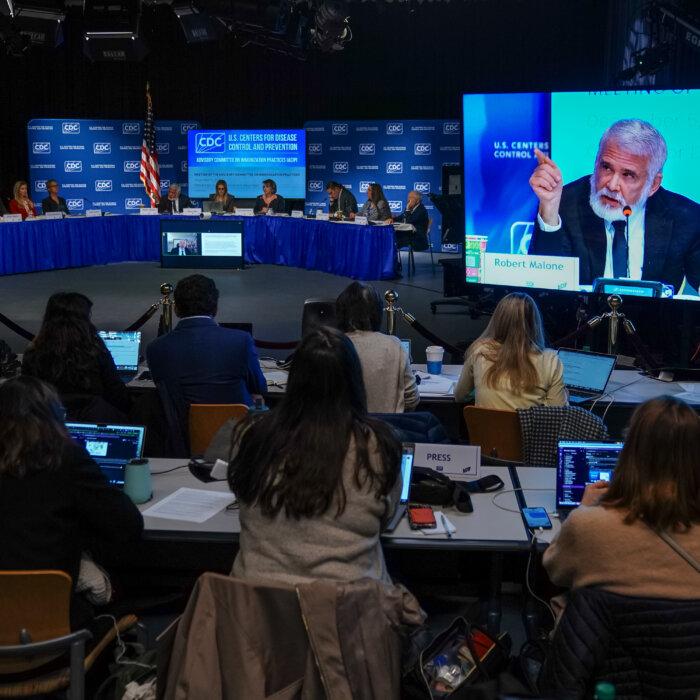
Again, the COVID period changed everything. And although there has not been any real commission, the period of national life is being litigated in other ways in seemingly unrelated venues, such as advisory committees of the Centers for Disease Control and Prevention, and with this court case. What’s at issue is the very core of the idea of government of, by, and for the people.
At the oral arguments, Justice Ketanji Brown Jackson presented the case for not allowing the president to control his own branch:
“My understanding was that independent agencies exist because Congress has decided that some issues, some matters, some areas should be handled in this way by nonpartisan experts, that Congress is saying that expertise matters with respect to aspects of the economy and transportation and the various independent agencies that we have. So having a president come in and fire all the scientists and the doctors and the economists and the Ph.D.s and replacing them with loyalists and people who don’t know anything is actually not in the best interest of the citizens of the United States. This is what I think Congress’s policy decision is when it says that these certain agencies we’re not going to make directly accountable to the president.”
In other words, she is arguing for a fourth branch of government that is nowhere in the U.S. Constitution. It seems clear at this point that the majority of the court will reject this view. It’s hard to see how they could do otherwise. If the point of the Supreme Court is somehow to make sure that the Constitution is followed, they are going to have to reverse the Humphrey’s Executor precedent and put the elected president back in charge.
The question is how far this logic extends. Twentieth-century governance has involved the creation of vast numbers of agencies, the Federal Reserve (central bank) among them. There is a grave concern for somehow allowing independence to the Fed (and perhaps intelligence agencies) while denying it to other agencies. The arguments for such carve-outs will be strained at best.
To be sure, a reversal of this precedent will give rise to cries that the president has become a dictator with vast agency power, something the U.S. Constitution never intended. Let’s say that is true. What is the core issue? The right of a president to manage his branch or the existence of this vast administrative apparatus itself? The answer is the latter.
If people worry about an imperial executive, there is an easy answer. Congress can get rid of these agencies.
Strangely, it is today’s sitting president and not the legislature that has been beating the drums to abolish agencies, not the reverse. It’s Congress that has kept them while eschewing any responsibility for managing them.
For that matter, if there is such a tangle over the Federal Reserve, there remains the option to get rid of it. Treasury Secretary Scott Bessent himself said of the Fed: “I don’t know what they do.” In some ways, that statement is historic and significant. The nation got by without a central bank for half its history and did just fine.
The court has a chance to do something revolutionary that is also perfectly conservative: simply enforce the first sentence of Article II. Whatever happens next—whether presidents wield these agencies or Congress finally abolishes them—will flow from restoring the Constitution’s original meaning rather than protecting a 20th-century accident.