Back when people cared about their homes, every household had a feather duster. Do you have one? I’ve gone my whole life without. As it turns out, it is more useful than one would suppose. Essential even. If you do not have one, get one now. Thank me later.
You can vacuum a rug and mop a floor but there must be a means by which the slowly accumulated dust on picture frames, lamps, blinds, and mirrors is removed. Dust is just weird. It’s not there or not. It gathers in undetectable and inauspicious ways, a bit at a time. On a table or floor, you can see it. But where it really matters is where you cannot see or do not want to see.
You just know it is there however, adding one tiny speck at a time. There are moments when a slight sunbeam shines in an otherwise dark room and you are startled to see a strange world unto itself revealed in the line of light. Where does all that strange stuff go? It settles on your stuff.
I’m not even sure I know what dust is, by which I mean, in what it consists. Probably a microscope could provide the answer but I’m not sure I really want to know. Can you even imagine?
Here is where the feather duster is crucial. It must be blasted away in some form. The feather duster is the best technology ever invented to do just that.

Dusting is hardly work at all. It just has to be done. In fact, it is enormously fun, as is any work around the house that truly makes a difference.
You can use a rag but that is as likely to smear rather than remove dust. The feather duster is the key.
It’s likely that the feather duster has been around since antiquity but, as Americans do, we had to invent and patent one in the 19th century. Because that’s what we do.
The innovation issue evolved around class and access. The rich always tied peacock or ostrich feathers to a stick to clean dust. The feathers work to emit an electrical charge that attracts dust.
The middle class did not have access to such a thing. Who owned a peacock or ostrich? Only eccentrics or far-away farmers.
So the turkey-feather duster—turkeys run around wild in the United States—was just waiting to be invented and used by the rising middle class.
In 1870, a farmer brought turkey feathers to a broom factory in Jones County, Iowa. A man named E.E. Hoag split the feathers and mounted them on a short broomstick; the early result was too stiff. He improved it and made it saleable. The Hoag Duster Company was founded in Iowa around 1874 and produced turkey-feather dusters for generations.
However, the history of invention is often one of simultaneous creation. Sure enough, around the same time in Geneva Lake, Wisconsin, Susan M. Hibbard and her husband George W. Hibbard worked with discarded turkey feathers.
As it turned out, George had received an earlier patent (US 154,985, September 1874) for improving feather dusters by splitting the stiff stems longitudinally to make common domestic-fowl feathers (like turkey) more pliable and usable in place of rarer, more expensive ones.
George, pleased with his patent, sold it to National Feather Duster Company in Chicago. They made a real go of it and became profitable. George and his wife became resentful and bitter about the decision to sell rather than profit down the line.
As a result, Susan filed for a related patent (US 177,939) in November 1874, issued May 30, 1876, covering a similar improvement. It was granted, for whatever reason.
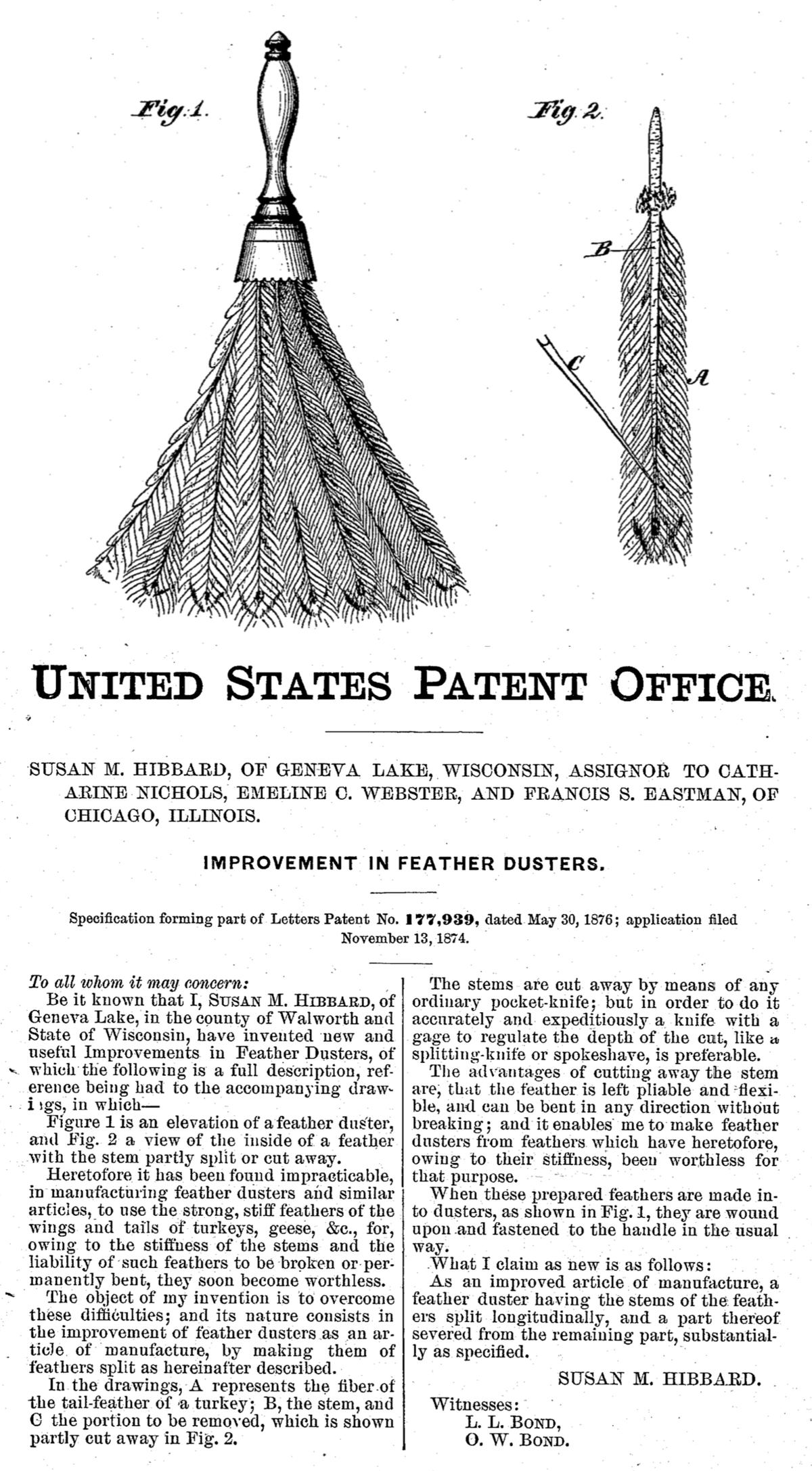
That patent filing set off a ferocious legal battle. The National Feather Duster Company—which now owned her husband’s patent—sued Susan. Their patents essentially covered the same invention! The judge in the case ruled in favor of the company and set aside Susan’s patent.
Susan had suggested trying to split or cut the stems to make the feathers limber. The court called this a “valuable suggestion” that George then acted on successfully, but held that a helpful suggestion during someone else’s experiments does not make the suggester the inventor. Susan was legally barred from claiming that she was the inventor. Moreover, she could be stopped even from making and selling such a product.
So there we go, a ferocious patent battle and probably a great deal of marital drama was involved there. They must have spent the rest of their days in sadness that they missed out on great riches, while each blamed the other. There were likely many silent evenings sitting as the sun set and the moon beams highlighting dust settling all over their furniture.
“Honey, can you dust the mirrors and clock please?”
“Oh with the duster the patent of which you sold, sold!, rather than held in a way that would make a new life for us and our children?”
“I know, we’ve been through this.”
“Doesn’t make it less painful.”
All that hard history aside, the patents have long ago expired and now you can buy a feather duster for a song. Then you will hold in your hand the final tool to make a life of cleanliness and hygiene yours. You can move from room to room, whisking dust from one thing to another, demonstrating your mastery over the elements and leaving surfaces untouched by the mean hand of nature.
Cannot resist a comment on the patent power itself. The old-fashioned justification is that patents incentivize innovation. Are we really supposed to believe that no one would have thought to attach turkey feathers to a stick without the patent or that the patent holders themselves were the first to do so? The whole thing is absurd.
A patent is a temporary industrial monopoly for the party who happens to pay a good attorney to file at just the right moment. It is not the incentive. The incentive is making a dream profitable, patent or not. This intellectual error mostly dates to feudal times oddly preserved for centuries, and for no good reason.
All that aside, the duster is underrated. Hard to know why. I suspect it has something to do with the perception that they are outdated and serve no good use except in mansions with a uniformed staff in need of busy work. Not so.
Think of your small space as just as important as a manor estate and you are the staff. Try it once and shake the results outdoors. You will be amazed at the cleaning power of this seemingly anachronistic tool that has experienced cultural demotion for absolutely no good reason.