Glyphosate does not have to be an all-or-nothing fight.
Right now, that is exactly how the conversation is framed. On one side, we are told that American agriculture would grind to a halt if glyphosate disappeared tomorrow. It has even been elevated to a matter of national security. On the other side, many Americans are increasingly uncomfortable with the amount of chemical exposure in their food and want these inputs gone altogether. Meanwhile, chemical companies are actively seeking liability protection at both the state and federal level, and the agrochemical complex still appears firmly in control.
It leaves many of us feeling disappointed, if not outright disillusioned.
But there is a middle line this administration could walk, and it could walk it right now.
It would not satisfy everyone. It would frustrate the agrochemical companies, and it would fall short for those who want a complete ban. But it would make a real and immediate difference for human health without collapsing the agricultural system.
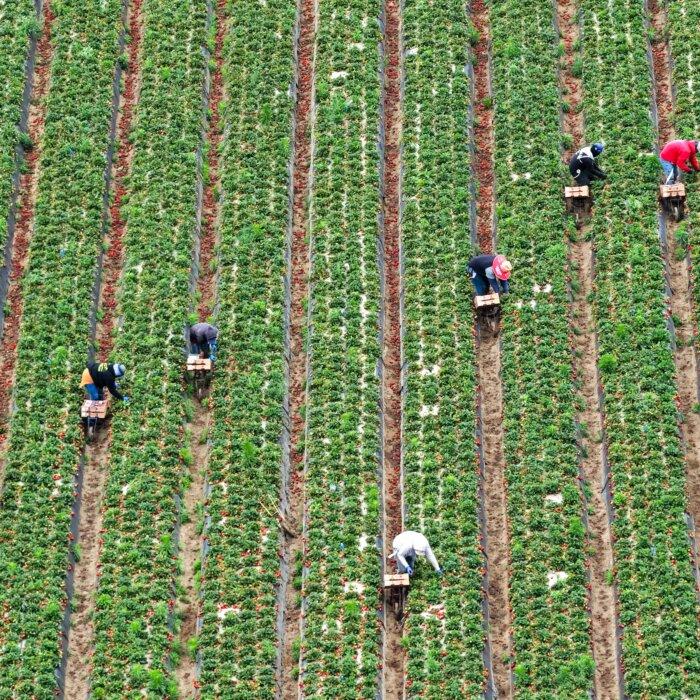
Most people do not realize that glyphosate has two very different uses in agriculture.
The first is the use everyone recognizes. A farmer sprays it to kill weeds. It might be sprayed before planting, in a field with herbicide-tolerant seed, in orchard alleyways, along fence lines, or around greenhouse floors. This is the traditional weed control use that most people picture when they think about Roundup.
The second use is far more concerning. On cereal crops such as wheat, oats, barley, and rye, glyphosate is often used as a pre-harvest desiccant. It is sprayed directly onto the crop shortly before harvest to dry it down evenly and allow farmers to harvest on a predictable schedule instead of waiting on weather and natural moisture levels. The same practice is used on pulse crops such as chickpeas and lentils, which often show some of the highest residue levels precisely because the chemical is applied so close to harvest.
That distinction matters.
Before this practice became common, harvest timing was dictated by humidity, temperature, and moisture content. Farmers harvested in a natural window to prevent spoilage. Pre-harvest desiccation changed that. It created a system that relies less on nature and more on chemistry. In doing so, it introduced a much more direct pathway for chemical exposure in the food supply.
This is where a meaningful policy line could be drawn.
If this administration wanted to take a serious step toward improving public health without destabilizing the entire food system, it could move to end the use of glyphosate as a pre-harvest desiccant on food crops. It could distinguish between weed control and the direct application of a weed killer onto crops just days before harvest.
That would be a clear, understandable policy. It would also align with common sense.
The history of glyphosate makes this even more striking.
Glyphosate was first synthesized in 1950 during pharmaceutical research. It was later patented as a chelating agent, meaning that it binds minerals and was used to clean industrial systems and pipes. Its herbicidal properties were discovered in 1970, and it was commercialized shortly after as Roundup. Over time, additional patents described antimicrobial properties tied to its mechanism of action.
In other words, this chemical has moved through multiple industries and applications over time. It was not originally developed as a farming necessity, and its role has expanded far beyond simple weed control.
And now, it is being sprayed directly onto food crops shortly before harvest.
There is another inconsistency that deserves attention. The allowable residue levels for glyphosate are significantly higher for cereal grains than for many fruits and vegetables. That difference may be rooted in how the chemical is used, but to the average person, it raises an obvious question. Why should it be more acceptable in one category of food than another? It all ends up in the human body.
This is where the all-or-nothing framing breaks down.
We are regularly told that any challenge to glyphosate is a threat to the entire agricultural system. But there is a meaningful difference between rethinking weed control strategies across millions of acres and simply deciding that we should not be spraying this chemical directly onto food crops just before harvest.
Ending pre-harvest desiccation would not end modern agriculture.
It would not remove every use of glyphosate overnight.
But it would remove one of the most direct exposure pathways in our food system.
My own perspective, both as a mother and as a farmer, is that we should be moving away from these chemicals altogether. There are emerging alternatives, from robotic weed management to biological systems that work with nature instead of against it. But meaningful change rarely happens all at once. It takes steps.
This is an obvious first step.
The argument that glyphosate has no impact on the human body is largely based on the idea that humans do not have the specific biological pathway it targets in plants. But the microbiology within our gut does rely on that pathway. The internal ecosystem that supports digestion, immunity, and overall health may not be as unaffected as we once assumed.
At the very least, that uncertainty should lead to caution, not complacency.
We are not faced with a choice between maintaining our food system and protecting human health.
We are faced with a choice about whether we are willing to draw reasonable lines.
Ending the use of glyphosate as a pre-harvest drying agent on cereal crops such as wheat, oats, and barley, as well as pulse crops such as chickpeas and lentils, would not resolve the whole issue. But it would be a meaningful shift. It would reduce direct chemical exposure in the food supply. It would restore some balance between efficiency and responsibility. And it would signal that we are capable of making nuanced decisions instead of defaulting to extremes.
It would not be everything.
But it would be real.
And right now, real progress matters more than an all-or-nothing argument.