The United States Supreme Court should take the Amish vaccine case.
Not because every American agrees with the Amish. Not because every American shares their views on medicine. But because if the First Amendment cannot protect one of the oldest, most peaceful, and most insular religious communities in America as they educate their own children according to their own faith, then we should all be asking what religious liberty actually means.
The Amish are not asking the government to impose their beliefs on anyone else. They are not trying to change public schools or require their neighbors to live as they do. They simply want to educate their own children according to their religious convictions. If that falls outside the protection of the First Amendment, then it is difficult to imagine where the Constitution still draws a meaningful line.
The Supreme Court has recognized the unique place of the Amish before. In its landmark 1972 decision, Wisconsin v. Yoder, the Court held that Amish families could not be compelled to keep their children in school beyond the eighth grade because doing so substantially burdened their religious way of life. The justices recognized that the Amish had demonstrated, over generations, a sincere commitment to living according to their faith and that the Constitution protected that commitment.
More than 50 years later, the Court has another opportunity to answer an equally important question. If the First Amendment protected the Amish from government interference in how they educated their children in Yoder, does it also protect them when they object on religious grounds to vaccination requirements as a condition of attending their own religious schools?

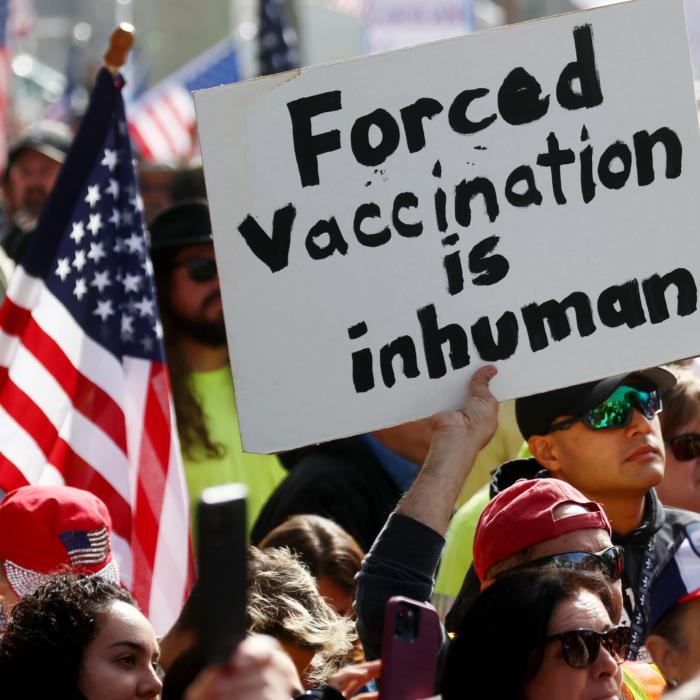
The First Amendment was never intended to protect only religious beliefs that were popular or convenient. The founders understood that government has a natural tendency to expand its authority, especially when it believes it is acting for the public good. That is precisely why they placed certain freedoms beyond the reach of shifting political priorities. Religious liberty was never meant to exist only when government approved of the beliefs being exercised. It was intended to endure precisely when those beliefs were unpopular, inconvenient, or at odds with those in power.
This case has already been before the Supreme Court once. Rather than deciding the constitutional question, the justices vacated the Second Circuit’s decision and sent it back for reconsideration in light of Mahmoud v. Taylor, a recent religious liberty case. Many hoped that meant the Court was signaling that the lower court had gotten it wrong. Instead, the Second Circuit reached essentially the same conclusion, leaving the central constitutional question unresolved. The case now appears poised to return to the Supreme Court, and I believe it is imperative that the justices hear it. The First Amendment deserves an answer.
I have never been vaccinated. I chose not to vaccinate my children, and I homeschool them because I believe parents—not government—bear the primary responsibility for shaping their children’s minds and values. My family grows much of our own food. We raise livestock, slaughter many of our own animals, bake our own bread, and work every day to live intentionally.
No, I do not live exactly like the Amish. I use an iPhone, drive a truck, own businesses, and depend on technology every day. But I recognize something familiar in their desire to order their lives according to deeply held convictions instead of simply accepting whatever modern culture tells them is normal. There are many aspects of my life that make me feel connected to the Amish, even if our lives look very different on the surface.
That is why this case matters to me.
For many Americans, objections to certain vaccines are rooted in faith and conscience. Some object because of the use of fetal tissue or fetal-derived cell lines in aspects of the research, testing, or manufacture of certain vaccines. Sincerely held objections connected to abortion do not belong to just one religion, as they are often portrayed. Many religious traditions hold the sanctity of human life as a foundational belief, and those convictions shape how millions of people approach modern medicine.
The Constitution does not ask whether those beliefs are fashionable. It does not ask whether they are held by a majority of Americans. It asks whether the free exercise of religion deserves protection. If bureaucrats become the ones deciding which religious objections deserve accommodation and which do not, then religious liberty gradually becomes something granted by government instead of something protected from government.
The Amish present one of the strongest religious liberty claims imaginable. They have lived apart from mainstream culture for centuries. They educate their own children in their own schools. They are not asking anyone outside their community to adopt their beliefs. They simply want the freedom to live according to them.
If the Constitution cannot protect them under those circumstances, who can it protect?
The Bill of Rights was written because the founders understood that liberty is most vulnerable when government believes it has a worthy objective. History shows that rights are rarely eliminated all at once. More often they are narrowed one exception at a time. An emergency becomes a precedent. A precedent becomes routine. Before long, what once seemed like an unquestionable constitutional protection begins to feel more like a privilege that exists only with government approval.
I believe we have become too comfortable allowing unelected agencies and bureaucracies to make decisions first and asking constitutional questions later. That is backwards. The Constitution should be the lens through which government exercises its authority, not an obstacle to be considered only after a policy has already been written.
This case is about far more than one Amish community in New York. If the First Amendment cannot protect a historic religious community educating its own children in its own schools according to beliefs it has held for centuries, then every American should pause and ask what meaningful protection remains for the free exercise of religion.
The Supreme Court does not have to agree with the Amish. It does not have to agree with me. But it should answer the constitutional question. If the First Amendment cannot protect one of America’s most peaceful religious communities in these circumstances, then the Court owes the country an explanation of what religious liberty still means.
The Amish deserve an answer.
Every American who believes the Constitution still limits government deserves one too.