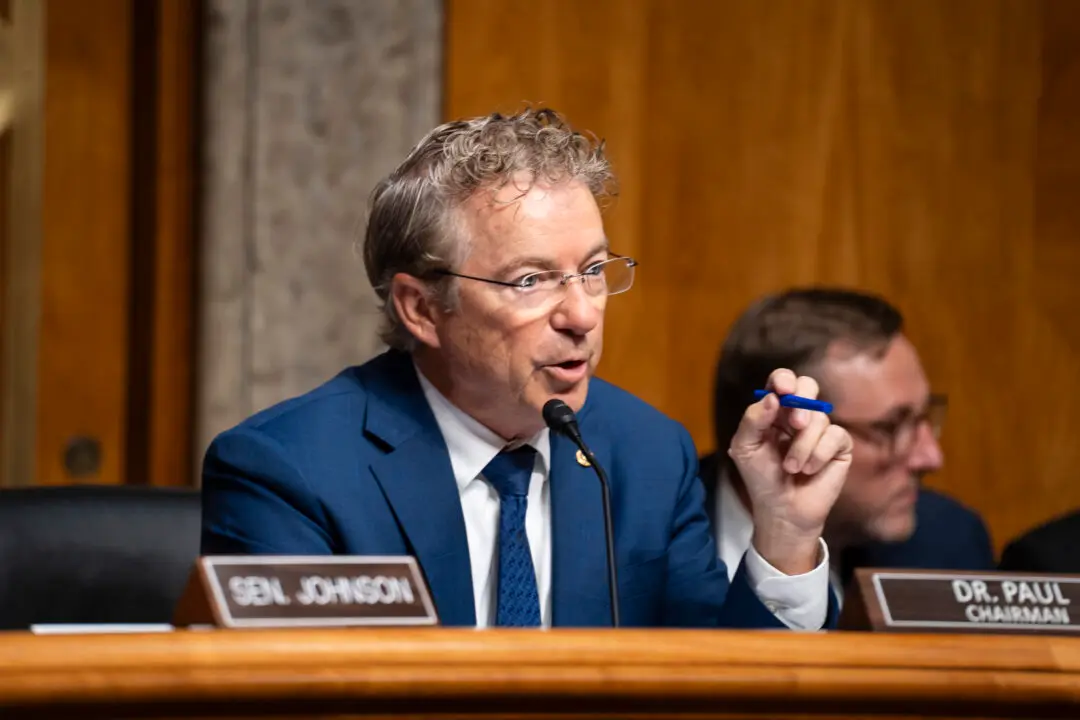
On Feb. 11, Sen. Rand Paul (R-Ky.) introduced a momentously important bill that stands a real chance of eventual passage, provided the grassroots get busy and back it. It is S.3853, an amendment to the Public Health Services Act. It would remove the liability shield for vaccine manufacturers that was passed in 1986. Sen. Mike Lee (R-Utah) is a co-sponsor.
Whatever your opinion on vaccines, this bill has merit. It would mean that vaccines would be regarded as a normal product in a market economy, subject to the liability burden that every other pharmaceutical product and every other consumable in the market economy bears. It would do nothing other than strip away special exemptions, not as some kind of punishment but in the interest of subjecting the industry to the same standards as everyone else.
In the 40 years since the passage of the liability shield, we’ve seen a gold rush among vaccine makers to get their products listed on the childhood schedule and administered to every child, often as a precondition for attending school or participating in extracurricular activities. It’s bad enough that millions are forced to accept an injectable, but it is intolerable that the shot-makers would bear no consequence for harm caused.
This is a bad incentive structure for any industry. It increases vaccine skepticism, feeding fear. After all, if the shots in combination or alone were generally safe or carried far more benefit than risk, why should such a shield be necessary? In the period this exemption was passed, there was a perception of a prevailing liability crisis such that the courts were clogged with frivolous litigation. Surely vaccines are so essential, the industry argued, that it should be given a complete escape from this thicket.
Although the 1986 act was widely supported on both sides of the aisle, it was a major error. It makes no sense to have such a carve-out. A shield like this creates dangerous incentives to make as many shots as necessary without having to bear the consequences. This is not how matters are supposed to work in a market economy. Liability for harm is something borne by all manufacturers from time immemorial.

You find this in the entire history of enterprise. In ancient Mesopotamia, the Code of Hammurabi, from 1750 B.C., held builders accountable for harm. If a builder constructed a house poorly and it collapsed, killing the owner, the builder could face severe penalties. This reflects early recognition that producers bear responsibility for shoddy work causing injury or death. This pattern dominates all history through British common law until the present time. The principle of strict liability for harm is firmly established in U.S. law.
With all the huge controversies these days about the childhood schedule, such as which shots are on or off and who is to say, the elimination of the special privilege is something on which everyone should agree. Champions of vaccines should welcome a test of their benefits that minimizes harm, and anti-vaxers should be glad to see something they oppose be subject to normal legal standards.
It would be especially welcome for those who have experienced vaccine injury. The floods of reports concerning the COVID-19 shots have not been litigated simply because they benefited from the shield. This leaves those injured with no real justice. They can, of course, appeal to the government’s own fund for injury, but it is well known that this system is wholly broken. They need access to courts, the same as any consumer of a product.
During the COVID crisis, friends would try to explain to me that it was perfectly fine that private businesses mandate shots, the same as they mandate uniforms or other conditions of work. The trouble is that such mandates are usually connected to liability. For example, let’s say your employer made skydiving a condition of employment. If you do it and die, your family would be in a position to sue the company for imposing unnecessary risk.
In the case of the shots mandated by business, if an employee is harmed, there is no recourse for the individual or his survivors. The business bears no responsibility because the shot-makers bear none. It is for this reason that such mandates are always and everywhere wholly unjust, contrary to those who say this is simply a matter of choice. If someone were responsible for harm, both the employer and the manufacturer might rethink the imposition entirely.
Even from the very first vaccines of the late 18th century, there was extensive documentation of harm. The inventor was Edward Jenner, who became physician to the king. An opponent of vaccination was the physician to the Princess of Wales, and his name was John Birch. In 1805, he published “An Appeal to the Public on the Hazard and Peril of Vaccination,” which had many credible reports of harm.
Vaccines came to the United States with James Madison’s Act to Encourage Vaccination, which mandated that anyone who wanted one could get one at no charge. As usual, injuries and mistakes in administration staked up to the point that the act was entirely repealed by 1822 in response to reports of deaths. This pattern repeated itself following mandates in the Civil War, in which injury and death were so high as to seriously damage the industry’s reputation.
Not even this decision, which is likely to be reversed by the Supreme Court this year or next, removed responsibility for harm from the manufacturers. As more shots came on the market in the 1960s and 1970s, there was ever more public concern about their downsides. As litigation increased, the industry lobbied Congress, explaining that if it had to compensate victims, the existence of the industry itself would be in question.
Was that hyperbole designed to intimidate Congress into passing the shield, or was that a realistic prediction of what would happen if vaccines continued to be treated as a normal good?
Sadly, we have no way of knowing. It seems about time that we should know. If these products cannot be created and delivered at a scale in which the profits exceed the liability costs, that would be extremely revealing. The net result of such a test is that we find out for sure which shots and how many can be treated as a normal market-based product.
There is no such thing as a pharmaceutical product without side effects. The key is open disclosure of them and strict liability for undisclosed harms. Thousands of such products are on the market today while bearing liability for harms. There is no reason for vaccines as such to be exempt from normal legal standards.
There is a great deal of high dudgeon today about the rise of anti-vaccine ideology. A major reason for this traces to the liability shield, which has only fed public fears. A solid compromise between those who are doggedly for vaccines and those doggedly against them is for them to occupy a conventional spot in the market economy, same as every other good that we are in a position to accept or reject based on risk acceptance.
Another possible solution is that the industry relies on individual waivers of liability, the same that you sign when you skydive, ski, or undertake many other dangerous activities. Surely there is some market demand for vaccines, and it is surely the case that the industry can simply ask those who want to bear the risk to waive their rights to sue. That’s how this matter should be handled in a free market.
At the very least, to get to this point of normalcy, the indemnification now guaranteed to an entire industry has to go.