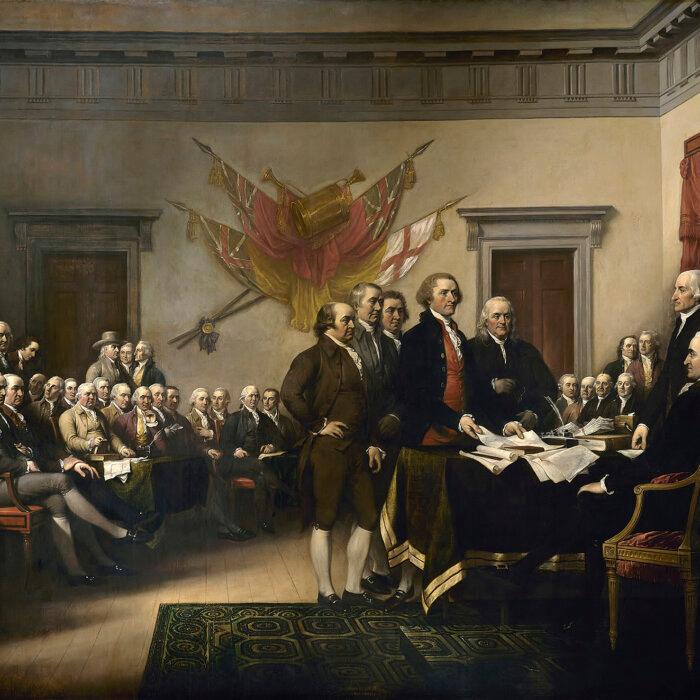
Most of the text of the Declaration of Independence addressed then-current events: the grievances against King George III, the reasons for Independence, the announcement of separation, and the signers’ determination to defend their decision.
The Declaration’s timeless, permanent legacy derives from its paragraph of basic premises or assumptions:
“We hold these truths to be self-evident, that all men are created equal, that they are endowed by their Creator with certain unalienable Rights, that among these are Life, Liberty and the pursuit of Happiness.—That to secure these rights, Governments are instituted among Men, deriving their just powers from the consent of the governed,—That whenever any Form of Government becomes destructive of these ends, it is the Right of the People to alter or to abolish it, and to institute new Government, laying its foundation on such principles and organizing its powers in such form, as to them shall seem most likely to effect their Safety and Happiness.”
“The sacred rights of mankind are not to be rummaged for, among old parchments, or musty records. They are written, as with a sun beam, in the whole volume of human nature, by the hand of the divinity itself; and can never be erased or obscured by mortal power.”
These premises have become America’s founding creed.
It is true, of course, that some academics sneer at them: When I served on a university law school faculty, one of my faculty colleagues used to tell entering law students that the entire concept of natural law was “simple minded.” (If so, I plead guilty to the fault.) But the Declaration’s assumptions are accepted widely among the general public.
Politicians usually dare not question the Declaration’s premises, even if they act in ways very different from what the Founding creed would suggest. But on Sept. 3, 2025, Senator Tim Kaine (D-Va.) became a rare example of a politician who did question the Founding creed. Without mentioning the Declaration, he compared the concept of God-given rights to Islamic theocracy.
Early Reliance on the Declaration
As I pointed out in the second installment in this series, a major reason for declaring independence was to induce other countries (particularly France) to aid the American cause. However, the Declaration seems not to have had that effect—at least not immediately. On the other hand, the document proved influential in America, where citizens began rather early to measure public policy by the Declaration’s standards. Of course, some of their assessments were correct, and some were not.On Sept. 17, 1787, the convention released the proposed Constitution to the general public, thereby triggering debate over whether the states should ratify it. The Constitution’s opponents said it violated the aspirations expressed in the Declaration by creating an aristocratic, powerful federal government. The Constitution’s advocates argued that the Constitution actually furthered the aspirations expressed in the Declaration.
Lincoln’s most famous use of the Declaration, of course, was in the Gettysburg Address: “Four score and seven years ago our fathers brought forth on this continent, a new nation, conceived in Liberty, and dedicated to the proposition that all men are created equal.”
Twentieth Century Reliance on the Declaration
Early in the 20th century, progressive scholars, frustrated with the checks on government power in the Constitution, claimed that the Constitution had been written by self-interested reactionaries to undermine the Declaration’s democratic ideals. This argument failed to explain why all five members of the committee that drafted the Declaration supported ratifying the Constitution (although Jefferson also insisted on a Bill of Rights). In the intervening years the claim that the Constitution’s writers were driven by self-interest to subvert the Declaration has been discredited.One might ask why people who oppose the Declaration’s fundamental principles nevertheless quote from it. One might as well ask why politicians who favor an omnipotent federal government cite the Constitution. Shakespeare answered such questions with his observation that, “The devil can cite Scripture for his purpose.” Because the Declaration is an enormously inspiring document, unscrupulous hands manipulate it into a propaganda tool.
The remedy for misuse of the Declaration is education. Part of a citizen’s job is to inform the rising generation of what the Declaration really said, what it really means, and why it is important. May we continue that effort long after this 250th anniversary has receded into history.