I had never been to North Dakota until recently.
I was honored to be invited to Medora to speak at a three-day gathering of the American Conservation Coalition at the new Theodore Roosevelt Presidential Library. The coalition brings together young people who identify as both conservative and conservationist, two words I have long believed should naturally belong together.
Conservative. Conservation. They even sound alike.
The American Conservation Coalition is a nonprofit organization working to build a conservative environmental movement, particularly among young people. Its approach is rooted in ideas such as conservation, innovation, market-based solutions, and environmental stewardship, rather than the larger government programs that have come to dominate much of the modern environmental conversation.
I have written about this before, including in an article for The Heritage Foundation. Caring for the land, conserving resources, protecting clean water, maintaining healthy soil, and leaving something productive for the next generation should not be the exclusive domain of the political left. If anything, these ideas fit naturally within a philosophy built on responsibility, restraint, local control, and the preservation of what is valuable.
So I was genuinely excited to spend several days and meals with young people trying to build a conservative environmental movement.
North Dakota made an impression on me immediately. The landscape is beautiful in a way that also teaches you something.
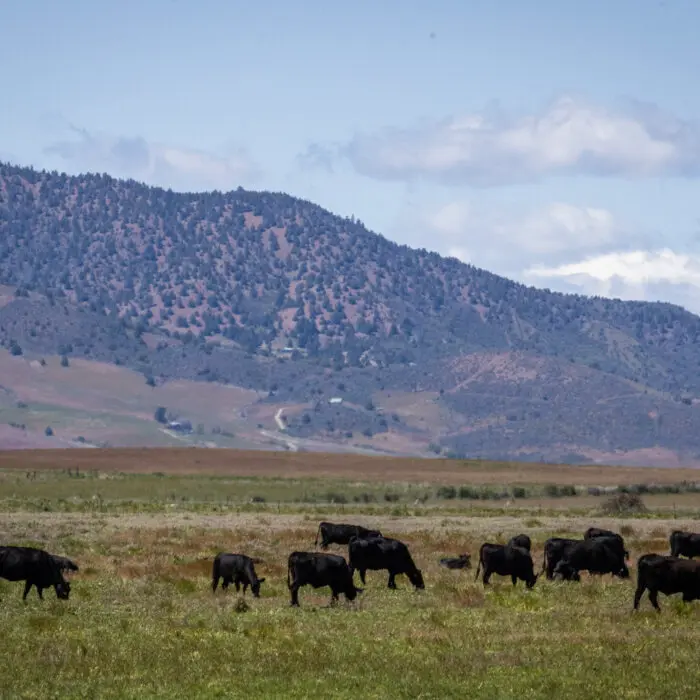
Looking across enormous stretches of grazing country makes obvious something that gets lost when agricultural policy is calculated on the back of a napkin: land is not interchangeable.
You cannot simply say that if Americans stopped eating cattle, all the land used for cattle could be used to grow corn, soybeans, or vegetables. Much of the land I looked across in North Dakota can grow grass and support grazing animals beautifully. That does not mean it can grow lettuce.
The landscape itself is an environmental lesson.
Then there is Medora.
Nearly everything in town seems to have Theodore Roosevelt, Teddy Roosevelt, or Badlands attached to it. It is charming and, at times, a little bit like an amusement park built around a former president.
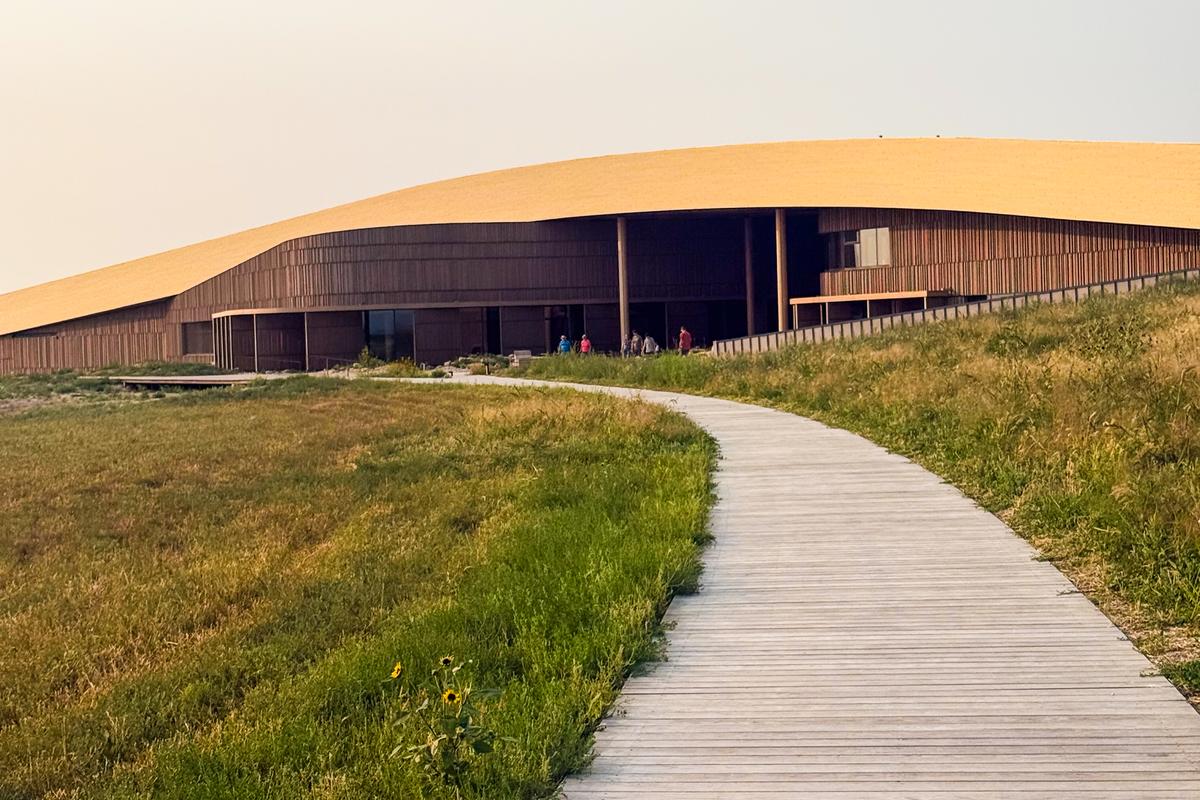
The new presidential library is striking. It is built into the landscape rather than simply placed on top of it, emerging from a mound and looking outward across the prairie and Badlands. Massive rammed-earth walls wind through the building. As a farmer and builder, I found myself staring at them almost as much as I did at the exhibits. I came home wanting to build something out of rammed earth on our ranch.
The exhibits themselves are remarkably modern and technologically sophisticated.
And somewhere over the course of the weekend, that became part of a larger question I could not shake.
I am deeply grateful to have been invited into a room filled with young conservative environmentalists. I am honored to have even a tiny role in shaping how the next generation thinks about conservation.
But I found myself having an uncomfortable internal conversation while sitting on stage.
I was there because I wanted to inspire these young people. Yet I was surrounded by incredibly smart, hip young men and women presenting visions of the future that sounded almost like science fiction: terraforming, weather modification, bringing extinct species back through gene editing and cloning, scientists from NASA, new energy technologies, and discussions about the enormous electrical workforce that will be needed to power a future increasingly dependent on data and data centers.
There was excitement around these ideas. There was investment behind them. There was the possibility of breakthrough, scale, and enormous economic return.
And then there was me.
What exactly was I offering these young people as a future?
Go become a farmer?
Spend your days moving cattle. Build fences. Fix water lines. Compost manure. Plant trees. Pay attention to rainfall. Learn your soil. Get up when an animal is giving birth at 2 in the morning. Spend years rebuilding a piece of land and perhaps never become wealthy doing it.
Standing beside all these shiny visions of the future, regenerative agriculture can seem almost quaint.
There is no rocket launch. There is no breakthrough announcement. Much of what we are rediscovering isn’t new at all. It is an older understanding of the relationship between animals, plants, soil, water, and human beings, combined with what modern science is allowing us to understand about those relationships.
But I know what I have seen with my own eyes.
I have watched damaged soil begin to function again. I have watched land hold more water. I have watched animals transform landscapes when they are managed correctly. I have watched food emerge from places that would never grow commodity crops.
These aren’t theoretical benefits promised decades from now. They are tangible changes occurring underneath my boots.
That was the tension I carried home from North Dakota.
What I was wrestling with wasn’t about the American Conservation Coalition at all. The conference simply gave me a window into a much larger question I have been thinking about in our society.
We have become extraordinarily good at investing in technological solutions to environmental problems. A breakthrough technology has the possibility of scale. It can be patented, licensed, acquired, and deployed to millions of customers. Investors can imagine an enormous financial return if it succeeds.
That creates an ecosystem of money, talent, and excitement.
But what is the financial model for a 25-year-old deciding to rebuild depleted soil?
Where is the enormous return on investment for the young farmer who spends decades improving water infiltration, increasing organic matter, planting trees, moving cattle, rebuilding biodiversity, and producing food for a community?
I know something about the economics of this firsthand. Regenerative agriculture is extraordinarily hard work, and the financial margins can be painfully thin. But I don’t want to make this about my farm. This is a societal problem.
We say we need farmers. We say we want healthy soil. We say we care about clean water, resilient local food systems, and preserving rural America.
Then we have built an economy in which an ambitious young person can look at the choices before them and quite reasonably conclude that almost any other option offers a better financial future.
There is no billion-dollar exit waiting at the end of rebuilding a watershed.
The return might instead be an aquifer that recharges, topsoil that doesn’t wash downstream, wildlife returning to a landscape, healthier food, and a piece of productive land that can be handed to the next generation.
Those are real returns.
We just haven’t built an economic system particularly good at valuing them.
This is also where I worry about our continuing belief that technology will allow us to avoid the harder work of changing human behavior.
I am not anti-technology. I am writing these words on a computer. I run businesses using technology every day. Farmers have always adopted tools that allow us to accomplish things our grandparents could not have imagined. Some of the technologies I heard about in North Dakota may prove extraordinarily important.
But technology can also become a way of avoiding a much more uncomfortable conversation.
What if some environmental problems cannot be solved without changing how we live?
What if conservation occasionally requires sacrifice?
What if the answer isn’t always inventing something that allows hundreds of millions of us to continue consuming exactly as we do now, only with fewer consequences?
There is no exciting venture-capital pitch for using less. There is no revolutionary patent for wasting less food, buying fewer disposable things, rebuilding soil, grazing animals appropriately, knowing where our food comes from, keeping water in the landscape, repairing something instead of replacing it or accepting that convenience sometimes comes with a cost.
Those changes are incremental. They are personal. And perhaps most importantly, they require responsibility.
My experience as a farmer has made me believe more strongly than ever that human beings are a keystone species. We can destroy ecosystems, certainly. But we can also improve them.
I don’t believe our highest environmental aspiration should be removing human beings from nature. I believe our mandate is to tend the garden.
That distinction matters.
If humans are fundamentally a problem to be engineered around, then our environmental future becomes increasingly technological and centralized. We need smarter systems, bigger infrastructure, and increasingly complex interventions to compensate for ourselves.
But if humans are stewards, the questions change.
How should we live? How should we farm? How much should we consume? What should we conserve? What responsibilities do we have to the piece of land underneath our own feet?
Those questions are less glamorous than technological innovation. They are also harder because eventually they point back at us.
During my time in North Dakota, I also drove through Theodore Roosevelt National Park. Watching bison move across the prairie and prairie dogs disappear into their burrows, I found myself thinking about the generations that lived on this landscape before us and the generations that will come after us.
I thought about Indigenous people who built lives in an extraordinarily harsh climate long before modern conveniences existed. I thought about young people crossing this country by wagon, arriving in places like North Dakota without any guarantee of what they would find or whether they would succeed.
And I found myself asking a different kind of conservation question: What are we doing to build young people courageous enough to face whatever is coming next?
We live at a level of comfort that would have been unimaginable to almost every generation before us. I am grateful for much of that comfort. I don’t want my children to suffer simply for the sake of making them tougher.
But I do wonder whether a life increasingly engineered to remove difficulty can produce the strength, resilience, and grit that human beings have always needed when circumstances become difficult.
Perhaps preparing the next generation for the future isn’t only about giving them better technology. Maybe it is also about making sure they know they can survive without it.
The young people I met in North Dakota gave me tremendous hope. They are engaged in questions that many Americans twice their age barely think about. They are willing to challenge the strange political assumption that caring about the environment requires subscribing to an entire progressive political agenda.
I want their movement to succeed.
And I hope that as they build it, conservative environmentalism retains something that conservatism at its best has always understood: innovation matters, but so do restraint, responsibility, competence, and stewardship.
Technology should be one of our tools. It should not become our substitute for stewardship.
Standing in a magnificent new building overlooking the North Dakota prairie, surrounded by young people determined to conserve America’s natural inheritance, I kept returning to one very old idea.
We inherit something we did not create. We use it during our brief time here. And we have a responsibility not to leave it diminished for the people who come after us.
There will undoubtedly be extraordinary technologies developed in the lifetimes of the young people I met. Some will help agriculture, energy, and conservation enormously. We should welcome them.
But I hope we teach this generation something considerably older at the same time.
We are not going to invent our way out of every consequence of how we live.
Sometimes, we have to consume less. Sometimes, we have to waste less. Sometimes, we have to change the way we farm, build, eat, or travel. Sometimes, the answer isn’t a machine, an algorithm, or another enormous piece of infrastructure.
And if we genuinely believe farmers, ranchers, and land stewards are essential to our environmental future, we also have to figure out how to make stewardship a viable future for the brilliant young people sitting in those rooms.
I can tell them this work is meaningful. I can tell them it is necessary. I can show them the results.
But meaning alone doesn’t pay for land.
Perhaps one of the great conservation challenges of their generation will be figuring out how to change that.
Because whatever is coming next, courage, competence, adaptability, and a willingness to do hard things will remain technologies we cannot replace.
And no matter how advanced our technology becomes, someone still has to tend the garden.