First, Solzhenitsyn the man, who is largely unknown to younger Americans: Solzhenitsyn (1918–2008) was a Russian patriot. After graduating from college, where he studied physics and mathematics, he served in the Soviet Army in World War II. Decorated for bravery and outstanding accomplishments on the battlefield, he rose to the rank of captain. However, in February 1945, while still serving on the front, he committed the indiscretion of writing a letter to a friend in which he criticized Soviet dictator Joseph Stalin. The Soviet secret police read Solzhenitsyn’s letter and labeled it treasonous. He was sentenced to eight years of labor in Soviet concentration camps to be followed by internal exile to a remote region of the Soviet Union.
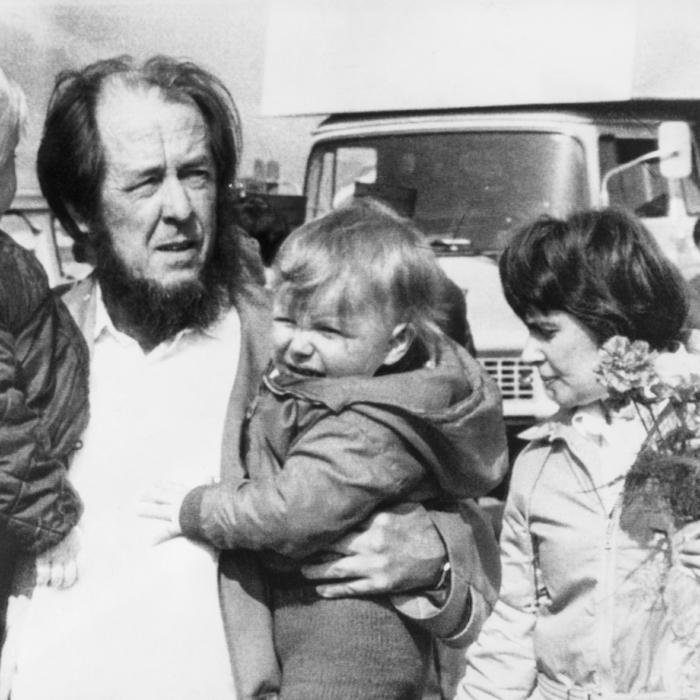
In 1975, just one year after arriving in the United States, Solzhenitsyn issued his warning to the West. He spoke as a friend of the United States and an avowed enemy of the U.S.S.R.’s oppressive socialist system. He warned Americans not only about the evils of the Soviet system, but about what he saw as some dangerous flaws in U.S. society: a lack of spiritual values, a flaccid, pre-woke press, a psychological inability to deal firmly with the implacable evil of Soviet expansionism, and especially a soul-killing cult of materialism. Solzhenitsyn feared that Americans believed so strongly in the primacy of material comfort and ease that they no longer believed there were any higher moral values worth fighting or dying for, and that this lack of moral clarity jeopardized our future as a free nation.
After the Soviet Union introduced the innovation of concentration camps, exterminating all opposition parties, committing genocide against peasants, and engineering the Holodomor—the deliberate starvation of 6 million to 10 million Ukrainians in 1932–33—among other horrors, U.S. President Franklin Roosevelt and the U.S. Congress, to Solzhenitsyn’s retroactive astonishment and horror, officially recognized the Soviet government.
Solzhenitsyn lamented U.S. appeasement of the U.S.S.R. dating back to World War II. In his words: “Beginning in Yalta, your Western statesmen for some inexplicable reason signed one capitulation after another. Never did the West or your President Roosevelt impose any conditions on the Soviet Union for obtaining aid. He gave unlimited aid, and then unlimited concessions. Without any necessity whatever, the occupation of Mongolia, Moldavia, Estonia, Latvia, Lithuania was silently recognized in Yalta. After that, almost nothing was done to protect Eastern Europe, and seven or eight more countries were surrendered.”
From 1945, when World War II ended, to 1975, when Solzhenitsyn spoke out with his warning to the West, the Russian author detected what he called “a very dangerous state of mind ... [in the West]: Give in as quickly as possible, give up as quickly as possible, peace and quiet at any cost.” He tried valiantly to convince us that it was impossible to appease the Soviets, that it was a policy of defeat to temporize with them, to cut deals with them—deals that they would cheat on as soon as it suited them—to make concessions to them in the deluded hope that they would forswear further aggression. He concluded that America had lost the ability to deal with Soviet methods in the only way that could lead to a favorable outcome: to be firm and unbending.
Solzhenitsyn’s warning overflowed with truth and wisdom, but he didn’t see everything with perfect clarity. Consistent with his rebuking the West’s misguided willingness to compromise with an implacably evil opponent, he denounced the 1970s U.S. policy of seeking détente (mutual compromises to lessen tensions) with the Soviet Union. The irony is that détente was probably the only reason that the Politburo sent the world-famous author into exile, where he did so much to expose the true nature of the Soviet system, instead of returning him to the gulag or simply assassinating him.
True, Solzhenitsyn underestimated America’s spiritual reserves back in 1975. The United States went on to prevail against the Soviet Union. But what about today? Does “Warning to the West” have any helpful insights and advice for how we should deal with the successor to the Soviet Union, the Stalinist regime of Vladimir Putin? Or with the Chinese Communist Party? Those are questions worth pondering.