This copy is for your personal, non-commercial use only. Distribution and use of this material are governed by our Subscriber Agreement and by copyright law. For non-personal use or to order multiple copies, please contact The Epoch Times Reprints.
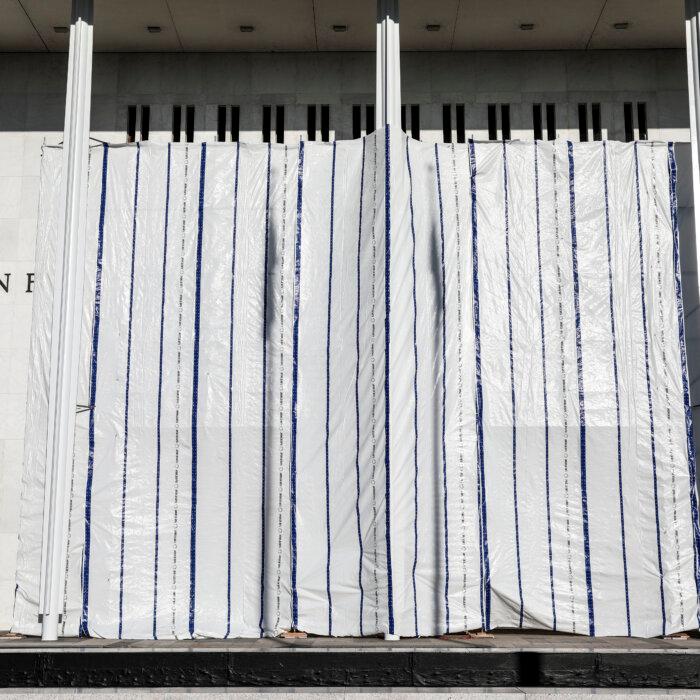
Workers stand on scaffolding near signage for the Donald J. Trump and John F. Kennedy Memorial Center for the Performing Arts as efforts continue to remove President Donald Trump’s name from the venue in Washington on June 12, 2026. A federal court ruling ordered the change following a legal dispute over the building’s naming. Alex Wroblewski/AFP via Getty Images
The court-ordered removal of President Donald Trump’s name from the Kennedy Center on June 13 was, of course, celebrated universally by his opponents. In the left-leaning world of the performing arts, the entire episode felt a bit surreal, with many performers canceling their scheduled concerts and shows in protest.
It didn’t help that the institution’s own rules seem to place its ultimate authority in the hands of Congress, not the president.
Even Trump himself seems to be walking away without much of a fight. He said in a Truth Social post, “We are going to be working with Congress to transfer this failing Institution back to them so they can make a determination as to what to do with it.”
From one perspective, the name game has unfortunately distracted from the really important story: the needed renovations are being scrapped along with the name change. The power to carry these forward now is floating in political space with an uncertain outlook for the future.
You can see for yourself the sad state of the Kennedy Center in photos posted on their website. For a premier venue under the auspices of the federal government in the nation’s capital, this is indeed a disgrace. Prolonging its current state by punting to Congress is adding insult to a national injury.
From another perspective, the removal of the president’s name—a move that was reached by the Kennedy Center’s board, not the president himself—is actually a bigger problem and national tragedy, far greater even than lost renovations. What has been removed is not simply the name of a politician (who you may or may not like), but rather the ideal of leadership—and, more importantly, the virtue of taking responsibility and ownership.
America is facing a deadly drought of people taking responsibility. The No. 1 example of this is fatherlessness. One in four children in the United States is now raised without a father in the household. This figure has doubled since the 1970 census. In 1950, the number of fatherless households was a mere 7 percent. Today, fatherless children disproportionately account for 90 percent of all homeless and runaway children, 80 percent of all prison inmates, and 63 percent of all youth suicides.
Yet if dads are treated the same way that Trump is treated by the mainstream media and politically motivated officials and judges, who can blame the dads for leaving and shirking their responsibility?
As members of American society, we should be encouraging good leadership and people taking responsibility, not eviscerating men who follow what they—and we—know in their hearts is right and who undertake difficulty at their own expense to achieve it. Isn’t that what the president was doing with the renovations?
We see this drought of responsibility playing out in every sector of American society.
Property ownership is going down. Property ownership is good because it creates a sense of community responsibility and stewardship, resulting in a stronger society with more economic stability. If people can’t afford property, then their chance to increase their sense of responsibility decreases, creating a negative cycle.
Consumers are also bucking responsibility for their spending. Credit card debt has almost tripled since 1999, crippling consumers with high interest rates. Student loan debt has more than tripled since 2006. These economic hardships push property ownership further out of reach.
In education, we are in a “generation-long decline” that began before COVID-19. Who will take responsibility for this: school districts, principals, teachers, parents, or students? Where does the buck stop?
In my ideal republic, we would give the president—any president—a lifelong term so he or she could stay out of party politics and appoint a non-politicized judiciary. When something is obviously broken, like the Kennedy Center, it would be fixed. In fact, this simple, common-sense approach is in part why Founding Father Alexander Hamilton proposed at the Constitutional Convention in 1787 that the U.S. president serve a life term. What incredible good could such a leader accomplish?
The Palace of Versailles has King Louis XIV, St. Basil’s Cathedral in Moscow has Czar Ivan IV, and the Parthenon of Athens had the Greek statesman Pericles. There is a reason why great buildings throughout history have been associated with great figures, and why these nations have endured to the present as high watermarks of civilization. The celebration of people doing difficult things and taking responsibility for doing difficult things is a virtue that should be put on a pillar—not primarily for the benefit of the great figure himself, but for the benefit of all of us who can look up to, appreciate, and emulate what has come before us.
Views expressed in this article are opinions of the author and do not necessarily reflect the views of The Epoch Times.