For most of American history, parents were recognized as the primary authority in their children’s lives. Today, that authority is repeatedly under attack, especially in public schools.
Across the country, families are being shut out of what their children learn, denied access to critical health and personal information, and blocked from choosing schools that fit their children’s needs. This is not a minor issue. Rather, it is a fundamental threat to family authority, a child’s well-being, and the future of our society.
To a growing extent, schools have begun operating as if parental involvement is optional instead of essential. But parents do not lose their rights when their children enter a classroom. Education exists to serve families, not replace them.
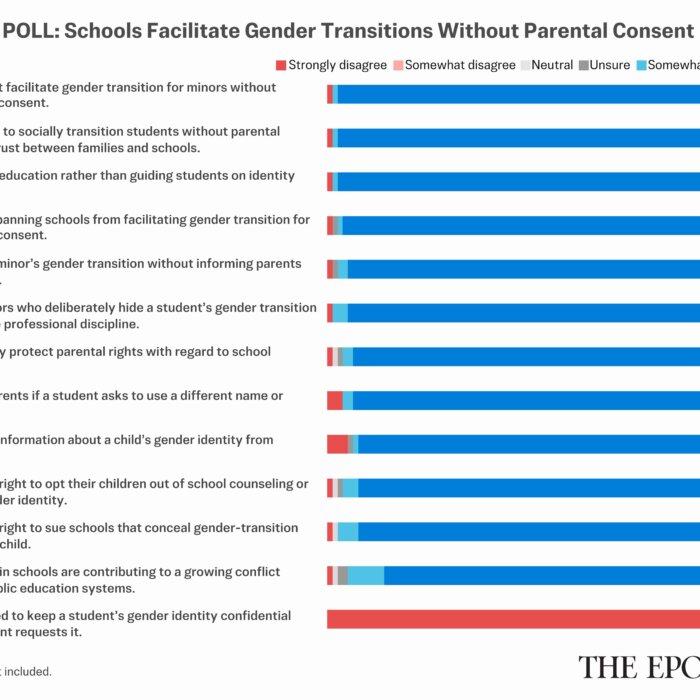
The problem extends beyond curriculum, as teachers and administrators are withholding critical medical or personal information from parents about their minor children. Yet parents cannot fulfill their responsibility to care for their children if key information is deliberately withheld.
This conflict is not hypothetical. In recent years, a growing number of school districts have adopted policies that allow, and even encourage, students to socially transition at school—by using different names or pronouns—without notifying their parents. In some cases, school staff are directed to keep this information hidden from dads and moms. Policies such as these drive a wedge between parents and their own children.
Finally, parents are still denied meaningful authority over where their children are educated. Millions of families remain assigned to schools based solely on ZIP code. If a child struggles academically, faces bullying, or needs a different learning environment, parents are often left with few options. This puts children’s education and well-being at risk.
Thankfully, change is taking place. Across the country, states are expanding school choice programs that allow education funding to follow students rather than remain tied to the system. Private school scholarship programs, education savings accounts, and tax credit scholarships are giving families the freedom to choose the learning path that best meets their children’s unique needs.
Parents are desperate to exit the public education system because it has failed to fulfill its core mission of providing quality learning, has stopped listening to them, and, in many cases, has pushed them out.
Parents, not school bureaucrats, must hold the final authority over their children. Moms and dads raise them, have known them since birth, and will be part of their lives long after the school year ends. No teacher or administrator, no matter how well-intentioned, should ever replace that role.
For most of our nation’s history, that was obvious. Parents had both the right and the responsibility to direct the upbringing and education of their children, and courts repeatedly affirmed that principle.
Yet today, that authority is under threat. Bureaucratic policies, as witnessed in California, are increasingly working to replace the role of parents in a child’s life.
Excluding parents erodes trust, strips schools of accountability, and harms children. Families are sidelined while systems dictate what kids learn, what personal information they keep private, and even which schools they can attend, leaving children without the guidance of those who know and love them best. Schools should operate with transparency, not secrecy. Parents should be treated as partners, not obstacles, and their decision-making authority must be respected.
Children belong to families, not bureaucracies. Institutions should never forget that. Restoring parental authority is not radical. Rather, it is simply a return to a long-standing American principle: Families, not government institutions, are the foundation of society, and parents should be trusted to guide their children’s upbringing and education.
If we fail to protect that principle, we risk raising a generation with less parental guidance, less accountability in schools, and fewer opportunities to succeed. But when parents are respected and empowered to lead in their children’s lives, families grow stronger, and so does the future of our nation.
It’s time to put parents back in their rightful place—as the first, most trusted, and most important decision-makers in their children’s lives. This Supreme Court decision is an important step in the right direction.