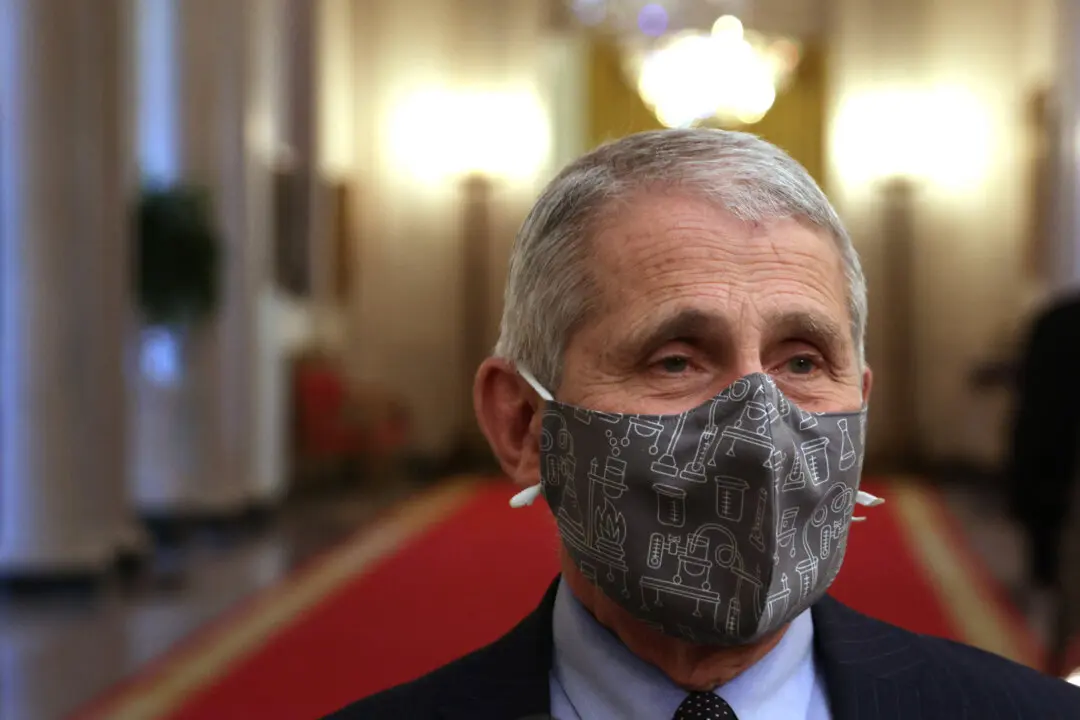
Here is the text of the announcement: “Nearly half of those surveyed last month indicate they think the science on vaccines remains up for debate and that it’s damaging to require people to receive them, rather than that the science is clear and challenging it is dangerous.”
I’ve come to make a habit of looking carefully at the questions in the poll rather than just examining the headline summary of the results. I then test these questions against a commonsense understanding of language and its implication. Looking carefully at the poll in question, one thing jumped out. It was clearly constructed to show results that are the opposite of those it produced. That’s probably why it made big news.
The headline answer is generated from the following question, which I had to dig to find: “Which of the following comes closest to your view? 1) The science on vaccines is clear and it is damaging to question it [or] 2) The facts on vaccines are still up for debate and it is damaging to enforce their uptake.”
Look at this language: “enforce their uptake.” Have you heard anyone speak that way? I cannot remember hearing such a phrase. It’s strange English. If you were speaking plainly, you would say, “damaging to force people to get them.”

Why didn’t the poll say that? Because it was gamed to get people to answer the first choice. Even then, it did not work. A shocking 46 percent made the second choice, while only 39 percent made choice one. That’s why the pollsters were so stunned. It did not turn out the way it was supposed to turn out.
Let’s look at other questions in the poll: “What expresses your view? 1) Parents should be the ones to decide whether to vaccinate their children [or] 2) Parents should be required to vaccinate their kids against dangerous diseases to protect them and their community.”
In this one, 38 percent chose the first answer while 51 percent chose the second answer. The trouble is that the two answers are not parallel. The first statement is fine but the second one adds wholly unnecessary verbiage. For example, it adds “dangerous diseases” and “protect them and their community.” But additions sound like qualifiers. Who doesn’t want to protect himself and his communities against dangerous diseases? Under these conditions, it’s amazing that anyone would choose the first one over the second one.
Are you getting the hang of this? I ask because all of this gamification is new to me. I did not know just how mischievous these polls could be until the responsibility fell to me to construct one. Then I realized how just one extra word in there can skew the results. Now I see this kind of skewing everywhere I look. I’m just trying to guide you through how it is done.
Let’s look at another question: “Which of the following comes closest to your view? 1) Americans have a duty to be vaccinated to protect other Americans [or] 2) Americans are responsible only for themselves, and have no duty to be vaccinated to protect others.”
The results were 52 percent for No. 1 and 35 percent for No. 2. But, honestly, look at this language! Do you have a duty to protect people or are you only out for yourself? Plus, your decision to be out for yourself fails to “protect others.”
None of the implied claims are empirically correct for most shots on the market. For those that are nonsterilizing and don’t stop transmission—that’s really all but two—they are not protective of others. So it’s not even good science here.
Truly, what the heck kind of poll is this? I will tell you: It’s a poll constructed to support the vaccination industry and those who live off it.
A lot of thought goes into constructing polls this way. It could easily have been a balanced poll with nonincendiary language. That’s what you would do if you really wanted to find out what the public thinks. Too often, that is not the reason polls are undertaken. Rather, the purpose is to mold public opinion by making outlying views feel embarrassing or marginal. This is a very powerful tool in a democratic system, which is why polls are so popular.
On the matter of vaccines in particular, it should be obvious what the underlying issue here is. During the COVID-19 pandemic period, an immense and globalized campaign took place to lock down the world economy on the promise of a mass inoculation. People were forced to get these shots. It happened the world over.
Then it turned out—which even I anticipated—that the shot did not stop infection or transmission. How could it be otherwise with a fast-mutating respiratory virus with a zoonotic reservoir? Anyone with a middle-school education in virology would have known that. What I had not anticipated was just how dangerous it would be for people’s health and life. That’s the shocking part.
Are we really going to pretend to be alarmed and amazed that every day people are suddenly questioning the entire vaccine regime? It’s absurd. People are blaming Health Secretary Robert F. Kennedy Jr., but this would have happened with or without his leadership on this issue. It was already headed in that direction in any case. It’s actually mind-boggling how an entire industry would have banked its 200-year reputation on a product that simply could not work and then had a known safety profile that would not otherwise have met regulatory approval.
Of course, there is growing vaccine skepticism. It is very intense right now, more so probably than in at least a century. No poll, no matter how gamed it might be to show otherwise, can cover up that fact.