It’s time to reveal the annual ranking of Orange County’s 34 cities in Southern California for the year ending June 30, 2025. More than two-thirds of the cities, 24, were able to have their auditors complete their field work before the end of 2025.
“Our industry-leading financial management practices are a justifiable source of community pride. Cypress is the only city to be recognized twice by former State Senator (and Certified Public Accountant) John Moorlach for having the strongest unrestricted net (fiscal) position of Orange County’s 34 cities.”
Since cities are watching, how are they ranked? The ACFR provides the unrestricted net position (UNP) for governmental activities in the basic financial statements. Divide this number by the city’s population and one comes up with a per capita. In the chart below, the cities are ranked in order of their per capitas and compared to their positions in the prior year.

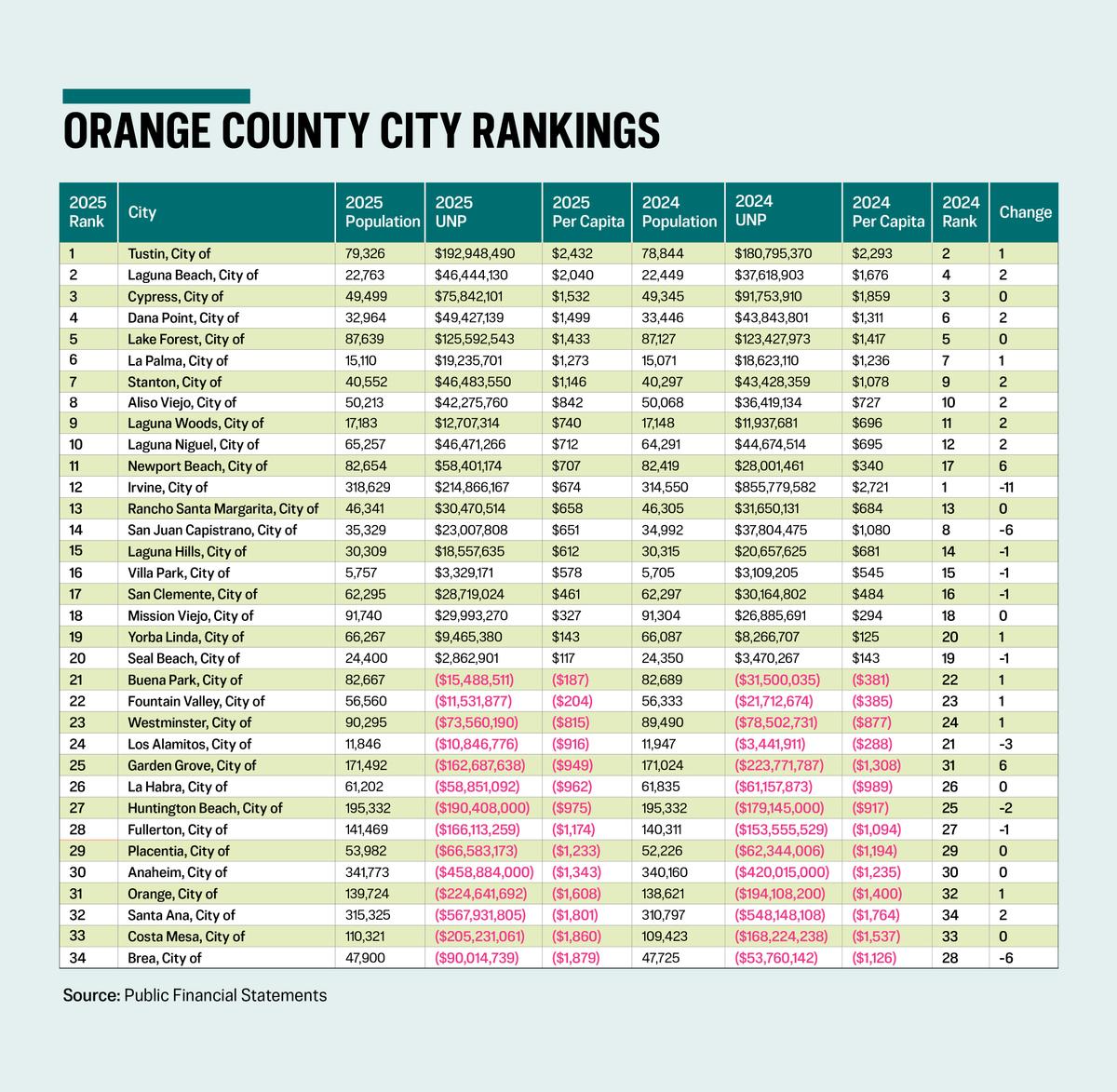
While 28 of the county’s 34 cities stayed pretty much in place, six cities have stories to tell, as two rose six positions and four dropped three or more places. But the big story is that one city increased its capital assets, land and construction in progress, by nearly a half-billion dollars.
Yes, it has a beautiful coastal location. And yes, it is a tourist destination. But it’s also a full-service city with fiscal priorities consistently followed by subsequent city councils that have been moving it up the ranks. It’s now in 11th place, moving up six places.
Not bad for a city that was in 32nd place in 2017.
An investment made in the previous year was erroneously classified as an expense. The city appropriated $6,444,635 to its net investment in capital assets and transferred $394,202 into restricted assets. The net result was an increase to its unrestricted net deficit of $7,404,865, causing it to drop three places.
The big story is Irvine. It made a massive capital asset acquisition, with land and construction alone of $455 million. That’s one-half billion dollars. With all of the other capital asset activities, its net investment in capital assets increased by $391 million. Its expenditures exceeded revenues by $21 million. And it transferred $229 million into restricted assets. Combined, it reduced the unrestricted net position by a whopping $641 million. This dramatic drop represented 91 percent of the net combined drop of all the Orange County cities combined.
Communicating with Dahle Bulason, Irvine’s director of administrative services, was a pleasant experience. The City Council recently approved the city’s ACFR, so I asked about the delay in doing so.
“The ACFR opinion was issued on February 26; however, our typical practice is to present all four audit reports together as a receive-and-file package. As a result, we generally wait until the ACFR, Single Audit, Great Park audit, and South Coast Air Quality Management District (AQMD) audit are all complete before scheduling the item for Finance Commission and City Council consideration,” Bulason said.
I would recommend posting the ACFR as soon as possible, as inquiring minds want to know what is going on. Especially when acquisitions of nearly one-half billion dollars are being made and there is concern about a $6 million budget deficit.
If you reside in Orange County and need information about your city’s ACFR, staff should be available to assist with your inquiries. It’s difficult to tell all of the stories in detail. For example, the massive amount of dollars being moved around in the city of Irvine should provide its residents with plenty of questions to ask, as getting deeper into the weeds would make this analysis very lengthy.
One word to the wise: If your city is near the bottom of the rankings, do not be surprised if your city council engages in discussions that tax increase measures be placed on your November general election ballot. That’s why the rankings are a helpful tool in keeping your elected officials transparent and accountable.