In the first and second quarters of 2022—a time of intense political struggle of grave consequence—the Commerce Department reported successive declines in the gross domestic product: negative 1.6 percent and negative 0.9 percent. Normally that would be called a recession.
It was labeled a “ghost recession,” however, since the jobs numbers appeared strong. In a normal recession, we see evidence in unemployment, but not this time. The people who date the business cycle decided not to call it. After all, the jobs data looked good.
This, of course, affected midterm elections.
But then a strange thing happened. The Bureau of Labor Statistics (BLS) revised its numbers. The preliminary benchmark revision for 2022 was released in August 2023. It adjusted total nonfarm employment for March 2022 downward by 306,000 jobs. For the second quarter, the final benchmark revision reduced job gains by approximately 150,000, with downward adjustments for April (to 294,000 from 368,000) and May (to 338,000 from 390,000).
In other words, what looked like strength was not actually impressive at all. The jobs gains were also a ghost that vanished upon further examination.


This just kept happening for four years from 2021 through 2024. Typically, in the past, revisions would pertain to tens of thousands of jobs. It is more typical now to affect hundreds of thousands of jobs. Revisions used to be 0.2 percent, but now they can be 0.5 percent or higher. Then you have the huge divergence between the household and establishment surveys, with one going up and one going down.
Let’s grant that there are huge problems in the BLS and have been since the lockdowns of 2020. Times were so chaotic that it was hard to get accurate numbers for anything. Millions left employment or worked from home, and businesses were closed and opened and closed again. After that, many businesses simply stopped participating in the surveys.
These have been maddening years for those who were watching carefully. Between the wild revisions, the divergent numbers, the flood of undocumented workers, and nonstop statistical anomalies, I and others wrote many dozens of articles. At some point in 2024, I threw up my hands and declared all the numbers to be useless. They have the appearance of science without the reality.
The problem with such chaos is that they tempt malefactors. It has been impossible not to notice the political drive in reporting. It was obvious even from the press releases that were strangely rosy from 2021 to 2024 while suppressing the bad news that was obvious even from the data alone. It became very obvious to me that the agency was operating as a political actor.
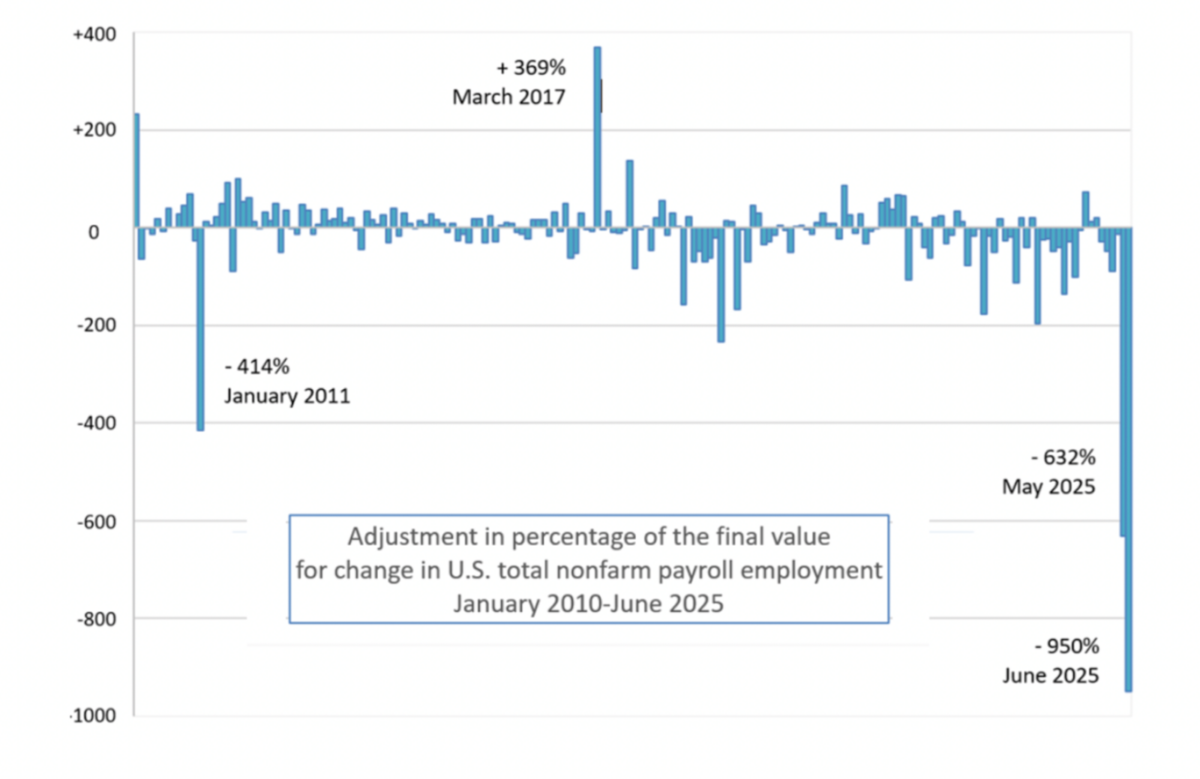
Let’s talk about 2025. The BLS suddenly and shockingly revised the jobs numbers dramatically down. Economist Genevieve Briand has looked at what they have done:
“May and June 2025 employment increases have been adjusted down from 139,000 to 19,000 for May 2025 and from 147,000 to 14,000 for June 2025. While it is usual for employment numbers to be adjusted—adjustments representing 632 percent and 950 percent of their final values, are not.”
Indeed these are the largest downward adjustments in 45 years!
In light of the latest report, which stunned observers for showing lackluster job growth, Donald Trump had finally had enough. He immediately fired department head Erika McEntarfer, a Biden appointee who was confirmed in 2024.
The whole of the mainstream media went full-on high dudgeon, warning that this was authoritarian and Soviet-like. The president got numbers he didn’t like and so fired the agency head as a warning to others.
Commentators pointed out that McEntarfer was not personally responsible. She oversees teams of hundreds of economists who use complicated methodologies. She is not dictating the numbers herself, so it seems unfair that she would be summarily terminated.
In real life, however, this is how things work. When a company’s stock prices sag and sag, the CEO is fired, even if he did not cause it. Part of being in a leadership position—actually, this is most of the job—is bearing responsibility for outcomes. Such jobs come with high pay and prestige, but there is a downside. Your head is on a platter when things go wrong.
For this reason, I am willing to defend Trump on this point completely. The critics are missing the context of the previous four years of crazy numbers, revisions, and rosy press releases. Any objective observer could see—or at least be suspicious—that the reporting was being influenced by political considerations.
In fact, no one knows for sure how it came to be that the BLS has been such a mess for so long. Maybe it is just data irregularities, bad reporting, dated methodology, inaccuracies inherent in such data collection, and so on. Or perhaps there is some really bad stuff going on over there.
“It’s been a tough adjustment for all of us to realize that government economic data can no longer be trusted. It’s one thing to have a different methodology or counting errors along the way. That’s understandable. This is different. This is manipulating the numbers solely to produce political spin. ... The American jobs machine is being systematically dismantled month by month and yet, the mainstream corporate media sells it to the American public as a glorious triumph of the Biden administration. Truly, I never thought I would live in such times.”
I quote this to prove that the depredations of the BLS have been well known for years. There is nothing at all shocking about the firing of the political appointee who heads the agency. Something needed to be done to fix the problem. That problem is politics, which has seemingly been a leading driver of this agency for some years.
No, I cannot prove that the agency has been deliberately manipulating the data for years to assist in creating perceptions that affect political outcomes. I have no smoking gun. But there sure is a tremendous amount of smoke. It is wholly within Trump’s rights as president to choose his own agency heads. He picked a great time to do it.
There are plenty of problems aside from politics. The methods by which they collect data need to be updated. Press releases need to report good and bad data. We need more transparency. In general, accuracy needs to be the main concern. Perhaps firing the agency head will get the message across.