The latest Pew Research Center survey should disturb Americans. Across much of the world, favorable views of China have increased, while those of the United States have declined. In 25 of the 36 countries surveyed, China now receives a more favorable rating than the United States.
Beijing will undoubtedly welcome those numbers. They fit comfortably within the narrative the Chinese Communist Party (CCP) has spent years constructing: The United States is a declining power, the Western order is exhausted, and China represents the future. Russia, Iran, North Korea, and other enemies of the United States have their own reasons for encouraging variations of the same story.
Americans should take the survey seriously. We should not, however, accept our adversaries’ interpretation of it.
There is an enormous difference between declining international approval of the United States and a global embrace of China’s totalitarian system. There is an equally important difference between popularity and legitimacy, between temporary opinion and enduring national power.
The Pew findings should, therefore, neither lead to denial nor to national self-flagellation. They should force Americans to ask a harder question: Why is a constitutional republic founded upon liberty increasingly losing the contest for international opinion to a totalitarian state governed by the CCP?


The answer begins at home.
American power has never rested solely on military superiority or economic wealth. From the beginning, there was an idea attached to the American experiment.
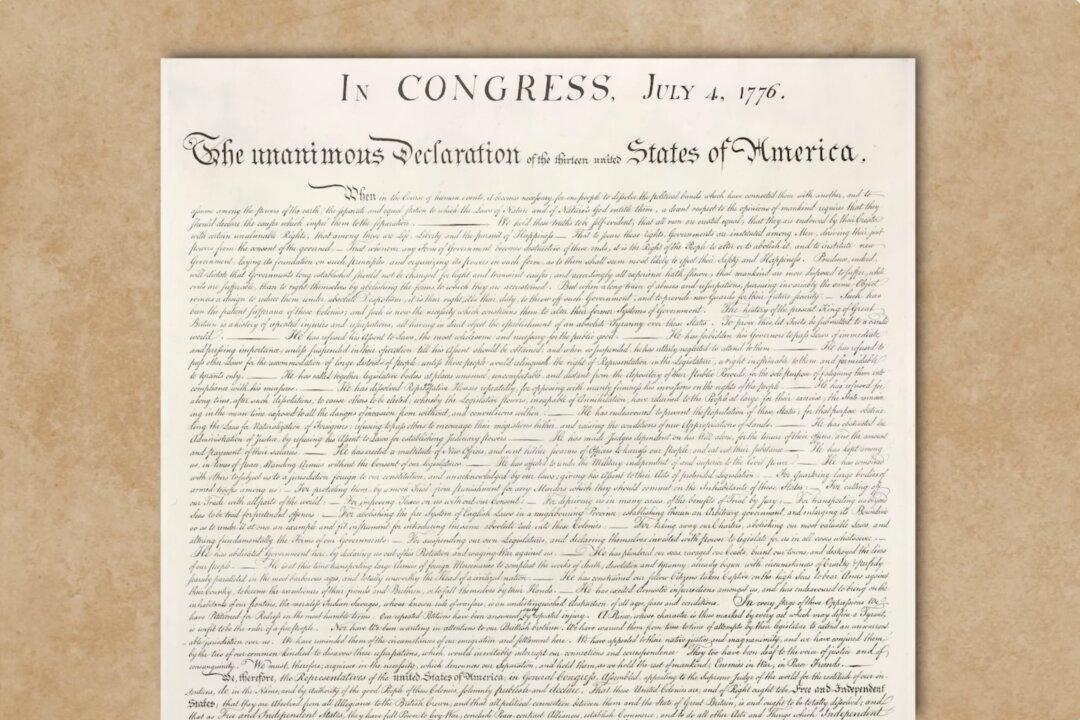
The Declaration of Independence asserted truths about human nature, natural rights, legitimate government, and the source of political authority.
The Constitution attempted to translate those principles into an enduring political order.
These principles themselves provided both the standard for judging any failures and the means for correcting them.
That distinction matters when comparing the United States and China. America’s failures occur in tension with its founding principles. China’s repression stems from the Communist Party’s supremacy over the individual and society. These are not morally equivalent political orders.
Yet international politics is not a seminar on political philosophy. Nations must demonstrate through conduct that their principles mean something.
Here, the United States has reason to be concerned. Allies and partners watch American elections, diplomatic commitments, military decisions, economic policies, and domestic turmoil. They judge whether American commitments will survive the next election and whether American power will remain sufficiently strong to protect the international order Washington helped create. American credibility cannot survive indefinitely on memories of 1945 or 1989.
The CCP understands this vulnerability.
Its objective does not require convincing the world that communist China is virtuous. It merely needs enough people to conclude that the United States is no better—or that whatever moral differences exist no longer matter.
That is a far more attainable strategic objective.
It also brings us to something largely missing from simplistic interpretations of international polling: Global opinion is now formed inside an information battlespace.
China, Russia, Iran, and North Korea do not represent identical regimes, and they should not be intellectually collapsed into a single category. China and North Korea remain totalitarian states whose governing ideologies subordinate inherited institutions and individual liberty to the state or Party-State. Russia is better understood as authoritarian, drawing upon nationalism, historical memory, traditional institutions, and increasingly religion in service of regime power. Iran combines authoritarian rule with its own revolutionary theocratic system.
Their methods and objectives differ. Their interest in weakening confidence in the United States does not.
Russia has spent years exploiting political and social divisions inside Western societies.
The Chinese regime has developed an increasingly sophisticated system of overt and covert influence designed both to improve perceptions of China and to weaken unfavorable narratives.
Iran has conducted influence operations of its own.
North Korea’s capabilities are most evident in cyber operations, although it remains part of the larger struggle against the Western order.

Artificial intelligence (AI) potentially transforms that struggle.
Propaganda once required newspapers, radio transmitters, printing presses, television stations, and armies of human operatives. The digital revolution lowered those barriers. Generative AI lowers them further. Synthetic personas can produce material continuously. Bots can amplify it. False accounts can create the appearance of consensus. AI-generated images, video, comments, articles, and translations can be produced on a scale impossible only a few years ago.
The goal need not even be persuasion in the traditional sense.
Confusion and cynicism can be enough.
Creating the impression that everyone lies, every institution is corrupt, and every political system is morally equivalent can itself constitute strategic success for a dictatorship confronting a constitutional republic.
This does not mean Chinese bots produced the Pew numbers. There is no evidence sufficient to make such a claim, and doing so would allow Americans to dismiss a genuine warning by blaming foreigners for uncomfortable information.
American policies, American political behavior, diplomatic choices, economic relationships, and China’s own growing economic importance all contribute to changing international attitudes.
But neither should we pretend that those attitudes develop in some pristine marketplace of ideas untouched by foreign manipulation. The information environment itself has become contested terrain.
There is another danger. Americans have become increasingly preoccupied with China, and with good reason. The People’s Republic of China represents the most comprehensive long-term challenge to American power.
Nor do China, Russia, Iran, and North Korea operate in isolation from one another. Their interests are not identical, and their regimes are not interchangeable. Nevertheless, they increasingly benefit from weakening an American-led international order that constrains each of them.
The United States, therefore, confronts something larger than a public-relations problem.
It faces a contest over legitimacy.

The answer cannot be American propaganda designed to imitate Beijing or Moscow. Nor should Washington attempt to purchase popularity by abandoning American interests whenever foreign publics disapprove of them.
Great powers sometimes must make unpopular decisions. Statesmanship is not an international popularity contest.
The answer begins by recovering the sources of American strength.
America must remain militarily powerful enough that allies can depend upon it and adversaries fear the consequences of challenging it.
Its diplomacy must become more reliable and historically informed.
Its alliances must be treated as strategic assets rather than temporary conveniences.
Its intelligence and national-security institutions must recognize information warfare as an integral component of grand strategy.
The United States must expose foreign manipulation aggressively while resisting the temptation to label legitimate criticism as foreign propaganda.
Above all, Americans must remember what distinguishes their civilization from the systems challenging it.
The United States cannot defeat totalitarian China by becoming more like China.
It cannot defeat Russian authoritarianism by abandoning its own constitutional restraints.
It cannot answer the Iranian revolutionary ideology by losing confidence in its own principles.
And it cannot defend the American Republic abroad if Americans cease believing that the Republic is worth defending.
The Pew survey is, therefore, a warning, but perhaps not the warning contained in the headline.
China’s improving international image does not demonstrate that history has vindicated totalitarianism. It demonstrates that China has become more capable, more economically consequential, and more effective at presenting itself as an alternative. At the same time, the United States has allowed doubts about American leadership to grow.
In 1838, Abraham Lincoln stated, “At what point then is the approach of danger to be expected? I answer, if it ever reach us, it must spring up amongst us. It cannot come from abroad. If destruction be our lot, we must ourselves be its author and finisher. As a nation of freemen, we must live through all time, or die by suicide.”
There is no reason to minimize that development.
There is equally no reason to concede the field.
The contest between the United States and China is ultimately about more than aircraft carriers, semiconductors, AI, trade routes, or even space power. Behind those instruments stands a much older question: What kind of political order best protects the human person while preserving the strength necessary to defend civilization?
America already possesses an answer.
Its greatest danger may be forgetting it.