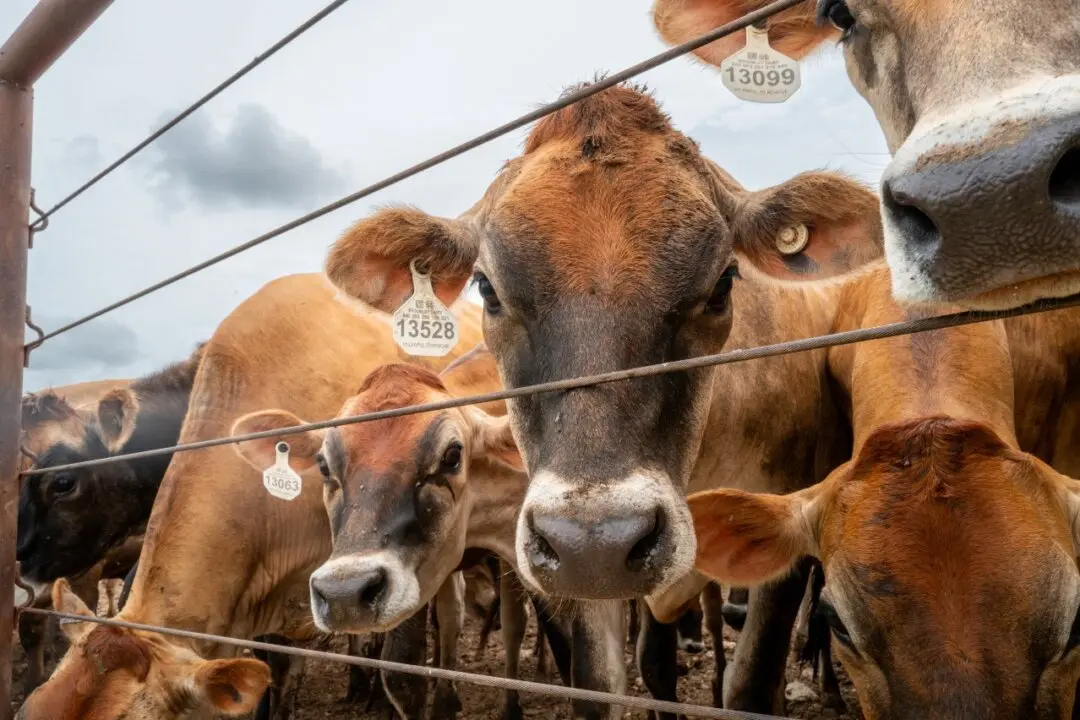
Recently, Joel Hollingsworth, a young rancher who scaled one of the largest ultra-high-density grazing operations in the country, wrote an open letter to the federal government and those implementing the Make America Healthy Again agenda. Starting with nothing—no money, no agricultural background, and no cows—he worked his way to having more than 500 head in less than five years, securing 700 acres of owned land and 120 acres of leased land and even rescuing herds that had lost their leases along the way. He did all this while practicing true regenerative management.
What struck me most about his words wasn’t just his success but his honesty about the pain points. He laid bare what so many of us know but rarely hear acknowledged outside of farming circles: The system is broken and farmers are being asked to do the impossible.
Hollingsworth began with a presupposition: “Regenerative agriculture is MUCH more profitable than commodity agriculture IF we measure value in all forms (not just financial cash flow extraction but even there it is better) over long enough time horizons and at a competitive scale.”
That is the truth many of us live by. And yet, despite it, farmers practicing regeneration are burning out and giving up. As Hollingsworth put it, regenerative agriculture has become “a churn factory of excited young people in the front door and broken dreams out the back.” The reason is not that regeneration fails; it’s that the system we’re working within is hostile to those trying to repair it.
In his letter, Hollingsworth laid out the barriers with unflinching clarity. Paraphrased in my own words, they include:
Farmland is being priced as a financial asset rather than valued for its productive capacity, with inflation, subsidies, and foreign investments pushing it beyond reach for young farmers.
Our processing and distribution systems are built for commodity, not for context-specific, locally adapted regenerative products.
Credit and debt programs meant to support farmers have drifted from their original purpose, leaving new farmers without the means to start at a viable scale.
Certification schemes and loopholes in country-of-origin labeling erode consumer trust.
Industrial agriculture continues to offload its costs onto the environment and public health, while regenerative farmers internalize those costs.
Universities and granting agencies have been captured by corporate interests, leaving regenerative producers to fund their own innovation.
Each one of these isn’t just a hurdle; it’s a structural mismatch between the future we need and the system we have.
Hollingsworth put it bluntly: “Regenerative farms are being asked to repair land and ecosystems that were given to them broken, with no capital access, with no market access, to solve longtime horizon problems without going bankrupt as they try to compete in the immediate while carrying all the weight of that.
“This is a zero-to-one type problem that incremental assistance doesn’t fix. The subsidies proposed in this agenda would be a rounding error in my operation and would have done basically nothing for getting me off the ground and scaled the last five years.”
That line cut deep for me, because I know it to be true. Incrementalism is not enough when what’s required is transformation.
Hollingsworth admitted that he doesn’t know if national-level change is even possible, given the debt spiral, inflation, and corporate capture. But he insisted that honest dialogue is still our best shot.
“Having honest dialogue about it is the best shot we’ve got as leadership means providing both the vision and the will for the world as we want it to be,” he wrote.
That honesty is what makes his letter so important.
Like many farmers, I am struggling financially while trying to do the right thing. Every day, I push up against broken systems and bureaucracy, and I can’t seem to get people to care enough to spend their dollars locally. We are living through a full-blown agrarian collapse: one in 15 farms lost over just the past eight years. The action that’s needed is not incremental. It is not something the government alone can fix. It requires radical change on multiple levels: a reckoning, a realization of what’s truly important.
And here is where I want to be very clear: Farmers cannot carry this burden alone. Each of you has to do your part. If the system is not set up to bring our food to you, then you must go to us. The customer is the missing link. The system will bend to your needs and your desires, but only if you show it how. Every one of you is the customer. Every one of you is the consumer. And the only way this system changes is if you spend every dollar you can on what I call the small farm diet. The local farm diet. That is the only diet that matters right now.
But there’s another truth we must face: We also have to stop asking the government’s permission to contract with each other over food. Rolling back bureaucracy is the only way forward. I believe that the government should spend far more time rolling back so-called safety regulations that make it nearly impossible for small farms and processors to operate and far less time inventing new ways to print money and expand subsidies.
Every time a farmer is forced to spend hundreds of thousands of dollars on compliance designed for mega-processors, the community loses access to local food. Every time consumers are told that they can’t buy food directly from the person who grew it, the bond of trust between land and table is broken. If we want resilience, we must restore that freedom.
Hollingsworth is right: The system is broken. Farmers cannot carry this alone, nor should we have to. If we value food, health, and land, then we must value the people who steward them. It is my privilege to stand alongside him in saying so.
You can read the open letter at www.SmokeRiverRanch.com.