Russian planes recently flew into Polish and Romanian airspace to test NATO’s resolve, while the world veers toward a conflict in Asia—one that could be far worse than the situation in Ukraine—in which true deterrence and resolve remain largely absent.
However, what is often overlooked in the discussion about the event is that it represents the financing and support mechanisms behind a new type of quasi-world war. The ongoing Russia–Ukraine war is one example, and the potential invasion of Taiwan by the Chinese regime is another. Let’s explore this further.
The Xinhua images of the Sept. 3 event, featuring Chinese leader Xi Jinping, Russian President Vladimir Putin, and North Korean leader Kim Jong Un consorting in solidarity, should be interpreted as a calculated response to the new tripartite model that the West has devised for militarily supporting Ukraine. That model conveys that Kyiv identifies its military hardware needs, European allies provide the financing, and the United States produces and delivers the hardware.
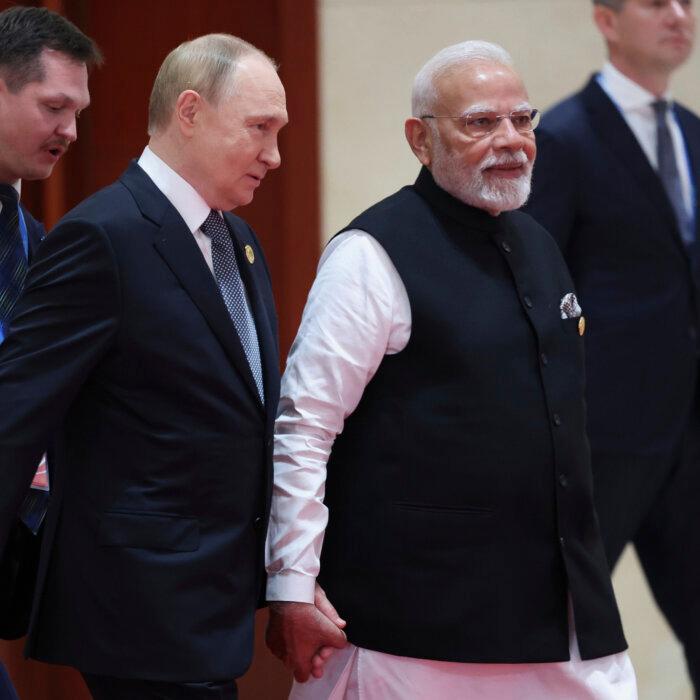
The Beijing event showcased a parallel model: Moscow requests war materiel, including troops, China and North Korea supply them in exchange for cheap Russian energy, with India and a few other countries dipping in. Thus, even though the war’s actual fighting is confined within Ukraine and Russia, its financing involves a much wider array of adversarial states. The coalitional symmetry in this financing mechanism can prolong the bloody conflict indefinitely, which Russia and Ukraine, if left to their own devices, cannot achieve.

But whatever happens regarding the war in Ukraine, the world would not be okay even when Putin agreed to call it quits, because Xi has all the intentions to do a sequel. Xi’s primary interest in supporting Russia lies in an expected reciprocation from Moscow if China invades Taiwan. What would a China–Taiwan war look like?
The Russia–Ukraine war is already a quasi-world war. Despite the combat space being narrowly confined, it nevertheless involves the participation of approximately 50 countries on four continents in various capacities.
An estimate of the total economic cost of the now three-year-old Russia–Ukraine war is about 3.5 percent of global gross domestic product, or approximately $3.5 trillion. On the other hand, the global cost of a full-blown China–Taiwan war could easily be more than three times as large, reaching a staggering $10 trillion, according to Bloomberg Economics.
The United States, in contrast to its current peacemaking role and indirect involvement in the Ukraine war, would have no choice but to take center stage in combat. Japan would also be compelled into an important role because of geographic proximity and treaty obligations. The conflict would come closer to an actual world war.
Trump needs to strengthen Europe by encouraging it to reduce its extensive welfare state and allocate more resources to its defense. The same applies to Japan, South Korea, Taiwan, and Australia, as they need to be aligned firmly along the first island chain. However, behind these two geopolitical pieces must be a thoroughly revitalized United States, which, unfortunately, has seen its strength sapped by decades of socio-economic decay. Trump is achieving this through a thorough revamping of U.S. institutions and policies regarding culture, education, industry, trade, and defense—the essence of the Make America Great Again movement.
Like a severely wounded beast whose blood flows to the core of its body to preserve its dwindling life force, the United States, as it restores itself, may seem isolationist to countries long accustomed to enjoying the economic openness and defense umbrella provided by Pax Americana. That is a dangerous misreading of Trump by many countries, friends and foes alike.