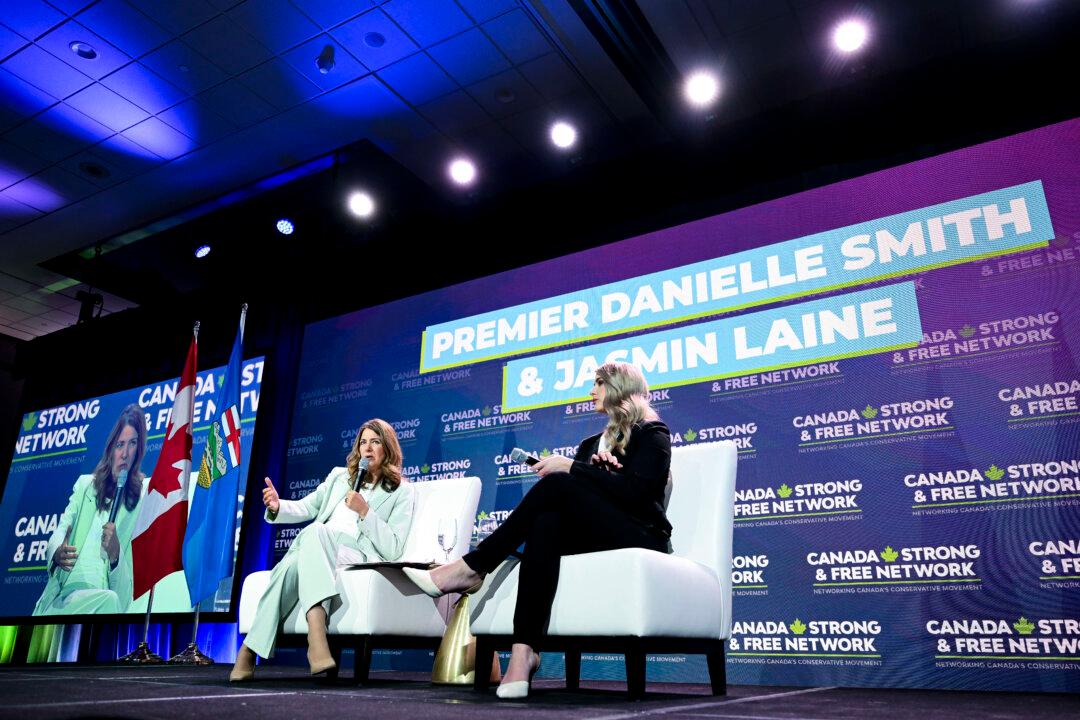
Alberta Premier Danielle Smith’s artful dodge of the latest litigious mischief of the militant indigenous is a welcome move onto the fast track of the devolution of the Canadian Constitution. On May 13, we had the absurd national embarrassment of the indigenous people in Alberta, representing approximately 3.5 percent of the province’s population, gaining a preliminary court judgment that Alberta did not have the right to hold a referendum on the issue of seeking independence from Canada without prior discussion with appropriate First Nations representatives.
At the same time, other indigenous elements have challenged the right of the federal, Alberta, and British Columbia governments to build a pipeline to the Pacific for the exportation of Alberta oil and gas.
Alberta’s potential interest in secession from Canada is tied to its inability to gain approval for pipelines that would permit it to exploit the revenue it could gain from the increased exportation of its oil and gas to the many markets in the world clamouring for them. One group of First Nations is holding up construction of a pipeline that has been approved in principle by the relevant governments and that if constructed would materially reduce and perhaps eliminate the possibility of a vote by Albertans to secede from Canada. This is where the last decade of irrational preoccupation over climate change has led us.
Premier Smith has sidestepped the impact of this obstructive abuse of lower court meddling power by promising a differently phrased referendum question on whether Alberta wishes to remain in Canada. For technical reasons, this appears to be far more resistant to these endless legal challenges that the resourceful litigators of the indigenous activists constantly initiate to extract ever greater concessions from Canada. Our federal policymakers have been self-hobbled by pre-emptive concessions regarding past magnified wrongdoing from which the indigenous have suffered at the hands of the settlers from Europe and other continents who followed the indigenous peoples to Canada. (The First Nations were immigrants also.)
Assuming that the revised Alberta referendum proposal is held later this year, the entire question of the integrality of this country could become an immense controversy very quickly. The basic Alberta position is that the province has done more than its share of contributing equalization payments for the benefit of provinces that had a per capita income below the national average. This was a formula for wealth redistribution that was adopted by the federal government in 1955. It came after Quebec’s long-serving Premier Maurice Duplessis announced that he would exercise the constitutional right of provinces to collect a provincial income tax, and that if the federal government did not allow for the deduction of that tax on the federal tax returns of Quebecers, he would call an election on the issue.
The federal government of the distinguished Liberal Prime Minister Louis St. Laurent retreated and produced equalization payments as something of a consolation prize for the federal government. This was a generally accepted pursuit of equal services and infrastructure for all regions. But as nationalism continued to rise in French Quebec, these payments were amplified by the governments of Pierre Trudeau and Brian Mulroney to emphasize the irreplaceable generosity of federalism for Quebec voters.
There is no doubt that equalization payments did assist in producing a negative vote on the Quebec referendums of 1980 and 1995. These sought the authorization of Quebec voters for the provincial government to attempt to negotiate a form of sovereignty for Quebec while retaining a substantial association with Canada. They were essentially trick questions along the lines of eating the cake while still retaining it.
The current controversy in Alberta is a much more direct threat to Canadian federalism than the Quebec referendums were. With Quebec, it was always implicitly understood that an argument could be made for the 80 percent French-speaking province to set up an essentially French-speaking country that, with extensive natural resources and an educated population of over 8 million, would clearly be a more viable country than scores of the world’s 201 existing nationalities. The argument for the French Quebecers to have their own country could always be advanced competitively with the alternative argument for Canada—a much larger country already well-established as a G7 nation—in which two of the world’s most distinguished cultures would cooperate in its governance in a state of official equality.
Alberta and Quebec are easily distinguished. Alberta is not offering its voters a trick question, and Albertans know that if they seceded, their province would be a wealthy petrostate that could dispense with income taxes and revel in one of the world’s highest standards of living. Quebec must choose between a bi-cultural country where the French Quebecers have exercised more than their demographic influence in a federation that has worked well for them financially. Alberta can choose between continued membership in an English-speaking country with which it has more than a century of shared tradition, and a new country with a suddenly vastly higher per capita standard of living.
And there is a wild card. In the current state of Canada–U.S. relations, no Canadian should doubt that if a preliminary referendum indicated that Alberta was seriously contemplating independence, the Trump administration would be happy to assure Albertans that if they opted for independence, the United States would relieve it of the tedious necessity of endless debate with First Nations and the burdens of Canadian equalization, and would facilitate the exportation of all the oil and gas Alberta wanted to sell through the pipeline now about to be developed to Wyoming, which could easily be extended to Pacific and Gulf Coast ports.
There is no need to take this hypothesis to excessive lengths. But if Alberta seceded, Quebec would promptly follow, and the rest of the country would be thrashing about with no backup plan and no plausible political leadership figuring out what to do next. Readers may speculate as accurately as I can on the alternatives, but for better or worse, continentalism would be at hand. This is a fact that should give pause even to Quebec nationalists, who would find the United States less congenial than Canada.
These scenarios are not far-fetched and are not a flattering reflection on the governance of this country in the last 11 years—a period during which its relative prosperity has needlessly declined and the possibilities of its fragmentation have steadily increased.