Let us venture into one of the greatest controversies of our age: how to make the best coffee. And let us do this with a partisan position in mind, that which favors the least-fashionable view of all: namely, that you should percolate, the old-fashioned way.
Please hear me out.
If you go to any major hotel with a buffet for breakfast or brunch, go to catered events, or attend a church social, your coffee comes from a large steel drum with a front spout. It’s delicious. The method is likely percolation, which is precisely how Americans made their coffee from the mid-1880s all the way through the 1970s.
With the sweep of nostalgia in the United States today—music, fashion, gaming, technology, interior design—might it be time to revisit the percolator for your own home? Despite the many decades of fashion for every other solution, I seriously doubt that there is a better method for making coffee.
You can find percolator pots at the Goodwill or thrift store or buy a new one (made just like they were in 1947) for a mere $24. It’s stainless steel with a glass top. It’s utterly beyond me why people spend $1 per K-Cup for their Keurig makers that yield a cup that everyone agrees is not up to snuff.

There are, of course, many methods of making coffee. In the 1970s, the drip pot became the first major competitor to the percolator. It then became a class marker: to have a drip maker meant that you were up with the latest thing. The American love of progress—the dubious presumption that the latest thing is the best—took care of the rest, never mind whether and to what extent it is actually better.
The drip pot gave way to a wild explosion of coffee and espresso machines. The prices are all over the place, but I’m looking at one offered by a major chain for $5,400. It truly defies belief that such a thing exists. The only possible reason surely traces to some perceived social status associated with having such a thing on your counter.
The Keurig method did sweep the industry, and I admit to getting caught up in it. Then I realized the preposterous economics of the machine. The successor Nespresso machine offered a huge improvement in quality at an even higher price. At some point, it dawned on me that the old drip maker was far superior, and it was never obvious that one was better than another. That’s where I’ve been for many years.
There are, of course, those who swear by the French press, too, although my experience suggests that this is usually a temporary enthusiasm. Eventually, the mucky color and muddy flavor get on one’s nerves. I’ve even known people who swear that instant coffee has become so good that it is better than any brewed coffee.
Then you have the lifetime experimenters who come to the conclusion that the only truly great way to make coffee is with the pour-over with a filter. It takes a tremendous amount of time and discipline to learn to get it right. It’s like a labor theory of value: the more fuss, the better the results. These same people are those who insist on grinding their own beans or, even more hardcore, roasting their own.
In all this shifting and digging around for the perfect cup of coffee, the missing percolator is a mystery to me. Consumer Reports does not even list it at all, as if the method is so disreputable as to not merit mention in any case.
Can this be right? Percolation was the main U.S. way for a century and longer until the mid-1970s. Can it really be wrong?
Percolation was a 19th-century method, but the first U.S. patent issued for the modern percolator came in 1889. It belonged to farmer and inventor Hanson Goodrich, although many people had come up with similar ideas.
As usual, it was a case of who gets to the patent office first. I’m sure Goodrich was a great guy, but many others deserve credit for this wonderful innovation.
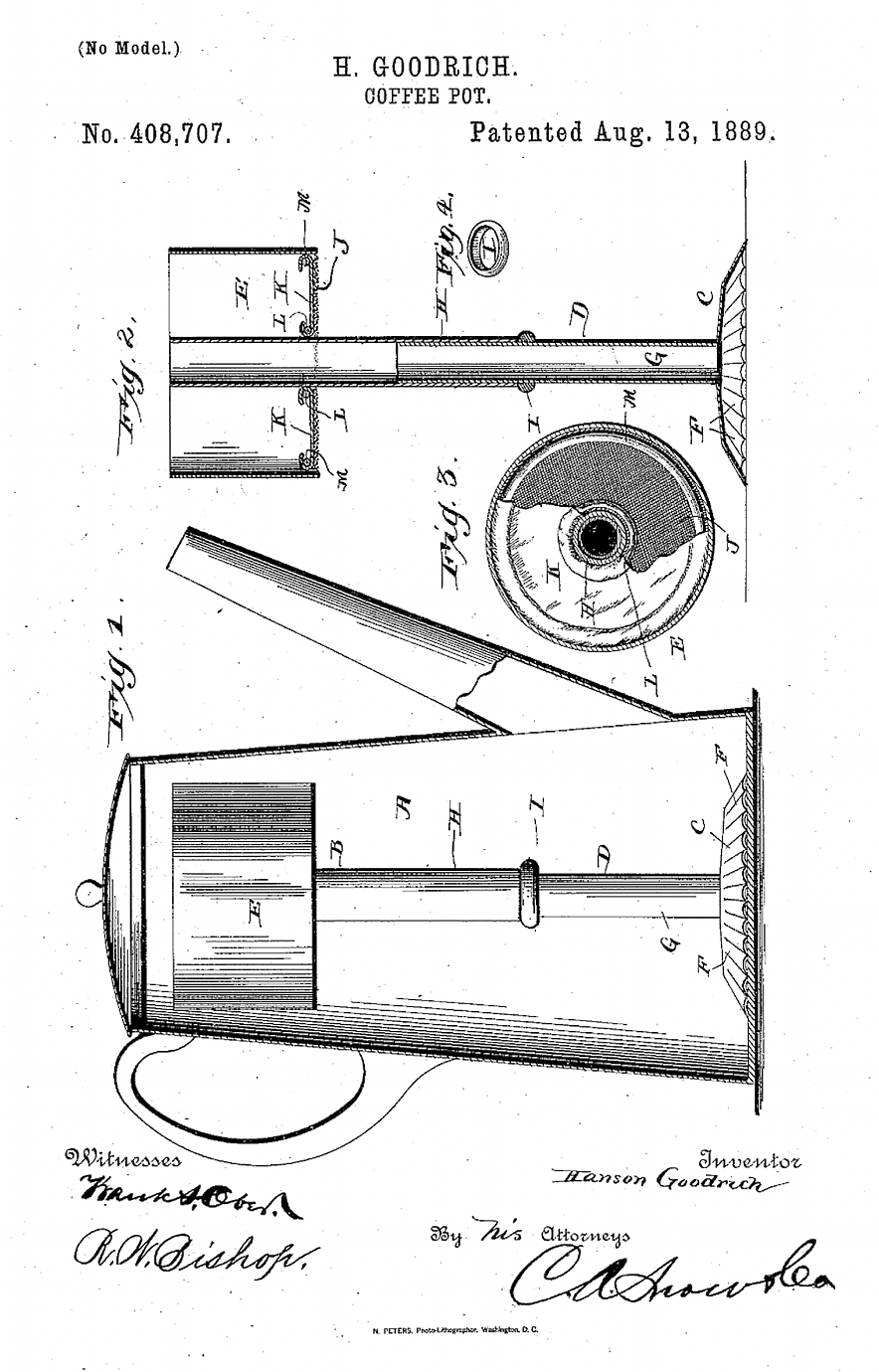
It was in force for 17 years, but there’s no evidence of any litigation over infringement. Twenty years later, by the 1910s, percolation with some version of this pot was the main method for all U.S. coffee.
Let’s talk about fundamentals here. The word itself ties together two Latin words. “Per” means through, and “colare” means to strain, so percolator literally means “through a strainer.” “Colare” is also the basis of “collate,” which is what you do when you arrange papers in the proper order.
Idea: If you are embarrassed to admit that you use one, you can pronounce it like Latin: Pear-Coe-LAH-ter. Plus, everyone will think that you are smart.
Notice how the common pronunciation is wrong. It is not Per-Cue-Later or Per-Kuh-Later but rather Per-Coe-Later and Per-Coe-Lashun. I have no idea why nearly everyone messes that up. Once you see the correct pronunciation, you will never say it incorrectly again.
Now, to the most obvious advantage of percolation over every other method. When the coffee is brewing, steam is emitted from the pouring nozzle. It picks up the scent of coffee that is getting increasingly rich. It fills your house with the smell of fresh coffee.
Don’t underestimate the power of the nose. You know how when you go into a Cinnabon store, you are suddenly dying to eat a cinnamon roll? By the time you bite it, it feels like the greatest experience of your life. That’s because your whole body has been prepared for what’s about to happen.
It’s exactly the same with coffee. It’s why coffee seems to taste so much better in a coffee shop.
So why not be overwhelmed by the smell of freshly brewed coffee in your own home? You cannot get this from drip. Keurig and Nespresso won’t do it. Neither will a French press or a pour-over.
The answer is percolation. It’s the fulfillment of your dreams.
Now, there are tricks to making it. The top of the grounds container must be tight. If it is not, the grounds will spread around. You have to get good at turning down the burner. It starts high to get to the boiling point and then goes very low to percolate.
How long should it percolate? My instructions said seven to 11 minutes. That’s a huge range and not very helpful. Realizing this, I had a sudden and overwhelming sense of something I’ve not experienced in a while from any household appliance: personal responsibility! Imagine that!
Yes, it is trial and error. I’m now three days deep, and I’ve done five minutes and eight minutes. That’s an estimate because I wasn’t really keeping track. It was great all ways, so I’m not sure where I’ll end up. Probably I’ll just wing it. The results are tremendously hotter than coffee made by any other method, so be careful.
Yes, you can get an electric percolator pot that shuts off automatically or gives you a light. But hey, if we are going analog here, let’s go all the way: The stovetop model is what fires up the historical imagination. It’s camping but right in your home.
I pitched this whole project to a friend who said he could never do this. Why?
“Humiliation,” he said.
Fleshing that out a bit, he explained that he has spent thousands of dollars on coffee makers plus subscriptions to locally roasted beans. If he discovered that he could do better with a $24 percolator, he could not live with this knowledge.
That’s precisely it. We are all guilty of the sunk cost fallacy. Overcoming it requires the humility to admit that maybe great grandma had it right all along. Maybe the whole of society took a wrong turn with the drip and everything that followed.
Maybe the new age of percolation is about to dawn. Will you join me?