Viewpoints
Opinion

City of Los Angeles Makes Big Financial Move Backwards

City of Los Angeles Makes Big Financial Move Backwards
Los Angeles City Hall in Los Angeles on Nov. 1, 2024. John Fredricks/The Epoch Times
|Updated:
0:00
Commentary
Of the 88 cities in Los Angeles County, seven made major financial moves of six or more places during the fiscal year ending June 30, 2024. Another eleven cities moved four or five positions. That leaves 70 cities—or 80 percent—pretty much staying in place.

The top 18 ranked cities found themselves maintaining their positions, as did the 15 bottom cities. Reviewing the graph below, let’s see what these seven cities did.

The first step in the process is to obtain the annual comprehensive financial reports (ACFRs) from each city. This is easier said than done. Thirty-four cities completed their audit field work before the due date of December 31, 2024. Another 33 met the secondary deadline of March 31, 2025. That leaves 22 cities delinquent in performing a simple audit function and should be an indicator that something is amiss in the finance department.

Pomona, Rolling Hills, Monrovia and Montebello completed field work in April, but Rolling Hills took forever to post their annual comprehensive financial report (ACFR) online. Palmdale, Culver City, Lancaster and Azusa completed their ACFRs in May. Commerce in June. Maywood, Palos Verdes Estates and Inglewood in July. El Monte and Glendora in August. South Pasadena in September. Redondo Beach in October. And Bradbury in November.
Perennial last place finisher, Compton, finally finished this annual requirement on Feb. 5, 2026, but did not approve the audit until April 28 and finally posted it after May 9, after my request for them to do so. The good news is that it moved up three places. The bad news is that tardiness is probably the biggest transparency issue in the nation.

The states of Florida, Texas and Utah have laws requiring penalties for lateness. California recently approved one last year with Senate Bill 595 (Choi). Let’s hope that municipalities get the hint that many of us actually read their ACFRs and review numerous components to evaluate their overall financial health.

The second step is to look at the basic financial statements and find one amount in the statement of net position labeled “Unrestricted” for “Governmental Activities.”

The third step is to divide this “unrestricted net position” (UNP) by the population of the city to arrive at a per capita.

The fourth step is to rank the per capitas and review the results. If you reside in the county seat, the city of Los Angeles, you’ll find its negative per capita increased by $579.7 million. This means that if the city wanted to liquidate, every man, woman and child residing within its borders would have to assist by chipping in $1,522 each. A family of four would have to donate $6,088. Don’t fret, there are 18 other cities with higher negative per capitas. And with Los Angeles’ mayoral candidates receiving national attention, plenty is being stated about this city’s dire fiscal situation.
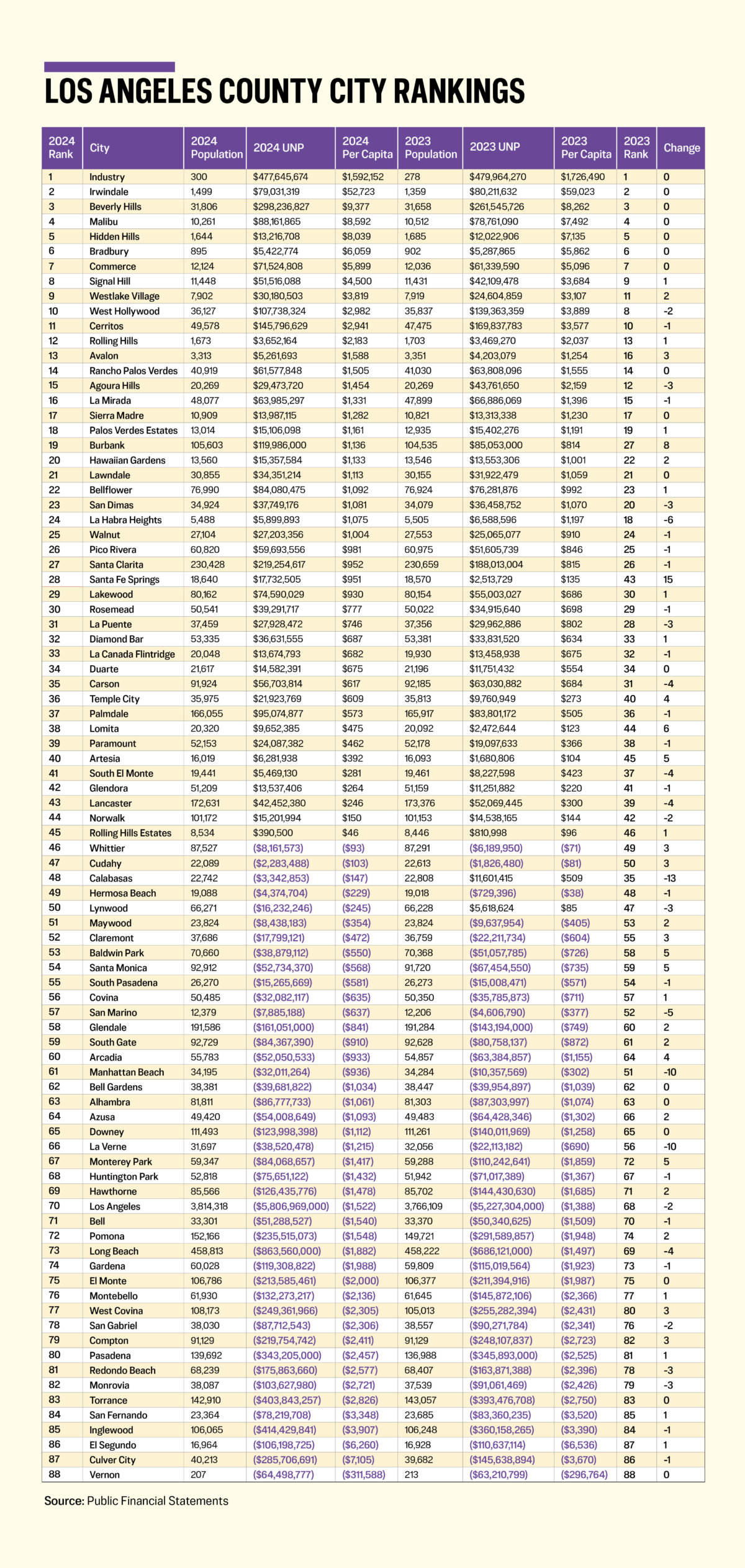
Let’s see what the big movers did during the last fiscal year. The winner is the city of Santa Fe Springs. And it has an amazing story to tell.

The famous author, Charles Dickens, wrote something obvious about finances in his novel “David Copperfield”:

“Annual income twenty pounds, annual expenditure nineteen nineteen and six, result happiness. Annual income twenty pounds, annual expenditure twenty pounds ought and six, result misery.”

Bottom line? Don’t spend during the year more than your annual income.

Once again, Santa Fe Springs had revenues in excess of expenditures, and this year it was $30.4 million. This is $8 million lower than the previous year but explains its rapid movement up the rankings. It transferred $6 million into restricted assets and allocated $9.2 million to net investment in capital assets. Combined, this caused its unrestricted net position to grow from $2.6 million to $17.8 million, moving it up 15 places.

But this city has been moving up the rankings like a proverbial rocket ship. It was in 86th place in 2019, 84th place in 2020, 83rd place in 2021, moved up to 77th place in 2022, then up to 43rd place in 2023, where we mentioned this city is now case study material. For 2024 it is now in 28th place.
What fuel is this city using? In “Amazon to Roll Out New Fleet of Electric Trucks in Southern California,” The Epoch Times reported that Amazon has its fulfillment center 25 miles northeast of the twin ports. Is this the secret sauce? The city of South El Monte, which has a similar population, had sales tax revenues of $11.2 million, while Santa Fe Springs had $40.4 million. Was Santa Fe Springs the beneficiary of the sales tax revenues of orders delivered to residents of neighboring cities? It also has two retail malls, the Santa Fe Springs Mall and the Whittier Downs Shopping Center. And, with cash on hand, it also generated $9.1 million in interest income. No wonder it jumped up 15 places.
Burbank had revenues in excess of expenditures of $62 million, transferred $15.7 million into restricted assets and appropriated $11.6 million toward its net investment in capital assets. Combined, its unrestricted net position improved by $34.9 million, moving it up eight places.

Lomita had revenues in excess of expenditures of $4.5 million and transferred $2.7 million out of its restricted assets, explaining the $7.2 million improvement in its unrestricted net position and moving it up six positions.

La Habra Heights had revenues in excess of expenditures of $2.2 million, putting nearly all of it, $1.9 million, into restricted assets. It also allocated $1 million towards its net investment in capital assets, reducing its unrestricted net position by $0.7 million, and dropping it six places.

Manhattan Beach had a prior period adjustment of $0.7 million correcting the amount of capital assets. It also had expenditures in excess of revenues of $9.2 million. It transferred $1.4 million into restricted assets and increased its net investment in capital assets by $11.8 million. The combination, $21.7 million, tripled its unrestricted net deficit, from $10.4 million to $32 million, and caused it to drop 10 positions. Add this to its 33-place drop in 2023.
La Verne had revenues in excess of expenditures of $14.4 million, transferred $31 million into restricted assets, had $0.2 in net depreciation expenses, increasing its unrestricted net deficit by $16.4 million. It also dropped 10 places. It dropped 11 places in 2023 and moved up 14 places in 2022. The roller coaster has been going since 2019, where it dropped five positions (see “Cities in Los Angeles County Finally Issue Their Financial Reports … From 2019”).
Calabasas had revenues in excess of expenditures of $7.5 million, added $6.5 million to its net investment in capital assets, and transferred $15.9 million into restricted assets. The combination reduced its unrestricted net position by $14.9 million, moving into deficit territory and dropping it 13 positions. This, after dropping seven places in the previous year after improving in 2022 (see “7 Los Angeles County Cities Made Strong Financial Improvements in Latest Rankings”).

Although the combined unrestricted net deficit of Los Angeles County’s cities increased by $716.2 million, roughly six out of every ten cities improved their fiscal standing during 2024. If your city was one of them, thank your city council and finance director for moving it in the right direction.

The June 30, 2025, ACFRs should have been available months ago. Let’s hope the city of Compton catches up and we won’t have to wait a year from now to provide the 2025 rankings.

Views expressed in this article are opinions of the author and do not necessarily reflect the views of The Epoch Times.
Google LogoMark Us Preferred on Google
John Moorlach
John Moorlach
Author
John Moorlach is the director of the California Policy Center's Center for Public Accountability. He has served as a California State Senator and Orange County Supervisor and Treasurer-Tax Collector. In 1994, he predicted the County's bankruptcy and participated in restoring and reforming the sixth most populated county in the nation.