China’s latest rocket launch should have generated headlines around the world, but it barely generated an announcement.
The new rocket launch system, launched on June 1, delivered satellites for China’s rapidly expanding Qianfan (“Thousand Sails”) satellite constellation, a network intended to compete directly with SpaceX’s Starlink system.
Filling the Reusable Rocket Gap
The Long March 12B missile represents something far more significant than just another Chinese rocket launch. It’s part of Beijing’s effort to close one of the few remaining technological gaps separating China from the United States: low-cost, reusable access to space.Curiously, the rocket itself bears a striking resemblance to SpaceX’s Falcon 9. It is a two-stage vehicle powered by nine kerosene-and-liquid-oxygen engines in the first stage and is designed for future booster recovery and reuse.
Following SpaceX’s Falcon 9
For more than a decade, SpaceX’s reusable Falcon 9 transformed the economics of spaceflight. Reusability has dramatically reduced launch costs, increased launch cadence, and enabled the deployment of thousands of Starlink satellites. Not surprisingly, Beijing was watching closely.
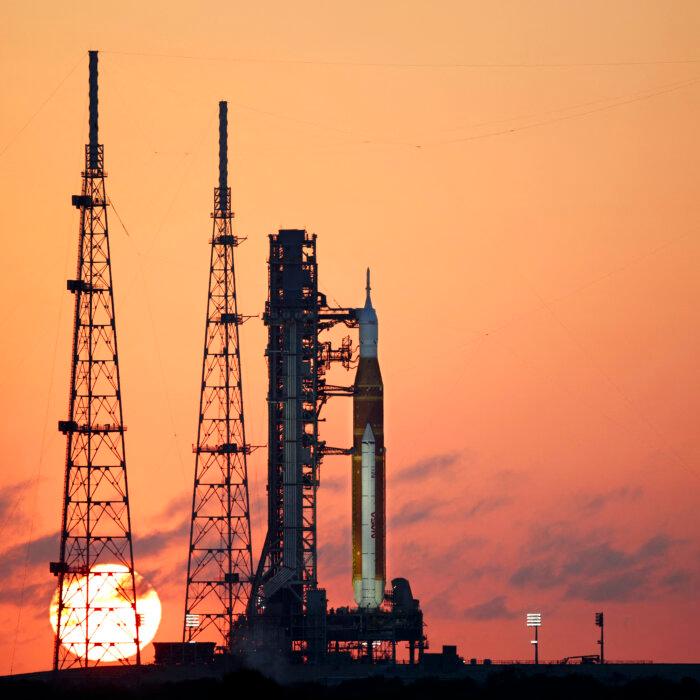
Now, China is attempting to replicate that advantage. The Long March 12B is designed to carry up to 20 metric tons into low Earth orbit and eventually to operate with reusable first-stage recovery.
The Military Impact Is Undeniable
Modern warfare increasingly depends upon satellites for communications, navigation, targeting, intelligence collection, missile warning, and battlefield coordination. The nation that can launch satellites faster, more cheaply, and more frequently gains enormous strategic advantages. China’s military planners appear to understand this perfectly.The Qianfan constellation launched aboard the Long March 12B is intended to become a massive low-Earth-orbit communications network similar to Starlink. The scalability is staggering. China’s broader Guowang and Thousand Sails constellations are projected to eventually include more than 10,000 satellites each.
Technological Dominance Is the Goal
Chinese planners undoubtedly drew lessons from that conflict, and Beijing’s goal is obvious. The Chinese Communist Party (CCP) seeks to create a Chinese-controlled global communications architecture that reduces dependence on Western systems and extends Chinese influence worldwide.But communications represent only part of the story. Artificial intelligence (AI) is rapidly becoming the next great strategic competition between nations.
AI systems require enormous computing resources, vast quantities of data, and increasingly sophisticated communications networks. Space-based communications constellations provide global connectivity and data transmission capabilities that can support future AI applications ranging from autonomous military systems to worldwide surveillance and logistics management.
Extending Dominance Beyond Earth?
The implications extend even beyond this world to Beijing’s accelerating ambitions in the new race to reach the moon and exploit its resources. China’s leadership has openly committed to landing astronauts on the moon before 2030. Chinese lunar hardware tests accelerated throughout 2025, including major testing associated with its crewed lunar program.Unlike the original Apollo era, the new lunar competition is not simply about prestige, but also about military and industrial positioning. The nation that establishes a sustained presence on the moon first may gain significant advantages in future space operations. Those operations may include the ability to control the moon for resource extraction, permanent infrastructures, scientific leadership, and ultimately, strategic advantage.
China’s Space Program Is Not There ... Yet
To be clear, the United States retains a substantial lead in reusable launch operations. The SpaceX Falcon 9 has performed hundreds of successful booster recoveries. On the other hand, China’s own reusable rocket efforts have experienced multiple setbacks.But focusing solely on today’s gap misses the larger story.
The question is not whether China has matched SpaceX and caught up with U.S. space-launch capabilities. It has not. But China has taken a big step toward doing so and has committed itself to closing the gap.
That’s where U.S. military and space planners need to pay attention. History shows that once Beijing identifies a strategic capability as essential, it mobilizes enormous national resources toward achieving it. Recent examples include shipbuilding, AI, semiconductors, electric vehicles, and solar technology.
And now, China intends to add reusable launch systems to its technological tool bag.
The Long March 12B demonstrates that Chinese authorities may know that access to space is central to military power, economic influence, technological leadership, and geopolitical competition.
Washington should pay attention because the launch itself is not the whole story. The story is also about what comes next and how Beijing appears to be moving much faster than Washington perhaps anticipated.