Artificial Intelligence (AI) is the global technology topic and for good reason. Experts everywhere warn us that it will fundamentally change how we live, much sooner than later.
What’s more, some observers (including me) warn that China is leading in many AI and related technology sectors, because it does. The Chinese Communist Party (CCP) wants the world to focus on its technology sector—artificial intelligence, the chatbots, the chips, the robots rolling off assembly lines in Shenzhen. To be sure, China’s multiple advancements in the vast and varied tech sector is an impressive show.
The Economic Triumph That Didn’t Last Long Enough
For years, analysts and apologists have insisted that China’s rise to the top of the global economic pecking order was inevitable. It was not a matter of if, but when. Furthermore, it would be at the expense of U.S. economic viability.That story is dead.
The fact is that China’s growth peaked back in 2021. Since then, its share of global GDP has slid from roughly 18 percent down toward 16.5 to 17 percent, even as America’s share has climbed to around 26 percent. Forecasters who once bet on China overtaking the United States by 2030 have pushed the date to 2035.


But under the Party’s current management, it may well not even happen with that additional five-year cushion, if at all.
And Beijing itself just confirmed the retreat by setting a 2026 growth target of 4.5 to 5 percent, which is the lowest ambition the Party has admitted to since 1991.
But it may be much worse than even that. Some independent economists who don’t answer to the National Bureau of Statistics believe the real number is closer to zero than to the official target once you strip out the deflation the Party won’t fully own up to because it can’t afford to.
The AI Engine That Can’t Save China
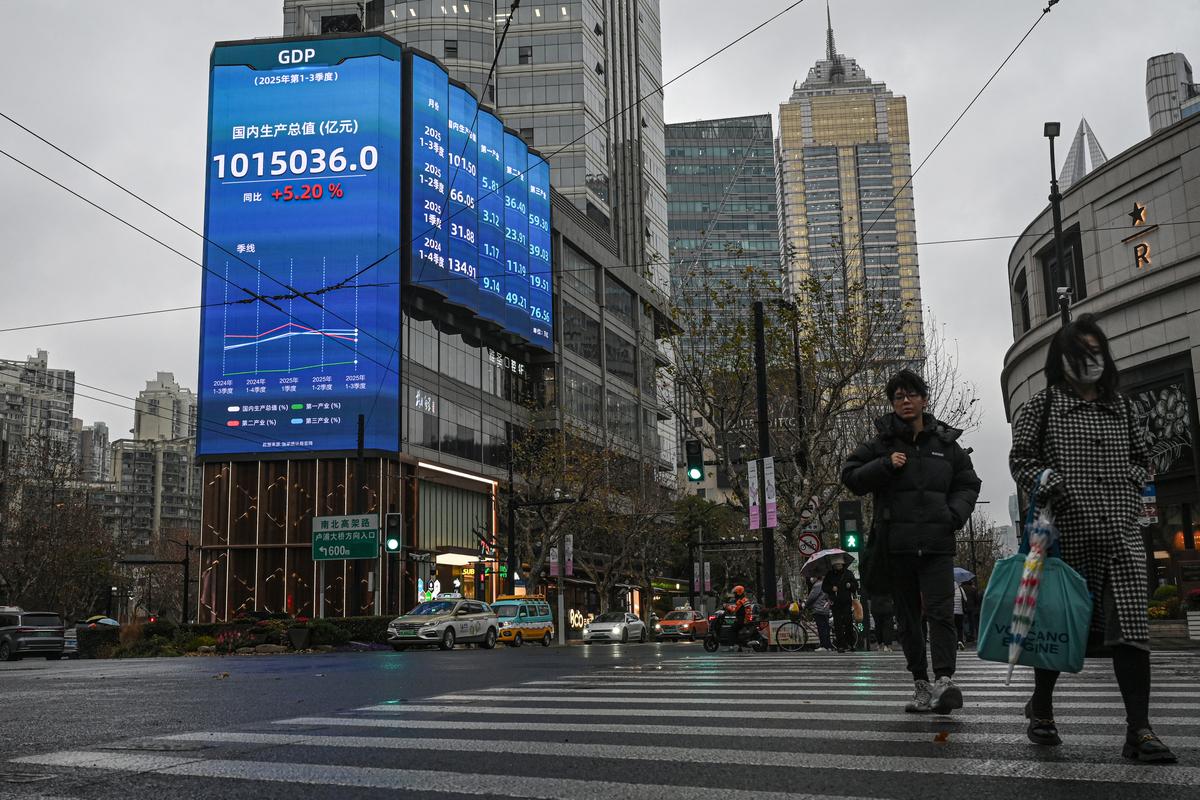
But what about AI?As noted, the elevation and shadow of AI as a world-changing technological development can’t be overestimated in its multiple applications across the spectrum of human activity.
But it’s a double-edged sword.
On the one hand, Chinese exports of AI-linked chips and data-processing hardware hit a record $30 billion in April 2026 alone, and the Party’s new Five-Year Plan leans hard into what it’s branding “New Quality Production Forces.”
That figure sounds impressive until you check the scale. Analysts peg China’s entire “new economy” bloc comprised of AI, robotics, EVs combined at somewhere around 15 to 20 percent of GDP. That means AI is contributing roughly a quarter of total growth in recent years.
Those are real accomplishments, real numbers (as far as can be determined), but those figures are also nowhere close to being large enough to carry the Chinese economy, and Beijing knows it.
The Property Sector Is Not ‘Stabilizing’—It’s Collapsing
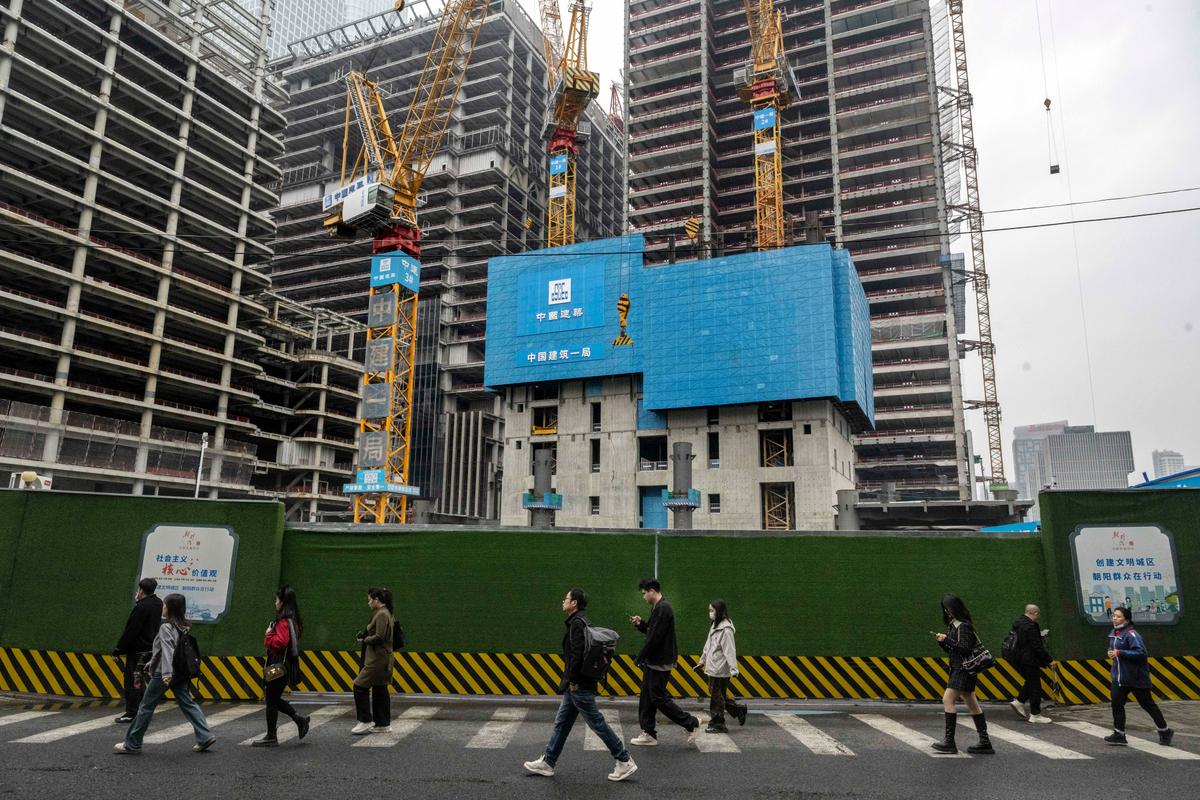
Real estate once generated close to a quarter of China’s entire GDP demand. Since the Evergrande implosion in 2021, property sales have cratered roughly 65 percent from their peak, new construction starts are down more than 20 percent year-over-year, and home prices across 70 major cities have now fallen for more than three consecutive years.The Party calls this “stabilization.” The IMF calls it something closer to an ongoing disaster, estimating that fully working out the sector’s distortions could eat up resources equivalent to roughly 5 percent of GDP over several years.
That’s not a small matter. It’s a structural wound the regime has no real plan to close, only manage on the way down.
A Generation Locked Out of Work
Youth unemployment for Chinese ages 16 to 24 has sat in the 16 to 17 percent range for more than two years, which is more than double the comparable U.S. figure. In 2025, China created a record 11.8 million university graduates, but the economy simply isn’t generating the skilled jobs they were promised.But that may not even be the reality.
One mainland Chinese professor who dared say it publicly put the true youth jobless rate as high as 40-plus percent once discouraged workers are counted, alongside credible reports of firms manufacturing “fake jobs” on paper just to keep young people off the official rolls.
Debt, Demographics, and the Money Walking Out the Door
Another key indicator is household debt, which has recently climbed past 60 percent of GDP, loaded up mostly through mortgages taken out during a property boom that’s since evaporated beneath borrowers’ feet.Combine that dreary statistics with the fact that China’s birthrate hit its lowest level ever recorded in 2025, and the future doesn’t look bright. In absolute terms, the world’s largest workforce is aging and shrinking faster than almost anywhere else in modern economic history.
A Divided Economy With a Hole in the Middle
None of these facts change, nor degrade, what China has actually built. Its manufacturing base is real, its trade surplus hit a record $1.19 trillion in 2025, and its AI sector isn’t smoke and mirrors. Its growth successes have been world-shaking.But the country’s economy is deeply divided in critical ways. On the one hand, we see a glittering, subsidized tech frontier that’s world class. On the other, China is shackled to a property sector in freefall, a generation locked out of work, and households too spooked to spend.
That is not the economic profile of a country on the verge of eclipsing the United States.