The invasion of artificial intelligence (AI) into our lives proceeds at a dramatic pace, causing some optimism but mostly just worry about what will happen to human beings in this new world.
For example, I’m right now using a documents program in the cloud, the same one I’ve used for at least 10 years. Just yesterday, I started getting prompts: “help me write.” Clicking it generates a series of questions about what I want to write and fills out the content.
In reality, I could complete this article by telling the prompt to rage against AI writing for 1,200 words. The results would be impressive.
Doing something like this is beneath my dignity. I won’t even use the new prompts that appear on my email composer. One button gives me a summary of what I’m reading, so I don’t even have to read emails, and the other crafts a response.
So I could be receiving and sending a thousand emails today, but all of them could be interfaced by machines that pretend to be human such that no aspect of authentic human volition spoke to any of them.

I was once a huge defender of the “cloud,” because it kept cruft and muck on one’s own computer. Email moved to the cloud, then documents, and then everything. Our machines are no longer running software that can be managed elsewhere.
There is tremendous convenience here. I got a new computer recently and it was fired up and working in all my personally customized ways in about five minutes. This was unthinkable in the old days, when it could take a day or two to move machines.
The downside is a loss of control over essentially everything. You are entirely at the mercy of what some giant company wants to do to you. If they make bad decisions such as rolling AI into your workflow when you don’t want it, there is nothing you can do. You also lose full control of your data. It belongs to someone else and can be sold unto infinity.
Was this worth the tradeoff? The answer is no longer obvious to me.
I just got off the phone with the electric company. It was a battle with an AI phone tree. My issue was not on the list, so the agent was thoroughly confused. I couldn’t stand it anymore and just demanded a person. The agent understood that and informed me that the wait would be more than an hour. The computer claims that it will call me back.
Here’s the weird problem I’m trying to solve. I’m looking at a bill for $49.80 to cover the electricity for a place at which I do not live. I get how it happened: I had briefly typed in the wrong address before I changed it to the correct one. The machine, however, recorded the mistake as reality. I’m now trying to make sure that this is fixed, but meanwhile I’m staring at an unpaid bill.
So far, I have no way of fixing this problem because I’ve not spoken to a person. For that matter, I have no idea if the person to whom I eventually speak will be in a position to override the machine logic and make things right. What if he can’t; who is going to pay this bill?
Meanwhile, I have some documents open that I need to read, but there are buttons flashing up top inviting me to read summaries instead. No more slogging through 10 pages. I can just push a button and let the machine do the reading and summarize for me, with absolutely zero assurance much less liability should something be wrong.
Do you see what is happening here? Our humanity seems as if it is gradually being replaced by dehumanized digits in small and big ways, a bit at a time.
To be sure, AI is not without its merits. In the old days, changing an airline ticket required you to deal with a person, and this person could barely speak English. The wait times were long—up to an hour—and you had to go back and forth on a huge series of accounting and booking digits. Now, there is a little window in the software. You make your request, and it is done in under a minute. It’s fantastic.
I mention this because this is the only use case of which I’m aware in which AI has been an unmitigated success. The case of large-language models are helpful, too, but they have huge accuracy problems and must be constantly checked against actual books, and so on. They are supremely intelligent but imperfect. Also their sycophancy toward the user loses them credibility.
My main gripe is how every platform these days, every venue and every experience, is presumed to be improved by AI, as if no one could possibly have doubts about this. In my email and writing systems in the cloud, there are no ways to turn it off. In this sense, an AI future is being forced on us.
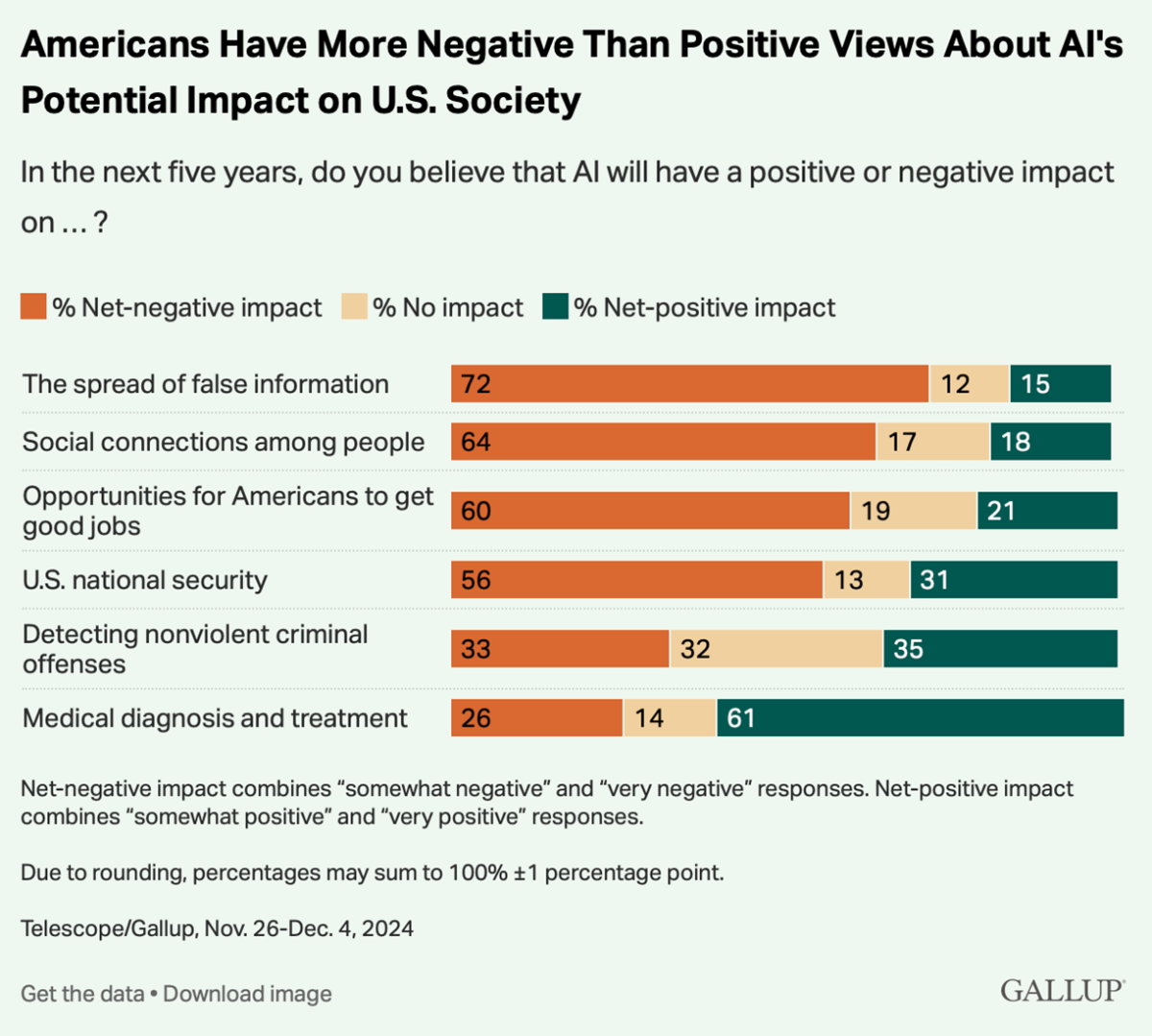
So there it is. We use it constantly but trust it not much at all. Drilling down further, it seems that people like AI for 1) legal matters, on which it is very good, 2) tech help, on which it is invaluable, and 3) mechanical issues, on which it can be genius.
This is why so many announcements of AI advances are harming stocks associated with legal and data services and other tools to get information to people as they need it. AI could indeed wipe out whole companies sooner rather than later, just as it has devastated the internet search industry.
Despite the business carnage, people like what AI does for them in getting them valuable information. What we don’t like is when it invades our lives in ways that are annoying, condescending, useless, or inaccurate.
For my own part, I’m swearing to avoid it unless absolutely necessary. Above all else, I would like to be in a position to choose. Turn it on and turn it off. Companies should not presume that we want these AIs built into the functioning of our daily lives.
Technological revolutions can be thrilling but also annoying, simply because of the tendency for public culture to believe that some fancy new tool is going to immanentize the eschaton. It will not. Even after this revolution passes, we’ll deal with most of the same problems that have always vexed humanity.
People still need to learn history, literature, philosophy, ethics, mathematics, economics, music, and science. If we do not, machines really will rule the world. The result will not be the eschaton but dystopia.
As a follow-up to my electric bill problem, I did finally speak to a person. She fixed the problem. Thank goodness for the relics in our midst, by which I mean actual human beings.