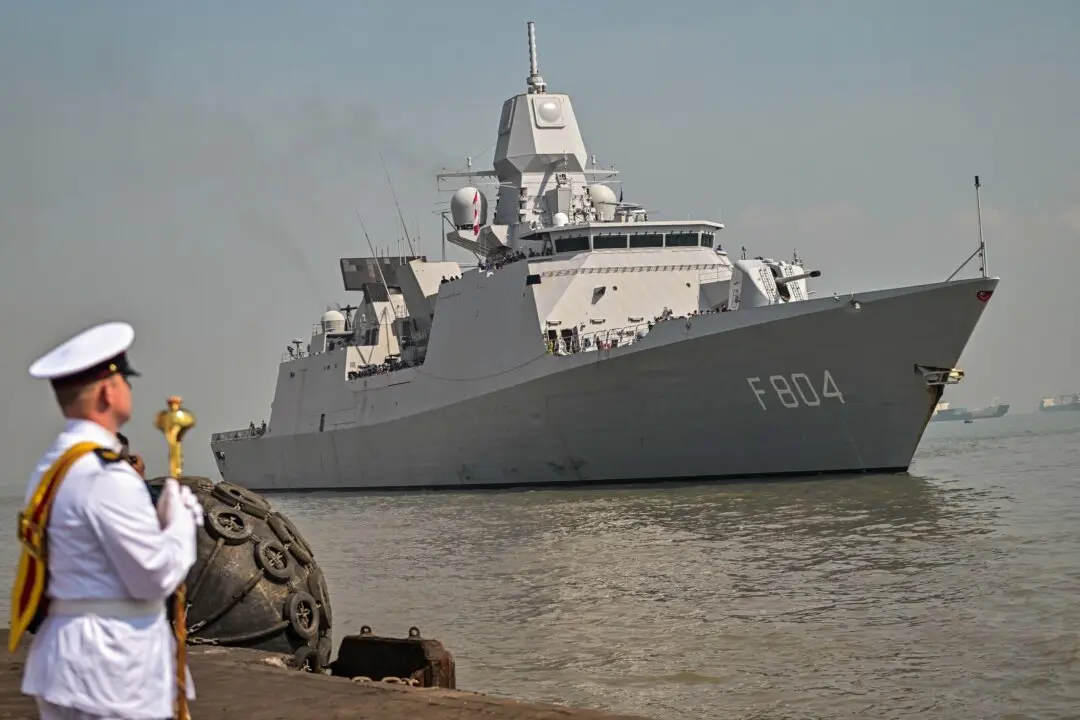
Recent naval exercises and demonstrations by China, Russia, and North Korea point to the so-called Axis of Evil moving into the business of naval nuclear coercion, challenging the United States to increase its theater nuclear deterrent capabilities.
Most provocatively, on July 6 at 12:01 p.m. China Standard Time (CST), a People’s Liberation Army Navy (PLAN) Type 094 nuclear ballistic missile submarine (SSBN) launched a submarine-launched ballistic missile (SLBM) to a target point in the South Pacific, past the U.S. territory of Guam, impacting near the small island state of Nauru.
China did not reveal any details, such as the type of missile or its launch location, but previous Chinese navigation warnings indicated it could have been launched from the Bohai Sea—where the PLAN has conducted all its previous SLBM launches—or from the South China Sea.
Around 6 p.m. CST, Chinese state television released two images of the SLBM launching at sea, but it could have been either an older 4,350- to 5,000-mile-range JL-2 or the newer 6,300-mile-range JL-3, as both SLBMs, as revealed in Chinese military parades, are about the same size.
Clarity regarding SLBM type and location came early from Taipei.
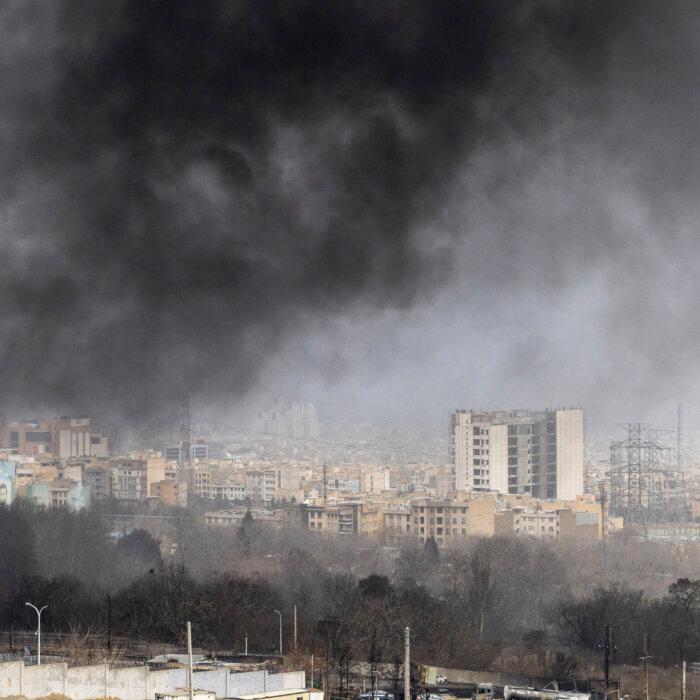

On July 6, Taiwan National Security Council Secretary-General Dr. Joseph Wu posted on the X platform that China had launched an older JL-2 SLBM from the South China Sea.
The southern launch was confirmed on July 7 by an anonymous Japanese government source to the Kyodo news service, and again on July 8 by Taiwanese Defense Minister Wellington Koo.
Also on July 8, Taiwan Lieutenant General Hsieh Rih-sheng, deputy director of the Intelligence Bureau of the Ministry of National Defense, revealed that the launch location was south of China’s Guangdong Province.
Launching SLBMs from the Guangdong area is a strong signal of Beijing’s intent to create protected pro-SSBN “bastions” near China, from which the longer-range JL-3 can strike targets in the United States.
Adopting Cold War Soviet strategies for SSBNs, firing from protected bastions means the SSBN does not have to take greater risks of detection by firing from more distant, deeper waters—also a key reason for China’s decades-long effort to control the South China Sea.
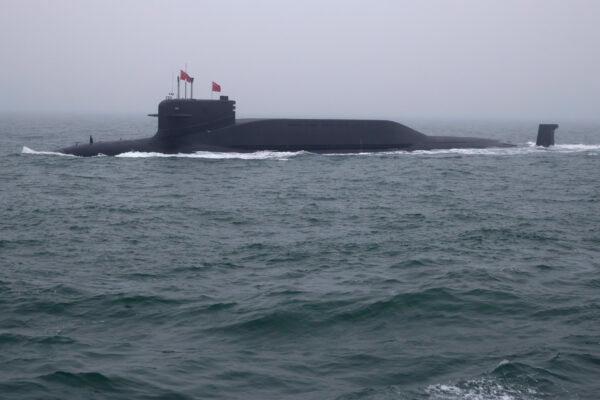
As for the Chinese regime’s future SLBM threat, in November 2022, then-U.S. Pacific Fleet Commander Admiral Samuel Paparo told journalists that China was arming its Type 094 SSBNs with the newer JL-3.
The JL-3 may carry “5-8” of the new smaller second-generation nuclear warhead called “5x5,” according to Hui Zhang, a Beijing University-trained physicist now with the Belfer Center at Harvard University who in November 2025 published a book using privileged Chinese data on its second-generation nuclear warheads—which he also briefed before the Carnegie Foundation on Dec. 9, 2025.
One Type 094 SSBN with 12 JL-3s could launch 60 to 96 warheads, while all six PLAN Type 094s could launch 360 to 576 warheads.
China’s SLBM demonstration caused shock and protest. According to a July 6 release from the Japanese Prime Minister’s office, China notified the Japanese Embassy in Beijing of its missile test about 30 minutes before its launch.
China’s missile demonstration also earned rebukes from Australia and New Zealand, with the latter’s Foreign Minister Winston Peters saying, “New Zealand considers this an unwelcome and concerning development. We, like our neighbors in other Pacific countries, have no interest in China using the South Pacific as a testing site for missile capability.”
On July 6, the U.S. State Department also issued a critical response, saying: “At a time when the United States is working harder than ever to prevent nuclear proliferation, China is doing the opposite. Beijing’s rapid and opaque nuclear weapons buildup is of great concern to the region and the world.
But no state has so far protested the broader exercise of nuclear coercion.
The July 6 SLBM launch was scheduled to coincide with the first day of the China–Russia “Joint Sea 2026” naval exercise, which was staging from the Chinese northern Bohai Sea port of Qingdao, where on July 5 the Russian navy sent two combat ships and a submarine, all of which can carry nuclear warhead-armed cruise missiles.
Having created a more credible “second strike” nuclear weapons capability, China and Russia may have greater confidence in threatening a nuclear “first strike” against the United States should it seek to oppose a Chinese invasion of democratic Taiwan, or to counter a North Korean attack against South Korea and/or Japan.
The close timing of the North Korean demonstration, the Chinese SLBM demonstration, and the China–Russia naval exercise also indicates that China and Russia could send naval and air forces to help North Korea defend coastal Bastion areas for its new nuclear-powered ballistic missile submarines.
That China, Russia, and North Korea might engage in more frequent and deliberate coordinated nuclear naval coercion would be consistent with their ambition to challenge and undermine the United States’ extended nuclear deterrent to U.S. allies and signal their potential to engage in coordinated nuclear coercion when the Chinese regime decides to invade Taiwan.
This is on top of China’s likely overwhelming theater nuclear superiority, which, according to the Pentagon, now includes about 3,000 land-based “dual capable” ballistic and cruise missiles, and could also include more than 2,000 air-launched dual-capable land attack cruise missiles, considering three volleys from their force of about 150 Xian Aircraft Corporation H-6K bombers, each armed with six LACMs.
As such, the Axis of Evil is posing an increasing challenge to the credibility of the U.S. extended nuclear deterrent, especially in Asia.
In order to restore that credibility and better deter war, it is necessary for the United States to begin by uploading the designed/original payload of three nuclear warheads on U.S. Air Force Minuteman-III intercontinental ballistic missiles that were reduced to a single warhead to comply with the 2010 New START arms control treaty with Russia, which expired this past February.
Washington should also begin talking to Seoul, Tokyo, and Canberra about a near-term U.S. forward deployment of B-61 tactical nuclear bombs and then move to accelerate the development of new U.S. low-yield nuclear warheads to arm new U.S. theater-range missiles.