An ominous article appeared in the mainstream press this week. It speculated that price controls were coming next. The problem is affordability—the word of the day. We’ve been through five hard years of dramatic devaluation of the dollar. At a minimum, the purchasing power of the dollar has lost a quarter. The reality is likely far worse. It is also not stopping.
Much of the inflation of the past five years has been delayed. The more you shop, the more you see it showing up everywhere. The hamburgers are shrinking. The houses are unaffordable. Some prices you pay for services are unrecognizable from anything we’ve ever experienced. I’m paying $50 for Ubers that used to cost half that. I just threw down $45 for a martini.
There is an element of absurdity about what’s going on. Sometimes you laugh. Sometimes you cry. Mostly, you just feel a profound sense of disorientation. You wonder when it will all end or at least stop getting worse before your very eyes.
There was a moment earlier this year when the grueling inflation of the past five years suddenly seemed to go away. That made us all optimistic that the worst was over. But within weeks, the plague of depreciation returned again. It has been accelerating ever since. Right now, inflation is overall running between 2.5 and 3 percent, which is much hotter than the target from the old days.
In such times, people start to get desperate. That’s when the subject of price controls comes up. This is pure nihilism. Not a living soul believes that they work. They have been tried for thousands of years, and the results are always the same. Price controls create shortages, disrepair, and business stagnation.
Price controls forever make a bad situation worse. This is widely admitted and not even controversial. And yet it just keeps happening. The new mayor of New York City has promised to deploy them for rent, groceries, and more. People cheer. Why? Because there doesn’t seem to be any option. People during inflation just start to yell, “Make it stop.” But the attempt to control inflation this way simply does not deal with the real problem.
A bit of history. In the old, old days, the term inflation in reference to economics referred not to prices but to the expansion of the money supply. That was inflation. The change of the definition happened in the 20th century. The word started to be used to describe the effect rather than the cause.
Let’s look at the money supply over 10 years. Even a casual observer can see what is going on here. In a very short period of time, the Federal Reserve drove the creation of more than $6 trillion in new money. This infusion of cash that didn’t previously exist was pumped directly into consumer bank accounts. The result was to diminish the value of all previously existing dollars.
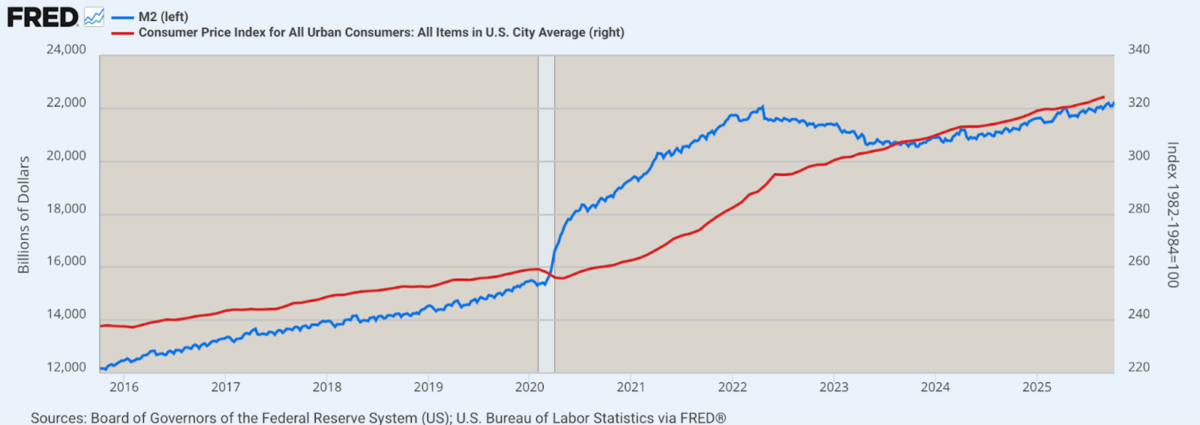
Here is the cause. Once you engage in this sort of policy, for whatever reason, you have to deal with the effects. This relationship between cause and effect is not mechanical and predictable in every respect. It hits different sectors in different ways and at different times. Nor is the overall impact subject to empirical prediction. We know that, under these conditions, prices will rise and purchasing power will decline, but with what kind of timing, we cannot know.
Inflation of the money supply, when the results are pumped directly to consumers, creates an inevitability. It’s like jumping off a tall building. Gravity determines the results. Economics, too, has laws like gravity. The “equation of exchange” is one of those laws. It says that money quantity times its velocity equals prices times output. The only fix is to unplug the money machine and grow your way out of the problem.
The point of this operation is not to cause price increases but to provide a market for government debt, the issuances of which are out of control and getting worse. The total amount of outstanding T-Bills is now up to a record $6.59 trillion, doubling since 2020. As always, the Fed is the buyer of first and last resort, an operation it undertakes with newly created money. The result is rampant devaluation.
A panicked frugality has swept the land. People are economizing on household products, cooking at home, foregoing travel, and otherwise live in a state of constant anxiety. These money worries have also degraded the culture. It seems like people are giving up on generosity in favor of taking what they can get when they can get it.
Price controls might seem like a fix. But this is a complete illusion. Businesses cannot make money and cease to do business. Products and services become quickly underpriced and disappear in their availability. Black markets appear almost immediately.
You can try this with any product. Put a price cap on eggs of $1 per dozen. They will disappear from shelves. They will reappear somewhere in your neighborhood with people reselling them out of their refrigerators. Then the farmers will stop deliveries and claim that their chickens have stopped producing. An entire world of speakeasy eggs will appear overnight. The price cap will have achieved nothing.
The United States has avoided price controls for the most part for half a century. Cities have largely repealed them insofar as they affect rents. There are no national price controls, unless you want to include the wage floor of the minimum wages. In general, policymakers seemed to have learned a lesson from the 1970s. Never attempt to control prices by force.
If we are to believe the latest media prattle, it’s entirely possible that price controls are coming regardless. This is what inflation does. It makes people crazy, desperate, irrational, and clamoring to do something, anything, even if it makes no sense. This is unfolding now.
If we intend to deal with the root problem, however, we would be looking straight to the central bank. Reforming or abolishing it would be the single most welcome reform of all. It would fix other problems, such as the penchant of Congress to authorize spending that is not in the budget. It would cause a repricing of risk in the bond market.
In the meantime, there is no wishing away the consequences of reckless monetary policy, which both enables and rewards dangerous spending habits by Congress and the presidency. The entire government needs the discipline we used to have with the gold standard. Until then, the crazy prices all around you today are a result of this and this alone.