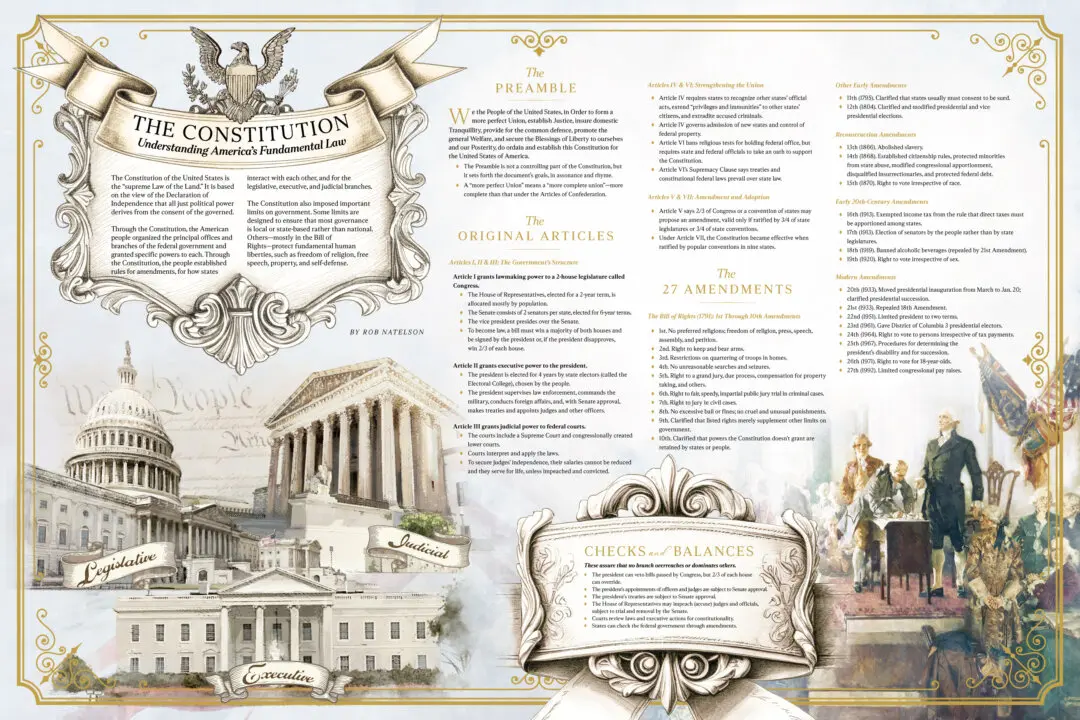
Last year, the internet resounded with chatter about how much American and British men ponder the subject of ancient Rome. Women started asking their husbands and boyfriends, “Honey, how often do you think about the Roman Empire?”
Still, the interest modern men have in Rome pales compared with that of the American founding generation. By “founding generation,” I mean Americans living between 1763 and 1791—that is, from the time when tension with Great Britain began until the Bill of Rights was ratified. Moreover, members of the founding generation not only were fascinated by Rome, but they also knew a great deal about it.
This new series is about the lessons the Founders drew from Rome when writing and debating the Constitution. I wrote it to help fill a gap left by the modern American public school system.

These educational changes largely severed modern Americans from their own traditions. After all, Latin was not only the language of ancient Rome, but for centuries afterward was a principal vehicle for the transmission of learning and culture: Aquinas, Newton, Galileo, Francis Bacon, and many other architects of the modern world wrote some of their greatest works in Latin.
Additionally, courses in civics were where students learned the underlying assumptions of the American system of government, its basic components, and how it all worked.
Rome Fascinated the Founders
Have you ever examined the Great Seal of the United States? You can find it on the back of the one-dollar bill.On the right side of the back is the front of the Great Seal. Its centerpiece is an eagle, which, not coincidentally, was the emblem carried by the Roman legions. The eagle holds a ribbon in his beak. It reads E pluribus unum—“out of many, one.” This Latin phrase is derived from a Roman poem called Moretum: the salad, or pesto. In the poem, a farmer uses a variety of ingredients to make his pesto, fashioning from many foods just one.
On the one-dollar bill’s left side is the Great Seal’s reverse. It contains two other legends, also in Latin. The first is Annuit coeptis. This is an abbreviation of two separate lines in Virgil’s poetry, one from his lengthy agricultural poem, the Georgics, and one from his epic, the Aeneid. It means that “he [i.e., God] has approved our undertakings.”
The second legend is Novus ordo seclorum, “A new order of the ages.” It comes from Virgil’s Eclogues, his first published book of poetry. The specific source is the fourth or “Messianic” eclogue, about which I’ll say more later in this series.
Rome in Founding-Era Education
During the Founding Era, schoolgirls were instructed in “reading, writing, and ’rithematic,” and then went on to study modern languages, music, household arts, and other useful subjects.Boys, on the other hand, were immersed in ancient Rome.
At roughly age 8, after acquiring basic literacy and numeracy, boys began the study of Latin. They read works of history, oratory, drama, poetry, and philosophy. The minority that headed for college later began studying Greek. Part of a typical college entrance examination was to take a designated passage from the Greek New Testament and translate it into Latin.
The college curriculum was heavy with the Greco-Roman classics. Students read advanced Latin authors, such as Seneca and Tacitus, and Greek writers, such as Plato, Aristotle, Xenophon, Polybius, and Plutarch. We shall have more to say about Polybius and Plutarch later.
Rome in the Wider Culture
The 18th century thought of itself as a classical age. Certainly, classical learning had a great influence on the wider culture. As just mentioned, Latin was dominant in the grammar school curriculum. Although only a small fraction of boys attended college, the college-educated exercised an outsized influence. One reason was the popularity of almanacs, which were disproportionately written and published by the college-educated. Another was that college-educated men often were elected to public office. For example, 27 of the 56 signers of the Declaration of Independence had at least some college education, as did 23 of the 39 signers of the Constitution.No one seems to have thought it the least bit odd to cite such authors in op-eds directed at the general public.