During the 250th anniversary of the Declaration of Independence, millions of Stars and Stripes are displayed at homes, churches, courthouses, and town squares. However, few Americans recognize one of the earliest banners carried in defense of American liberty. This flag featured neither stars nor stripes, nor did it display an eagle, shield, or any familiar constellation of states.
Instead, it displayed a simple pine tree above five remarkable words: An Appeal to Heaven.
To contemporary observers, the phrase may seem solely religious or poetic. In fact, it conveyed a much deeper significance. These five words articulated the philosophical, legal, and moral justification for the American Revolution. Understanding the Appeal to Heaven Flag is essential to comprehending why the Founding generation believed they possessed not only the ability but also the right to resist tyranny.
The phrase did not originate in America. It came from the English philosopher John Locke, whose “Second Treatise of Government” profoundly influenced Thomas Jefferson and the architects of the American Republic.
Locke argued that governments exist to protect the natural rights of life, liberty, and property. Political authority rests upon the consent of the governed and remains legitimate only so long as it fulfills that responsibility. When rulers become tyrants—destroying the very rights they were established to defend—the people are justified in resisting them.
But Locke also insisted that rebellion should never become the first resort of an angry populace. Peaceful remedies must first be exhausted. Laws should be respected. Petitions should be offered. Reconciliation should be attempted. Only after every earthly avenue of justice had failed did one final remedy remain.
There remained, in Locke’s memorable phrase, “an Appeal to Heaven.”
This phrase did not advocate fanaticism or religious zeal. Rather, it constituted an appeal to the highest conceivable authority. When all human institutions had failed to uphold justice, ultimate judgment was believed to reside with God alone.
The American colonists believed they had reached precisely that point.
For more than a decade, they petitioned the Crown, appealed to Parliament, protested taxation, sought compromise, and repeatedly asked that their rights as Englishmen be respected. Each effort failed. By 1775, many colonial leaders had concluded that no earthly authority remained willing to hear their grievances.
Only then did they make their appeal to Heaven.
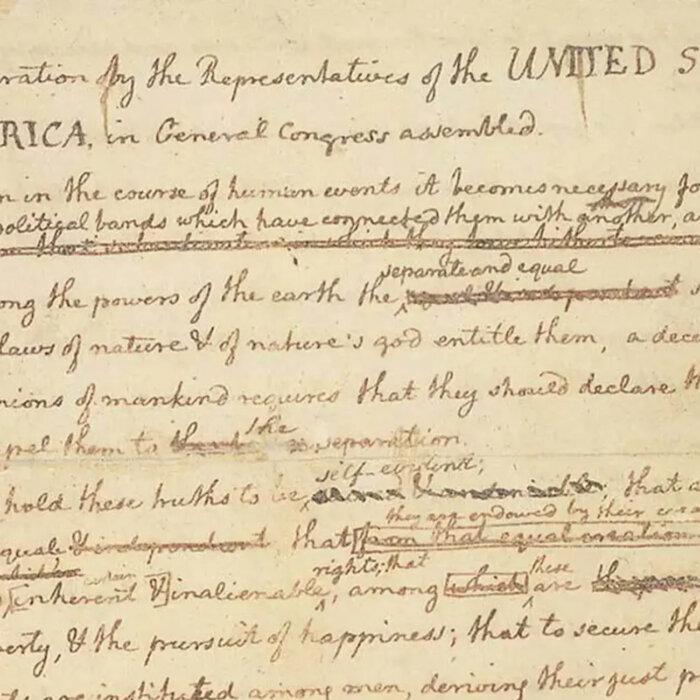
The phrase reappears, albeit in different wording, within the Declaration of Independence. Jefferson stated that the representatives of the American people were “appealing to the Supreme Judge of the world for the rectitude of our intentions.” This was not merely an eighteenth-century rhetorical flourish; Jefferson was explicitly referencing the Lockean tradition that had become integral to the Revolution’s intellectual foundation.
The Appeal to Heaven Flag thus represented more than a military banner; it served as a declaration that the American cause was grounded in moral legitimacy as well as military necessity.
The flag itself reflected New England’s history. The white pine had long symbolized the region. Its towering trunks supplied the finest masts in the world, making them indispensable to the Royal Navy. British authorities claimed the largest pines for the Crown under the notorious Broad Arrow policy, marking them with the King’s symbol and prohibiting their use by colonists.
Many colonists viewed these restrictions as yet another example of arbitrary imperial power. Resistance occasionally turned violent, most famously during the Pine Tree Riot of 1772 in New Hampshire, when local citizens confronted royal officials enforcing the Crown’s timber laws. Long before the Boston Tea Party became legendary, the pine tree had already become a symbol of colonial resistance and local liberty.
Accordingly, General George Washington authorized a flag featuring the pine tree for use by the Continental naval forces during the early months of the Revolution. While the image symbolized New England, the motto conveyed a broader message. Together, they signified that the American struggle was rooted in both historical identity and moral conviction.
This observation highlights a point frequently overlooked in contemporary discussions of the American founding.
The Revolution was not fought because the colonists rejected all authority. It was fought because they believed that political authority itself remained subject to a higher authority.
This conviction rested upon three great pillars that shaped Western civilization: the natural law tradition inherited from classical philosophy, the Judeo-Christian understanding that rulers are accountable before God, and the English constitutional tradition that even kings remain subject to law. Together, these ideas formed the intellectual architecture of the American Revolution.
The Founders did not believe rights originated with Parliament.
They did not believe liberty originated with kings.
Nor did they believe governments possessed unlimited authority simply because they exercised power.
Rights came from the Creator.
Government existed to secure those rights.
When the government consistently violated them, legitimacy itself came into question. It means that any government that embraces tyranny, arbitrary power, the rule of men over laws, or the rule of law over men is, by definition, illegitimate and in rebellion to God.
The Appeal to Heaven was therefore neither a declaration of theocracy nor an invitation to permanent Revolution. It was a sober recognition that there exists a moral law above every earthly ruler and a justice beyond every earthly tribunal. Only when all lesser remedies had failed did the colonists believe they could invoke that higher judgment.
President Abraham Lincoln understood this principle nearly ninety years later. In his Second Inaugural Address, Lincoln spoke not as a conqueror but as a statesman humbled before Providence. He reminded Americans that nations, no less than individuals, remain accountable to God’s justice. The humility expressed by Lincoln echoed the same moral tradition that had animated the Founders’ Appeal to Heaven generations earlier.
Today, Americans commonly celebrate the Declaration of Independence, the Constitution, and the Stars and Stripes. However, the Pine Tree Flag also merits recognition. This flag serves as a reminder that the American Revolution was not simply a dispute over taxes or representation, but rather a profound debate concerning the source of political authority, the limits of government, and the relationship between liberty and moral law.
As fireworks illuminate the skies during America’s 250th anniversary, it is important to recall the simple Revolutionary banner carried into an uncertain future by individuals who believed they had exhausted every earthly remedy. Their appeal was not to passion, vengeance, or political expediency, but to justice itself.
Two hundred and fifty years later, that remains one of the most powerful ideas ever to animate the American Republic.