Spring is dawning but in New England, a good tweed blazer is still serviceable clothing for daytime and especially for evenings. Too early for the wardrobe shift where we bring out the cottons and put away the sweaters and woolen coats.
My favorite blazer is a three-button model made in the early 1960s by the classic American company Pendleton and sold in Chicago back in the day. I picked it up on eBay of course but I’ve adored it for years.
A thing that happens to wool blazers like this that are 60-plus years old is that the seams start to weaken. The wool stays intact but after so many decades of changing seasons—hot, cold, wet, dry, sunny, dark—the cotton that holds the piece together starts to rip in unexpected ways. It’s an elbow here, an armpit there, and a back seam.
The first impulse might be to toss it in the trash. Surely it has served its uses. A second thought is better. Go to the closet and pull out the sewing kit. Pull a long thread from the spool. Sit in a place with good light. Thread that needle and tie up the ends. Get to work.
I say that with full knowledge that vast numbers of people who should know some basic stitches do not. Many people don’t even have sewing kits anymore. Several generations were raised during a time when clothes that tear or break are just thrown out entirely. This is a huge waste and a mistake.
Let’s make an implausible analogy to software development. The point of early release is to let the program run and see what causes it to break. You hone in on the code that is weak or poorly designed and try again. Only through deployment and breakage are you able to find the weak spots and fix them.
It’s similar with clothing. A tear or breakage is not bad. It happens and it can be turned into a good thing. Because once you fix it with reinforcements, it is stronger than ever and ready for more years of wear.
The tweed blazer I’m wearing now has my own hand stitching up and down the arms, in the back, and under the arms. Yes, I could have added leather elbow patches to cover up issues. While that is a good look, this blazer is too treasured in my mind to take that extra step that slightly degrades aesthetics. Stitching it up strengthens the jacket. Plus my time investment in this object adds to its personal value to me.
When I was younger, I loved to sew. My mother’s mother taught me and I used the skill when I was in the clothing business in high school and college. In fact, in a pinch I would alter clothing for customers. My boss once told the staff no alterations promised out sooner than three weeks. A man came in and bought seven suits on the condition that he get them the next day.
I sold them anyway and got to work and got them all done. The next day the boss congratulated me on my skills. Then he added that there is one thing no company can tolerate and that is insubordination. He fired me on the spot even though I beat all sales records. He had a point for sure and taught me a lesson. It should have stuck better than it did.
That aside, my sewing gradually stopped when, as happens, my eyes lost focus to the point that threading a needle was no longer possible. Once I had to walk down the street holding a needle and thread hoping to find a merchant in a store who could do it for me. To my amazement, it was not easy. I finally found a baker from Argentina who could do it. Then I walked back home.
Suffice it to say that I was disincentivized in trying the trick again. Then one day I discovered a needle threader. It had been there the whole time but I had never needed it. What a glorious discovery this has been for me. Now I use it every time and there are no more struggles.
The needle threader is one of the great inventions and yet hardly ever celebrated as such. It is like most such things of 19th-century origin. The earliest documented U.S. patent specifically for a needle threader (or “needle-threaders”) is U.S. Patent 42,394, granted on April 19, 1864, to James O’Kane of New York, NY. It changed everything because using it made the hard part so incredibly simple.
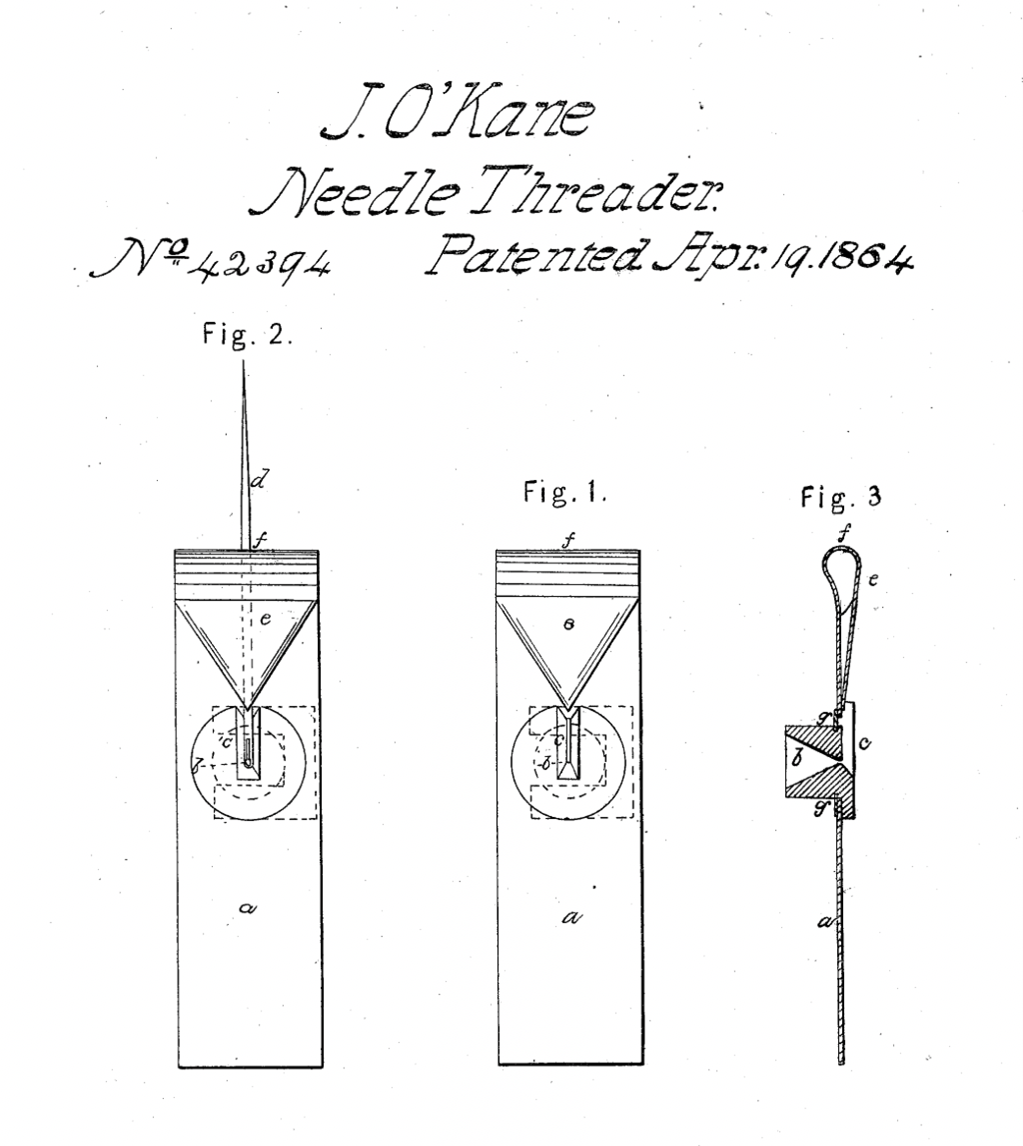
Without this thing, I would be utterly lost. So I make sure to guard mine carefully in a little pocket in my sewing kit, which I always carry when I travel just in case I pop a button or a rip appears in my trousers.
What to do if you don’t know how? I had my grandmother to teach me basic stitches but now we have YouTube tutorials by the hundreds. There really is no excuse.
I’m operating under the assumption that many skills that people developed in the past to get through hard economic times are skills we need to reacquire now.
I just noticed, for example, that some neighbors of mine in a fairly high-end section of town are now keeping chickens for eggs, with a chicken coop out back. This is in defiance of a town ordinance. They must have done this when there was an egg shortage and decided they would never risk this again.
The need to feed the children and themselves is one motivation that will override all enforcement attempts. You can have my chickens when you pry them out of my cold, dead hands!
The great thing about learning the basics of hand sewing—you don’t need a machine—is that you are defying no law. You are simply taking matters into your own hands.
It’s been many generations since we darned socks and sweaters but those times could be coming soon too, especially when you consider the poor quality of the new clothing compared with the old. These aging treasures deserve to be preserved. You can do it and should.
Another great feature of stitching things up is that it is decidedly an offline activity. It allows you to concentrate on something that is profoundly real. And you will be surprised. A bit of focus and an hour of attention is enough to stitch up even huge tears and rips and enjoy the profound self-satisfaction that comes with achieving something grand.