NYC Community Reflects on 9/11

September 7, 2011 Updated: October 2, 2015
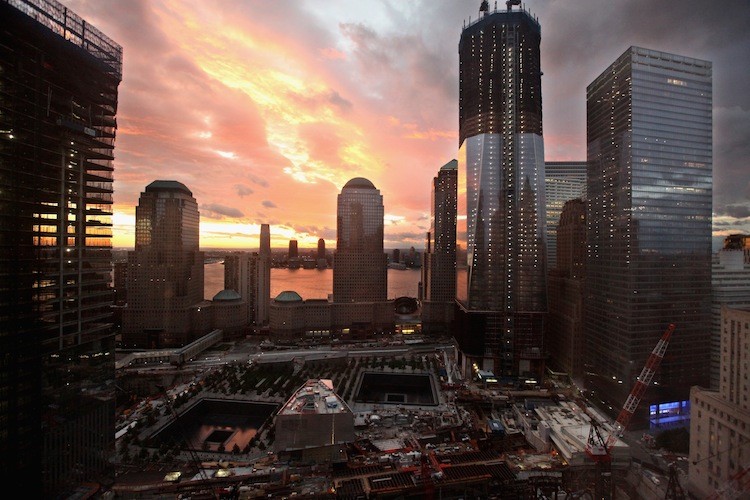
The sun sets over Jersey City and the World Trade Center site, with One World Trade Center to the right on August 28, 2011 in New York City.  (Chip Somodevilla/Getty Images)
The sun sets over Jersey City and the World Trade Center site, with One World Trade Center to the right on August 28, 2011 in New York City. (Chip Somodevilla/Getty Images)

NEW YORK—In the months following the terrorist attacks on Sept. 11, 2001, toxic dust filled the air in Lower Manhattan. City officials told everyone soon afterward, however, that it was safe to return to work in the area.

“Government officials had no idea, really, what health repercussions would be to people,” said Juan Gonzalez, who was the first journalist to break the story about the “toxic time bomb downtown,” as Tom Robbins called it.

Gonzalez and Robbins are among journalists and community leaders who have been at the forefront of 9/11-related issues for the past decade. They met on Wednesday for a roundtable discussion to explore the effects of the tragedy a decade later.

“It was unimaginable to have the financial markets of America shut down for a longer period of time,” said Gonzalez. Former Mayor Rudy Giuliani was not happy about his articles.

Gonzales said he encountered hesitation from his editors at the New York Daily News to cover the toxicity of the area and mum was the word among other news sources. When disaster strikes, he said, the government tries to keep the peace and avoid panic, enlisting the help of the media to this end.

“In any disaster, the media have to remain independent and government has to trust the public,” concluded Gonzales. Whatever the economic fallout, he thinks the city should have trusted the public to make an informed decision about returning to the area for work.

Wall Street wasn't the only stakeholder with something to lose. As tourism is important for the city's economy, Catherine McVay Hughes of Community Board 1 speculated that the city fudged facts to bring in tourists beginning Dec. 17, 2001.

This is the date on which the city declared that fires stopped burning at the World Trace Center (WTC) site, and it fell close to the opening of a busy tourist season. Despite the declaration, McVay Hughes said she could see flare-ups from her apartment window near ground zero into early 2002.

Park51, ideological battleground

The roundtable discussion was hosted by New York Neighbors for American Values, an organization that had formed to promote understanding between Muslim-Americans and other Americans following 9/11.

The development that has incited the greatest public outcry to date is Park51, an Islamic cultural center being planned to be built blocks from the WTC site. The facility will include a mosque on one of its floors.

On the 9/11 anniversary last year, the area surrounding WTC became an ideological battleground. On one side were opponents to the mosque. Army fatigues and red, white, and blue pervaded this crowd. Many of them thought building a mosque was fine—just not so close to WTC, where it could offend family members of victims. A few of them thought mosques have no place in America.

On the other side were the proponents of Park51 denounced the opposition as discriminatory and prejudiced. Mayor Michael Bloomberg took the side of the proponents, saying a private developer has the right to do what he will with his property and touting religious tolerance as the cornerstone of America.

NEW YORKER AND PROUD: Linda Sarsour (L) of the Arab American Association of New York speaks at a 9/11 roundtable discussion on Wednesday. Next to her is Margaret Fung (C), executive director of Asian American Legal Defense.  (Tara MacIsaac/The Epoch Times)
NEW YORKER AND PROUD: Linda Sarsour (L) of the Arab American Association of New York speaks at a 9/11 roundtable discussion on Wednesday. Next to her is Margaret Fung (C), executive director of Asian American Legal Defense. (Tara MacIsaac/The Epoch Times)
Linda Sarsour of the Arab American Association of New York tempered her community's praise of Bloomberg's support by saying, “I want to remind people that Mayor Bloomberg is a private developer.”

Sarsour said it isn't just about building a mosque near the WTC site. She pointed out several other mosques that have met with opposition, including one on Staten Island and another in Sheepshead Bay, Brooklyn.

In Sheepshead Bay, opponents to a mosque already under construction say they object on grounds of infrastructure, not prejudice. The mosque plan does not include a parking lot, meaning vehicles may line the streets.

The Muslim Society of America, however, hailed a judge's decision this spring to throw the case out as a victory for “equality and spirit of diversity,” in a press release. They took it as an issue of equality, not infrastructure.

Racial profiling

NYPD training and policies that promote racial profiling have drawn much ire over the last 10 years. The NYPD stopped showing a training film focused on Islam after public outcry this year. Still, others support the tactic of racial profiling in the name of national security.

Since 9/11, 250 Muslim groups and mosques have been under surveillance in the city, reported Sarsour. Gonzalez said people were arrested and brought into the Federal Court here in New York City without any forms being filled out, without any paper trail. A colleague of his observed this while stationed in the court.

“We're not going to look for the white grandmas; we know who we're looking for,” claimed Sarsour, mimicking officials who support racial profiling.

Sarsour said terrorists are smarter than that, and investigators must be, too. She wants to see profiling based on behavior, not on race.

“Alienating an entire community is not going to stop another 9/11,” concluded Sarsour, adding that 32 Muslims died in the WTC attacks—Muslims who worked at the site and who worked to help others. She called for recognition of the sorrow of Muslims who are innocent and who identify as Americans, and particularly as New Yorkers, as she does.