


NEW YORK—Timing is everything. The transit fare hikes have been in the planning for half a year, but they arrived right in the midst of a serious trial for the viability of the city’s transit services.
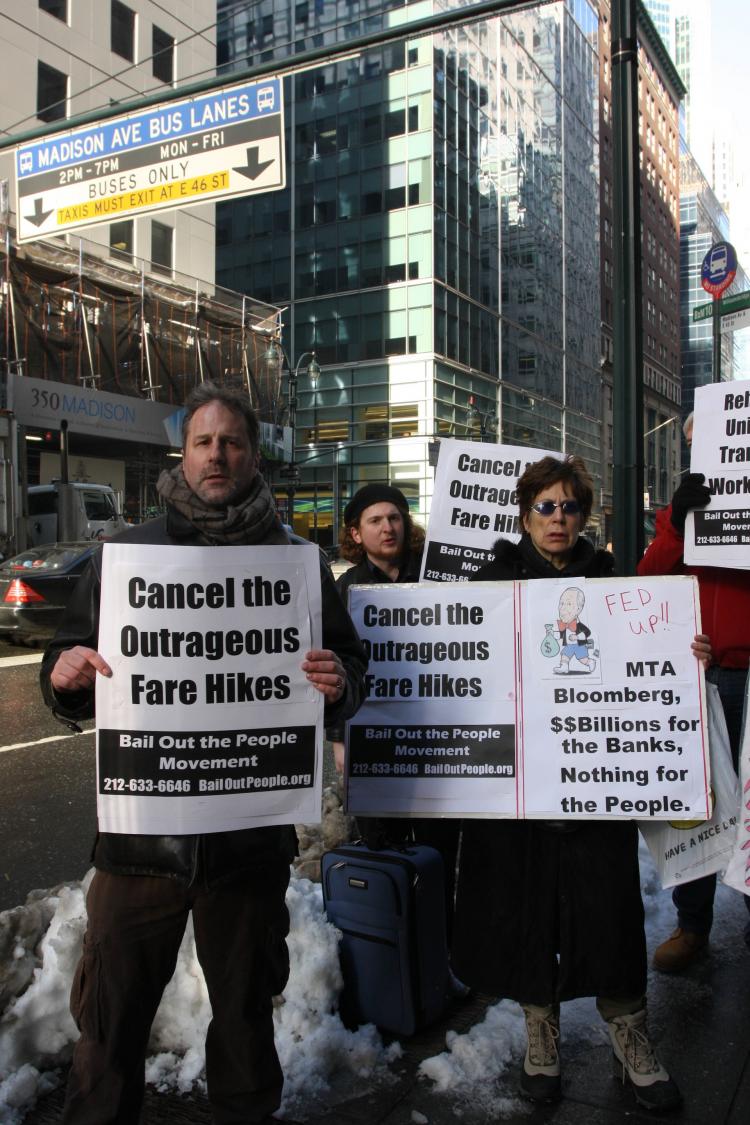
“The MTA (Metropolitan Transportation Authority) should be ashamed of raising the fare after the performance that they just conducted this week,” said Tony Murphy of Bailout the People, a national network that calls for the bailout money awarded banks to be used for social services instead. He was joined by several others on Thursday outside of the MTA office at 347 Madison Ave. to protest the increase of fares for what he calls a degenerating service.
“What this experience over this week shows is what happens when you lay off vital workers and when you cut vital services,” declared Murphy.
Following a massive blizzard that dropped 2 feet of snow on the city, MTA Chairman Jay Walder confirmed in a statement Wednesday that fare hikes would go ahead as planned on Thursday.
“It’s been planned for six months, and it has to go forward at this point. The agency fundamentally needs the resources,” said Walder.
While the MTA pleads insufficient resources, Murphy said the city’s projected budget surplus makes this plea-founded. A report released this month from the city comptroller’s office forecasts a city budget surplus of $1.16 billion for Fiscal Year 2011. While the MTA is not a city agency it is subsidized by the city.
“We know that the money exists for people to get whatever essential services it is they need, whether it’s MTA, or sanitation, or health care,” said Murphy.
The group gathered before the MTA office called for an emergency repeal of the fare hikes and the rehiring of transit and sanitation workers who have been laid off this year.
“What this city needs to get moving in every sense of the term is a jobs program for 10,000 jobs to be created to clean up the mess, [and] to dig people out of their neighborhoods,” said Murphy. The MTA has been trying to close its budget gap all year with layoffs, reduction of services such as Access-A-Ride, and closing station booths.
“The MTA has closed a $900 million budget gap for 2010 and our finances for 2011 remain extremely fragile,” said MTA representative, Aaron Donovan in an e-mail.
Johnnie Stevens, of Parents to Improve School Transportation (PIST), said cuts to school transportation through MTA have seriously affected students like his son, a third-grader.
“Kids were getting to school at 9:30 a.m., when school starts at 8 am. They were getting home at 5:30. … You had kids wetting themselves,” said Stevens.
“This is a huge increase for those of us making minimum wage,” asserted Edward Childs, who represented hospitality industry employees of the Unite Here union.
A passerby agreed, “It sure is!”
“The MTA (Metropolitan Transportation Authority) should be ashamed of raising the fare after the performance that they just conducted this week,” said Tony Murphy of Bailout the People, a national network that calls for the bailout money awarded banks to be used for social services instead. He was joined by several others on Thursday outside of the MTA office at 347 Madison Ave. to protest the increase of fares for what he calls a degenerating service.
“What this experience over this week shows is what happens when you lay off vital workers and when you cut vital services,” declared Murphy.
Following a massive blizzard that dropped 2 feet of snow on the city, MTA Chairman Jay Walder confirmed in a statement Wednesday that fare hikes would go ahead as planned on Thursday.
“It’s been planned for six months, and it has to go forward at this point. The agency fundamentally needs the resources,” said Walder.
While the MTA pleads insufficient resources, Murphy said the city’s projected budget surplus makes this plea-founded. A report released this month from the city comptroller’s office forecasts a city budget surplus of $1.16 billion for Fiscal Year 2011. While the MTA is not a city agency it is subsidized by the city.
“We know that the money exists for people to get whatever essential services it is they need, whether it’s MTA, or sanitation, or health care,” said Murphy.
The group gathered before the MTA office called for an emergency repeal of the fare hikes and the rehiring of transit and sanitation workers who have been laid off this year.
“What this city needs to get moving in every sense of the term is a jobs program for 10,000 jobs to be created to clean up the mess, [and] to dig people out of their neighborhoods,” said Murphy. The MTA has been trying to close its budget gap all year with layoffs, reduction of services such as Access-A-Ride, and closing station booths.
“The MTA has closed a $900 million budget gap for 2010 and our finances for 2011 remain extremely fragile,” said MTA representative, Aaron Donovan in an e-mail.
Johnnie Stevens, of Parents to Improve School Transportation (PIST), said cuts to school transportation through MTA have seriously affected students like his son, a third-grader.
“Kids were getting to school at 9:30 a.m., when school starts at 8 am. They were getting home at 5:30. … You had kids wetting themselves,” said Stevens.
“This is a huge increase for those of us making minimum wage,” asserted Edward Childs, who represented hospitality industry employees of the Unite Here union.
A passerby agreed, “It sure is!”


