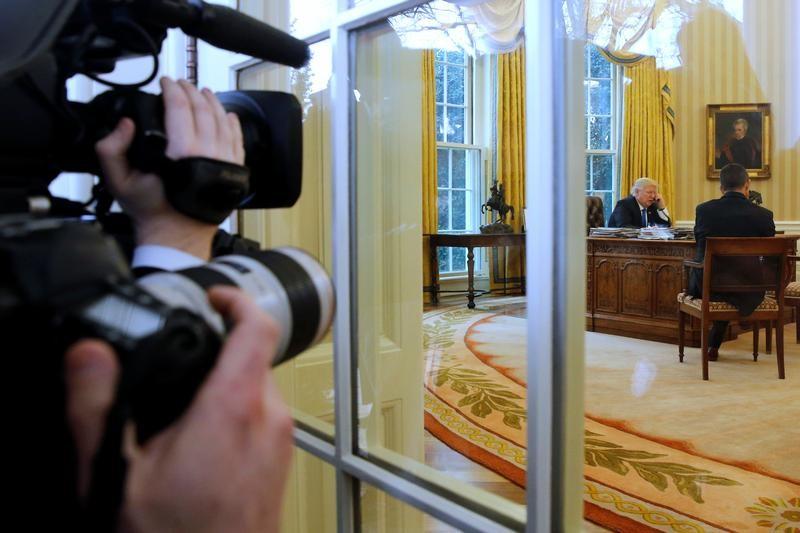
BERLIN—She is controlled and cautious, a physicist from East Germany who takes her time making decisions and has never relished the attention that comes from being Europe’s most powerful leader.
He is a wealthy real estate magnate from New York who shoots from the hip and enjoys the spotlight.
It is hard to imagine two leaders more different, in style or substance, than Angela Merkel, the German chancellor, and Donald Trump, the new president of the United States.
For months, they have been engaged in an uneasy long-distance skirmish over policy and values.
On Tuesday, they meet for the first time--a high-stakes encounter that will be watched by governments around the world for clues about the future of the transatlantic alliance, a partnership that has helped shape the global order since World War Two but which Trump is threatening to upend.
“Do I think they are going to become good friends? Probably not. They are very different personalities,” said Charles Kupchan, who advised Trump’s predecessor Barack Obama on European policy as a member of the National Security Council.
“But I do think they have a strong interest, both politically and strategically, in learning how to work together. It is arguably the most important meeting with a foreign leader of Trump’s presidency.”
German officials say the detail-oriented Merkel, 62, has been preparing assiduously for her trip to Washington.
She has watched Trump’s speeches and poured over his interviews, including a lengthy Q&A with Playboy magazine from 1990 in which he floats many of the controversial ideas he is now trying to implement as president, they say.
Members of her entourage have also analyzed Trump’s encounters with other leaders—including Britain’s Theresa May, Japan’s Shinzo Abe and Canada’s Justin Trudeau—and have had exchanges with some of their counterparts on how to handle the unpredictable former reality-TV star, the officials added.
“We have to be prepared for the fact that he does not like to listen for long, that he prefers clear positions and does not want to delve into details,” said one senior German official.
‘CATASTROPHIC MISTAKE’
On both economic and foreign policy, the divide between the two leaders appears vast.
Trump, 70, has called Merkel’s decision to allow hundreds of thousands of refugees into Germany a “catastrophic mistake.”
He has threatened to impose tariffs on German carmakers that import into the U.S. market. And he has criticized Berlin for not spending more on defense, a longstanding U.S. complaint that Merkel has promised to address.
Another source of tension is Germany’s 50 billion euro trade surplus with the United States.
Trump adviser Peter Navarro has accused Germany of gaining unfair trade advantages through a weak euro. Merkel and her ministers have pointed out that the European Central Bank—and not Berlin—controls the fate of Europe’s single currency.