London Tube Strike Causes Unprecedented Action by Authorities

September 7, 2010 Updated: October 1, 2015

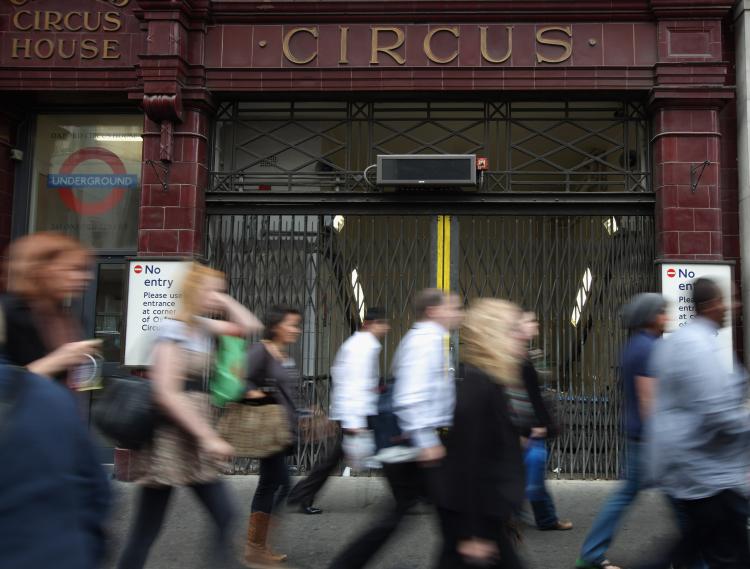
Commuters make their way past a closed Underground tube station at Oxford Circus on Sept. 6, 2010 in London, England. (Dan Kitwood/Getty Images)
A Tube strike in London on Monday and Tuesday has prompted unprecedented action by the Mayor and Transport for London (TfL).

About 100 extra buses, escorted bike rides, marshalled taxi ranks, and the capacity for 10,000 more journeys on the Thames are being provided to help keep London unclogged.

Volunteers positioned at tube, bus, and rail stations will assist Londoners with their journeys and give maps and useful information.

The strike concerns moves by London Underground (LU) to cancel a number of blue collar and management jobs and to close some ticket offices.

The National Union of Rail, Maritime and Transport Workers (RMT) claims the closures and staff reductions will jeopardize safety.

RMT general secretary Bob Crow pointed out that LU sent out a circular to staff which desperately appealed for volunteers to help run some skeleton services. In the circular, LU say that those without the required Operational Licences will still be deployed and that those with lapsed licenses can have them renewed without complying with the normal training and updating programme.

“Sending out a few volunteers without the necessary Operational Licences and training to try and run a handful of trains is a disaster waiting to happen.

“Instead of playing fast and loose with safety, it is about time that the Mayor and his officials took the issues at the heart of this dispute seriously, removed the threat of these savage cuts from above our members heads, and cleared the way for meaningful talks aimed at protecting safety and safe staffing levels,” he said in a press release.

“The station staff who apprehended a man carrying knives and loaded guns last weekend, along with the staff whose vigilance and skills averted major fire disasters at Euston and Oxford Service recently, are the very personnel whose jobs are on the block. That is what this dispute is all about.”

According to the Metro, the daily free paper for passengers, Bob Crow also said: "We have laid out the clearest possible evidence to the Mayor and his officials that if he breaks his promises and slashes station staffing numbers he will be giving the green light to disaster."

The Metro said the union pointed to an incident of a man carrying a Samurai sword last weekend and two incidents of smoke coming from machinery spotted by station staff as evidence of their importance.

The Transport Salaried Staff (TSSA), which represents managers, is striking at the same time over a pay freeze.

Trades Union Congress (TUC) general secretary Brendan Barber backed the strike and said: "Tube staff are right to say there can be no compromise on safety and we fully support their action. The Mayor should honour his election promises and put a halt to these cuts."

John Cridland, deputy director-general of the Confederation of British Industry (CBI), said: "Just 33 percent of balloted members supported the strike, only 17 percent of the total workforce."

The CBI has offices across the UK as well as representatives in Brussels, Washington, Beijing, and Delhi. It claims to speak for some 240,000 businesses that together employ around a third of the private sector workforce.

The CBI has proposed that strikes should only go ahead if 40 per cent of those balloted, as well as a simple majority of those voting, support the strike.

TfL say they have given assurances to staff that changes proposed by London Underground will not involve compulsory redundancies, that every station that currently has a ticket office will continue to have one, and that stations will remain staffed at all times.

Other services, London Overground, Tramlink, and Docklands Light Railway (DLR), will be operating as normal, although some stations where there is an interchange with London Underground may be affected.

LU say: “The proposed changes would mean a reduction in the total number of posts across LU, but will involve no compulsory redundancies, and will have no impact on the tube's high safety standards.

Some LU ticket offices now regularly sell only six or seven tickets an hour.

"Sales from ticket offices are down 28 per cent over the last four years as more and more people switch to Oyster, a top-up swipe card. Just one in 20 tube journeys now starts with a visit to a ticket office," according to TfL.

“The changes would not affect Tube drivers, and the majority of the roughly 800 posts that are identified for reduction are ticket office staff; this also includes a saving of around 150 posts from reductions in management and administrative staff,” the TfL website said.

“This is out of a total of around 19,000 London Underground staff, so represents less than 5 percent of the workforce. Some 250 positions are already, or are expected to become vacant, so these would merely not be filled.”

The strike will last throughout Tuesday, Sept. 7. RMT and TSSA maintenance and engineering staff began their 24-hour strike at 17:00 on Monday, Sept. 6. Other RMT and TSSA Tube staff, including station staff and some drivers, will start at 21:00.