A Moscow court postponed a hearing for a high-profile case scheduled for Dec. 15. The postponement was regarded as a test for the Kremlin, and a reflection of the political and judiciary system.
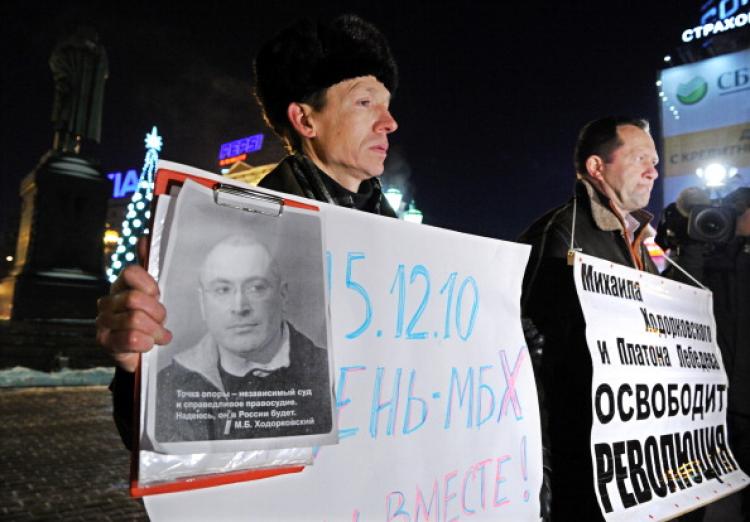
The court was set to give the final verdict for Mikhail Khodorkovsky, but rescheduled to Dec. 27 without providing an explanation. Hundreds of people gathered near the courthouse, among them were family relatives of Khodorkovsky, journalists, and human rights activists.
Khodorkovsky and his partner Platon Lebedev were arrested in 2003 on charges of fraud and tax evasion. Both were sentence to eight years in prison in 2005.
The case against Khodorkovsky has been among the highest-profile issues in Russia over the last several years. It is considered synonymous with characterizing Russia as an authoritarian state, where politics, the judicial system, and the criminal underworld are closely tied. It also ties into the perception that political reforms have no way to become realities, despite top officials paying them lip service.
Prior to his arrest, Khodorkovsky ran the Yukos Oil Company, which was one of the largest and most successful companies in Russia. Lebedev was his partner and the second largest stakeholder in the company.
Just one year into their sentences, in 2006, the Russian prosecutor’s office revealed new charges against them for money laundering and stealing close to 385 million tons of oil, with an estimated value of $27 billion. The oil was allegedly stolen from Yukos’ sub-companies between 1998 and 2003.
Former employees of Yukos have also faced heavy charges. Aleksey Pichugin, the head of company’s security service, was sentenced to life in prison in 2007.
Close to 55,000 company shareholders filed a lawsuit against the Russian government demanding $98 billion for financial losses from Yukos’ bankruptcy. Although the claim was filed in 2004, but only began to move this year.
Prior to his arrest, Khodorkovsky’s business and political ambitions were growing. It is believed that Russian President Vladimir Putin viewed this as interference with his plans to grip the country with a strong hand. At the time, Putin had already begun a campaign to suppress independent media.
Khodorkovsky had opposing viewpoints from Putin’s policy. He was rumored to have sponsored Russian opposition politicians—a move that irritated the Kremlin.
“We created together a model of half-criminal capitalism, which closes a way for Russia to the future. I want to change it,” said Andrey Piontkovsky, a journalist and political scientist, who has followed the case from its start.
“I try to change [the] rules of the game, but I can’t do it alone. It has to be done by the authority and officials, but they steal money and take bribes,” Piontkovsky said, regarding the disputes between Khodorkovsky and Putin.
“That’s an example of colliding two completely different models of economy,” he added.
During the last court hearing in Moscow, on Nov. 2, Khodorkovsky said that since his arrest he has “been feared more, but the rule of law has been respected much less.”
“I think that nobody seriously waits for me to admit my guilt. Today no one is unlikely to believe me if I say that I have stolen all oil, which belonged to my own company,” he said.
The second case was perceived as being launched due to the Russian government’s fear that Khodorkovsky’s release would begin the wane of Putin’s regime. During that case, the Russian prosecutor’s office demanded a six-year extension of the initial sentence.
The government prosecutor has not been able to prove Khodorkovsky’s guilt, however, according to observers.
“It was clear that this was a political trial, the aim of which is not only to prove that Putin was right to build a system based on bureaucratic capitalism and personal power, but also to show that he is not about to step down from this power,” states an analysis by Lilia Shevtsova, an expert with Carnegie Center in Moscow.
“For Putin to let Khodorkovsky out of prison would be tantamount to political suicide,” the analysis states.
Observers say that the delay on Dec. 15 was a display of the Kremlin’s fear to take further steps or move toward a positive resolution. The same delay took place in 2005 when a court was set to announce a verdict in Khodorkovsky’s first case.
“They want to grant Khodorkovsky and Lebedev with a big term, but fear doing it now. They are afraid of criticism outside and inside Russia,” said opposition politician Boris Nemtsov in his blog.
“It is an old authorities’ habit to postpone something to the very end so that people will pay less attention on it,” Khodorkovsky.ru reported, quoting Ludmila Alekseyeva, a Russian veteran human rights activist and the director of Moscow Helsinki Human Rights Group.
With reporting by Juliana Kim in Moscow
The court was set to give the final verdict for Mikhail Khodorkovsky, but rescheduled to Dec. 27 without providing an explanation. Hundreds of people gathered near the courthouse, among them were family relatives of Khodorkovsky, journalists, and human rights activists.
Khodorkovsky and his partner Platon Lebedev were arrested in 2003 on charges of fraud and tax evasion. Both were sentence to eight years in prison in 2005.
The case against Khodorkovsky has been among the highest-profile issues in Russia over the last several years. It is considered synonymous with characterizing Russia as an authoritarian state, where politics, the judicial system, and the criminal underworld are closely tied. It also ties into the perception that political reforms have no way to become realities, despite top officials paying them lip service.
Prior to his arrest, Khodorkovsky ran the Yukos Oil Company, which was one of the largest and most successful companies in Russia. Lebedev was his partner and the second largest stakeholder in the company.
Just one year into their sentences, in 2006, the Russian prosecutor’s office revealed new charges against them for money laundering and stealing close to 385 million tons of oil, with an estimated value of $27 billion. The oil was allegedly stolen from Yukos’ sub-companies between 1998 and 2003.
Former employees of Yukos have also faced heavy charges. Aleksey Pichugin, the head of company’s security service, was sentenced to life in prison in 2007.
Close to 55,000 company shareholders filed a lawsuit against the Russian government demanding $98 billion for financial losses from Yukos’ bankruptcy. Although the claim was filed in 2004, but only began to move this year.
Prior to his arrest, Khodorkovsky’s business and political ambitions were growing. It is believed that Russian President Vladimir Putin viewed this as interference with his plans to grip the country with a strong hand. At the time, Putin had already begun a campaign to suppress independent media.
Khodorkovsky had opposing viewpoints from Putin’s policy. He was rumored to have sponsored Russian opposition politicians—a move that irritated the Kremlin.
“We created together a model of half-criminal capitalism, which closes a way for Russia to the future. I want to change it,” said Andrey Piontkovsky, a journalist and political scientist, who has followed the case from its start.
“I try to change [the] rules of the game, but I can’t do it alone. It has to be done by the authority and officials, but they steal money and take bribes,” Piontkovsky said, regarding the disputes between Khodorkovsky and Putin.
“That’s an example of colliding two completely different models of economy,” he added.
During the last court hearing in Moscow, on Nov. 2, Khodorkovsky said that since his arrest he has “been feared more, but the rule of law has been respected much less.”
“I think that nobody seriously waits for me to admit my guilt. Today no one is unlikely to believe me if I say that I have stolen all oil, which belonged to my own company,” he said.
The second case was perceived as being launched due to the Russian government’s fear that Khodorkovsky’s release would begin the wane of Putin’s regime. During that case, the Russian prosecutor’s office demanded a six-year extension of the initial sentence.
The government prosecutor has not been able to prove Khodorkovsky’s guilt, however, according to observers.
“It was clear that this was a political trial, the aim of which is not only to prove that Putin was right to build a system based on bureaucratic capitalism and personal power, but also to show that he is not about to step down from this power,” states an analysis by Lilia Shevtsova, an expert with Carnegie Center in Moscow.
“For Putin to let Khodorkovsky out of prison would be tantamount to political suicide,” the analysis states.
Observers say that the delay on Dec. 15 was a display of the Kremlin’s fear to take further steps or move toward a positive resolution. The same delay took place in 2005 when a court was set to announce a verdict in Khodorkovsky’s first case.
“They want to grant Khodorkovsky and Lebedev with a big term, but fear doing it now. They are afraid of criticism outside and inside Russia,” said opposition politician Boris Nemtsov in his blog.
“It is an old authorities’ habit to postpone something to the very end so that people will pay less attention on it,” Khodorkovsky.ru reported, quoting Ludmila Alekseyeva, a Russian veteran human rights activist and the director of Moscow Helsinki Human Rights Group.
With reporting by Juliana Kim in Moscow