In the deeply and violently polarized politics of the Ivory Coast, partisan media has played a large part in fanning the flames and provoking violence. Most media outlets sit squarely in one camp or the other, often virulently attacking political leaders they do not support, other media, or the United Nations and foreign powers. In many instances, violence has ensued following their provocations. While Ivorian press is not responsible for the situation in the country, it has done much to exacerbate it, commentators say.
After the seminal presidential elections at the end of October 2010, media entities split into three camps: the Blue press—supporting the “old” President Laurent Gbagbo, who refuses to step down despite losing the election by most accounts; the Green press—backing the internationally recognized elected President Alassane Ouattara; and a small number that manage to stay independent.
Story continues after slide show
[etssp 209]
Ambroise Pierre, Reporters Without Borders (RSF) Africa desk head, says that the situation with a partisan media in Ivory Coast is nothing new.
What is new, however, is that the political crisis has deepened and the media have started using very tough language against each other. For example, the Blue press, represented basically by the two newspapers Notre Voie and Le Tempes, accuse Alassane Ouattara of being an element of destabilization and reject that he won the elections.
“They call Ouattara ‘a thief’ and ‘the stranger,’ implying he is not Ivorian. They assume he is just a puppet of the Western countries and their goal is to discredit this man and his supporters.”
Pierre, who is French by nationality, adds that in these newspapers you can find violent attacks against France and other Western countries and against foreign media also accused of destabilizing the Ivory Coast. However, he points out that media supporting Ouattara are just as guilty.
“On the other hand, in newspapers like Le Patriot or Ivorian, close to Ouattara, you can find propaganda in his favor, as well as articles against Gbagbo, accusing him and his supporters of killing people and of massacres, and you can find articles accusing them of the death of people because of pollution.”
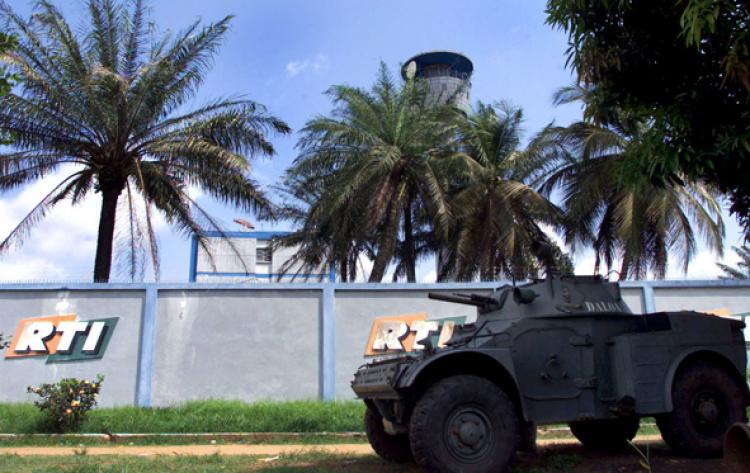
According to Pierre, the biggest propaganda producer in the country is the state-owned radio and television station Radiodiffusion Télévision Ivoirienne (RTI). He says RTI broadcasts hate speech against people whose Ivorian nationality is being disputed, like Ouattara, and propagates hate speech against the Western world as a whole.
Next: In Ivory Coast the state media is not a public media.
“In Ivory Coast the state media is not a public media. It is being controlled by the people in power,” said Pierre. Currently, the people in control are still Gbagbo’s people.
During the last month, there have been several attacks on the staff of the U.N. mission in Ivory Coast (ONUCI) after continuous anti-U.N. reporting by the state-owned RTI. On the night of Jan. 13, Gbagbo’s security forces fired on a ONUCI patrol in the Abobo district of Abidjan, according to a ONUCI statement. The previous day, a food convoy was assaulted, again allegedly by Gbagbo’s people.
Following the series of attacks, U.N. Secretary-General Ban Ki-moon warned in a statement on Jan. 14 that the U.N. has “concrete intelligence that the former president and those around him are inciting their followers to violence, both against the U.N. and their own countrymen.”
Ban repeatedly deplored the campaign of hatred and incitement by State radio, television, and other media loyal to Gbagbo, calling for “maximum restraint” and warning that “all persons who perpetuate such crimes will be held accountable.”
The U.N. chief stated he would eventually hand the case over to the International Criminal Court (ICC).
The online news channel African Press International quotes the Jan. 19 edition of pro-Gbagbo Notre Voie, which declared “Ouattara opts for terrorism.” The article further claimed that people paid by Ouattara had cut the throat of a forest warden in the Abobo district of Abidjan.
Failing in Their Role
Libasse Hane, program officer at the International Federation of Journalists Africa Office, says the media should step back from political matters and start acting based on their mission to provide information to people “with particular emphasis on the credibility of facts.”
“Any attempt at distorting the facts helps lay the seeds of unrest in [Ivory Coast],” commented Hane from his office in Dakar.
Hane does not blame the media for the deadlock in the Ivory Coast, but says their behavior since the end of 2010 has contributed to it.
“If the media had chosen to work in neutrality by emphasizing only the standards and ethical principles by systematically refusing to broadcast or publish any call for division, hatred, and discrimination, the problem would certainly not have had the scale we know today.”
However, as the Media Foundation for West Africa (MFWA) describes, the current media environment has its legacy.
In its report issued a few months prior to the disputed election, MFWA described Ivory Cost’s media as replete—with about a hundred newspapers—yet suffering because of a lack of infrastructure destroyed in the civil war, a lack of licensing and advertising restrictions, intimidation of journalists, and a shortage of political will to address media complaints.
Next: Media Under Attack
Media Under Attack