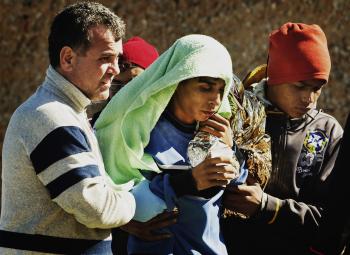
For Italians, the civil war in Libya does not evoke pictures of bloodshed and killings, but rather of a humanitarian disaster and the specter of an imminent wave of immigrants showing up at their doorsteps.
In the first days of the conflict, public debate in Italy circled around what Italian interests in Libya are and how Prime Minister Silvio Berlusconi should react. Now the focus has shifted to what Italy will do to cope with the possible flood of immigrants.
On Feb. 22, one week after protests began in Libya, Italian Foreign Minister Franco Frattini called upon European Union member countries to prepare themselves for the arrival of up to 350,000 refugees fleeing the violence in Libya. At a press conference in Cairo, he called the threat “immigration of epochal dimensions toward the European Union.”
Some experts say though, these worries are overblown, at least at the moment. Professor James Walston, political scientist at the American University in Rome says the Libyan story is being covered in Italy as an immigration emergency, but there is no emergency and so far only Tunisians have been arriving, not Libyans.
“They talk about ‘emergency’ as if it is already happening. But it is not,” says Walston.
In his opinion, fear is being percolated as a convenient way for the government to distract the public from the sex and corruption scandals that have been plaguing Berlusconi.
Since the start of the uprisings in North Africa, 5,500 migrants have arrived in Italy. Most are Tunisians, suddenly freer to leave home and look for better opportunities in Europe, reports geopolitical think tank Stratfor.
“In the present conditions, no one is arriving from Libyan shores. When the crisis is over, we will see. The crisis unfolding in North Africa will reshape things as well as the Italian approach,” wrote Roberto Aliboni, vice president of the International Affairs Institute, via his office in Rome.
Emiliano Alessandri, fellow at the Washington-based German Marshall Fund of the United States (GMF), says the specter of an immigrant wave to Italy has been over dramatized, but the risk is real.
The threat comes from the fact that now Col. Gadhafi and his regime is no longer in a position to control the flow of immigrants.
In the first days of the conflict, public debate in Italy circled around what Italian interests in Libya are and how Prime Minister Silvio Berlusconi should react. Now the focus has shifted to what Italy will do to cope with the possible flood of immigrants.
On Feb. 22, one week after protests began in Libya, Italian Foreign Minister Franco Frattini called upon European Union member countries to prepare themselves for the arrival of up to 350,000 refugees fleeing the violence in Libya. At a press conference in Cairo, he called the threat “immigration of epochal dimensions toward the European Union.”
Some experts say though, these worries are overblown, at least at the moment. Professor James Walston, political scientist at the American University in Rome says the Libyan story is being covered in Italy as an immigration emergency, but there is no emergency and so far only Tunisians have been arriving, not Libyans.
“They talk about ‘emergency’ as if it is already happening. But it is not,” says Walston.
In his opinion, fear is being percolated as a convenient way for the government to distract the public from the sex and corruption scandals that have been plaguing Berlusconi.
Since the start of the uprisings in North Africa, 5,500 migrants have arrived in Italy. Most are Tunisians, suddenly freer to leave home and look for better opportunities in Europe, reports geopolitical think tank Stratfor.
“In the present conditions, no one is arriving from Libyan shores. When the crisis is over, we will see. The crisis unfolding in North Africa will reshape things as well as the Italian approach,” wrote Roberto Aliboni, vice president of the International Affairs Institute, via his office in Rome.
Overblown but Risk is Real
Emiliano Alessandri, fellow at the Washington-based German Marshall Fund of the United States (GMF), says the specter of an immigrant wave to Italy has been over dramatized, but the risk is real.
The threat comes from the fact that now Col. Gadhafi and his regime is no longer in a position to control the flow of immigrants.