Fears were that the floodgates would open of unlimited spending of outside money by groups that have seemingly unlimited resources to influence the outcome of an election.
To take a closer look at the issue of outside money and how attack ads and other advertising tried to influence voters in the midterm elections, FactCheck invited representatives from the Republican and Democratic parties to present the strategies they adopted in the midterm elections.
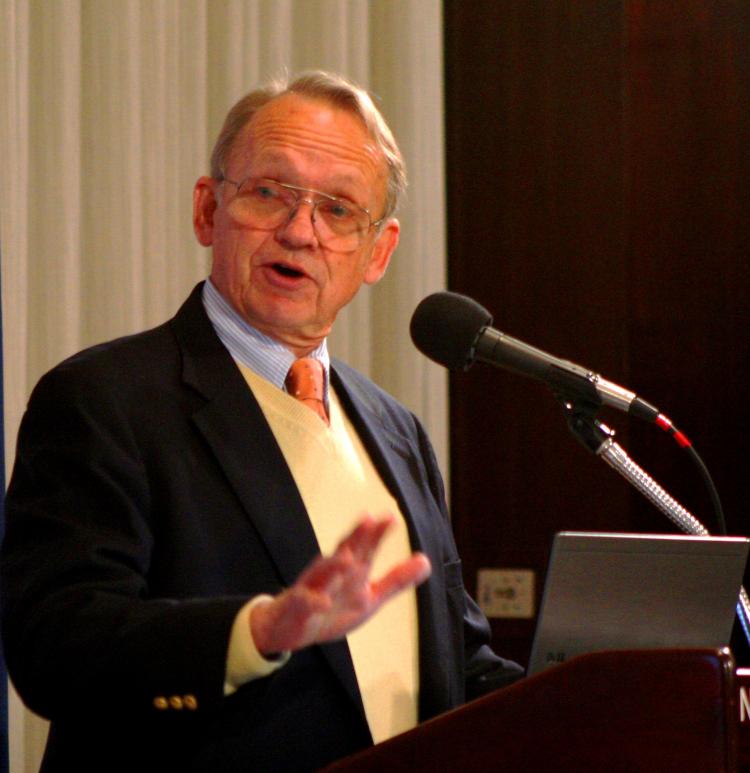
“We try to hold the politicians accountable to the factual accuracy of their campaign ads and other statements,” said Brooks Jackson, the director of FactCheck at the National Press Club on Dec. 13.
FactCheck is a nonpartisan, nonprofit organization that sees itself as a consumer advocate for voters. Its stated objective is “to reduce deception and confusion in U.S. politics.”
FactCheck, a project of the Annenberg Public Policy Center, University of Pennsylvania, has been in existence for seven years. The center’s materials are designed to educate scholars, policymakers, and the general public of the effects of the media on our lives. FactCheck drew upon other nonpartisan data sources, such as Opensecrets.org and Wesleyan Media Project at this conference.
Jackson said that outside group advertising tended to be attack ads. “The Supreme Court decision in Citizens United lifted many of the legal restrictions on business interests and labor unions in federal elections,” Jackson said. There was also a surge of spending by donors in this election cycle whose identities were not disclosed, he noted.
Citing the Wesleyan Media Project, Annenberg Public Policy Center Director Dr. Kathleen Hall Jamieson said that advertising spending in U.S. Senate, House, and gubernatorial races surpassed $1 billion—“a historical figure,” said Jamieson, borrowing the term that Wesleyan used to describe the record spending.
This amount did not include spending after Oct. 20, just short of two weeks before the end of the campaign. Spending in 2010 up to Oct. 20 for House seats was nearly 50 percent greater than for the same period in 2008 and nearly double the spending in Senate races.
Wesleyan says on its website that outside groups spent $120 million on advertising for candidates since Sept. 1. “The majority of that money ($85 million) has benefited Republicans.”
The Wesleyan Media Project is a massive undertaking. It tracks all broadcast advertisements of federal and state candidates in every media market in the country. Its stated motive is to analyze “how special interests are attempting to influence American democracy in general and political campaigns in particular.”
Expect more in 2012 of unrestricted independent spending, said Jackson, quoting from the L.A. Times, which stated there is a “financial arms race” in independent spending. Will we see the forming of new independent spending committees to raise ever-larger sums, making the next Congress in 2012 still more indebted to special interests? He could not see into the future, Jackson said, but we can examine the recent past and see what happened in a post-Citizens United world, and try to answer what the flurry of attack ads and spending by both sides actually accomplished.
Continued on the next page…