


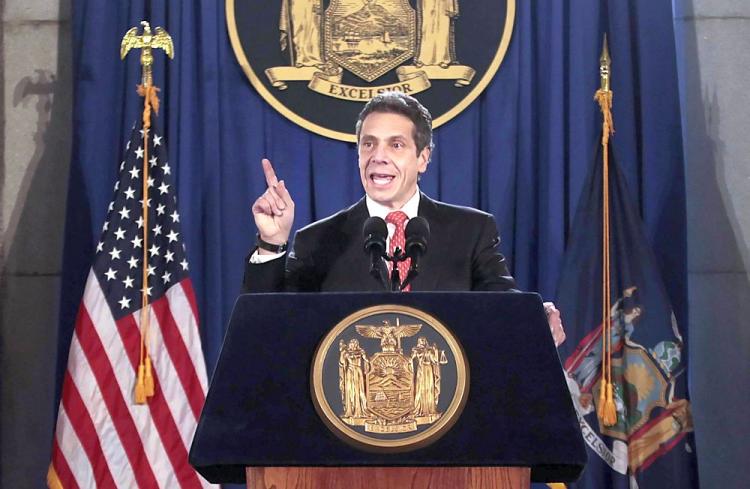
NEW YORK—Gov. Andrew Cuomo presented his $132.9 billion state budget for fiscal year 2011 on Tuesday afternoon. It was not a simple exercise in allocating funds, but rather a conceptual shift in the whole process of budget setting for years to come.
Cuomo says the $10 billion deficit is a figure created by the projected increase in state spending by about 12 percent. If state spending were to meet the rate of inflation, which was 1.5 percent on average for 2010, the deficit would decrease from $10 billion to $1 billion declared the governor.
“Nothing, my friends, is increasing by this amount!” exclaimed Cuomo. Medicaid spending is projected to increase by 13.2 percent over the next year, when the figures show an average 6.4 percent increase over the last 10 years. Spending for education is projected to increase by 13.1 percent this year; the governor says an increase of about 4 percent, comparable to the Personal Growth Index (PGI), is more reasonable.
“It is the cycle of passing these unsustainable increases that set us up for failure,” asserted Cuomo.
His plans, which include changing the laws that determine increases in state spending, sound a new tune for the “Albany budget dance.”
Gov. Cuomo has taken on a large task, and whether or not it is one he can execute depends upon the cooperation of the Legislature. A YNN-Marist poll indicates that 58 percent of New Yorkers are confident in Cuomo’s ability to remedy the fiscal woes of the state—those polled aren’t so sure, however, that the Legislature will meet the challenge.
Cuomo reiterated the tone of bipartisan cooperation he set in his State of the State address, saying he would work with anyone—Republican, Democrat, Libertarian, or any other affiliation—“we are all New Yorkers first,” he said.
“[It is] likely the Legislature will push for more spending and the governor will hold the line,” predicted professor William Eimicke, executive director of the Picker Center of Executive Education at the School of International and Public Affairs at Columbia University. “[But,] when it’s all said and done, I think it will be close to what Cuomo has proposed,” says Eimicke.
Eimicke agrees with Cuomo’s declaration that the taxpayers are behind him, that New Yorkers are in favor of cuts. Cutbacks in Medicaid, some layoffs, some attrition, and other measures that Cuomo proposes are likely to pass through Legislature, albeit with negotiation and minor changes because “it fits the fiscal climate,” says Eimicke.
Cuomo announced his much-anticipated cuts, and their distribution: Medicaid funding will be cut by 2 percent, education by 2.9 percent, municipality funding by 2 percent, and state agencies and administration by 10 percent.
“The state’s cut is five times higher than anyone else’s cut, and I’m proud of that,” beamed the governor. Just as he will have to deal with resistance from the Legislature, Cuomo is aware of resistance to any cuts or changes from municipal leaders.
The state cuts will manifest in a reorganization of the state’s agencies—he hopes to save $1.4 billion by consolidating 11 agencies into 4—but also likely in layoffs. The governor was very brief and noncommittal as he touched on this sore spot.
Cuomo hopes to cut $450 million out of the earnings of his approximately 200,000 employees. He said he would work with union leaders “in finding their best ideas to find these savings, the last resort and the least favored of these options would be layoffs.”
Next: 9,800 layoffs are on the table
He added that 9,800 layoffs are on the table, and quickly turned to the next subject.
While lower than the rumor of 15,000 layoffs that has been circulating in the media, that was just a rumor; now civil servants have a concrete figure right from the horse’s mouth.
Stephen Madarasz, spokesperson for the Civil Service Employees Association (CSEA) union, says the union is concerned about the services those jobs represent.
“Do we really want fewer people out driving the plow truck? Do we want fewer people in the hospital rooms? Do we want fewer people in the classrooms?” demanded Madarasz. “He kept talking about shared sacrifice, [but said] nothing to do with the millionaire’s tax,” added Madarasz.
A temporary tax applied to individuals with an annual income of $200,000 or more, or to households with an annual income of $300,000 or more is being called “the millionaire’s tax.” Cuomo does not support it, saying he does not want to drive the rich and their business to lower-tax regions.
“There’s absolutely no evidence that that happens,” said James Parrott of the Fiscal Policy Institute, an independent, nonpartisan, nonprofit, research and education organization that works to improve public policy. He says from 2003-2005 income tax increased and so did the number of rich living in the state.
With high-end income tax cuts at the federal level, he is of the opinion that high-income people do not need any more breaks. According to the YNN-Marist poll, 64 percent of New Yorkers agree with him.
The poll says 68 percent do, however, agree with Cuomo’s stance on property tax. His 2 percent property tax cap passed the Senate Monday.
The governor offered proposals for how to implement fiscal cuts in the areas of health care and education.
His Medicaid redesign taskforce will concentrate on reducing overhead costs. Cuomo looked at the home health care program as an example: out of every dollar, 52 cents goes to overhead costs and only 48 cents to the caregiver.
“This is a snapshot, but you can do this over, and over, and over again in the Medicaid system,” he pointed out.
In education, Cuomo’s 2.9 percent cut will translate into $1.5 billion—a figure he says should be covered by the $1.8 billion districts have in unspent or reserve funds. Cuomo points out that if teachers and management took a wage freeze that would trim $1.1 billion off the education budget.
He suggests a pay cut for the superintendents—40 percent make more than $200,000 annually.
“Why they get paid more than the governor of the state, I don’t understand,” said the Cuomo, joking that he applied for the job before settling for his position as governor.
The governor’s estimate of quantity was not without some consideration of quality. He demanded more bang for the taxpayer’s buck, repeating his plans for performance-based grants and agency accountability.
While transforming the way state spending increases are determined in the future, Cuomo also hopes to also infuse the budgeting formulas with performance measures.
The governor summed it up: “We spend too much, we get too little, and it makes us economically uncompetitive—that’s it in a line.”
Cuomo says the $10 billion deficit is a figure created by the projected increase in state spending by about 12 percent. If state spending were to meet the rate of inflation, which was 1.5 percent on average for 2010, the deficit would decrease from $10 billion to $1 billion declared the governor.
“Nothing, my friends, is increasing by this amount!” exclaimed Cuomo. Medicaid spending is projected to increase by 13.2 percent over the next year, when the figures show an average 6.4 percent increase over the last 10 years. Spending for education is projected to increase by 13.1 percent this year; the governor says an increase of about 4 percent, comparable to the Personal Growth Index (PGI), is more reasonable.
“It is the cycle of passing these unsustainable increases that set us up for failure,” asserted Cuomo.
His plans, which include changing the laws that determine increases in state spending, sound a new tune for the “Albany budget dance.”
Gov. Cuomo has taken on a large task, and whether or not it is one he can execute depends upon the cooperation of the Legislature. A YNN-Marist poll indicates that 58 percent of New Yorkers are confident in Cuomo’s ability to remedy the fiscal woes of the state—those polled aren’t so sure, however, that the Legislature will meet the challenge.
Cuomo reiterated the tone of bipartisan cooperation he set in his State of the State address, saying he would work with anyone—Republican, Democrat, Libertarian, or any other affiliation—“we are all New Yorkers first,” he said.
“[It is] likely the Legislature will push for more spending and the governor will hold the line,” predicted professor William Eimicke, executive director of the Picker Center of Executive Education at the School of International and Public Affairs at Columbia University. “[But,] when it’s all said and done, I think it will be close to what Cuomo has proposed,” says Eimicke.
Eimicke agrees with Cuomo’s declaration that the taxpayers are behind him, that New Yorkers are in favor of cuts. Cutbacks in Medicaid, some layoffs, some attrition, and other measures that Cuomo proposes are likely to pass through Legislature, albeit with negotiation and minor changes because “it fits the fiscal climate,” says Eimicke.
THE PLAN
Cuomo announced his much-anticipated cuts, and their distribution: Medicaid funding will be cut by 2 percent, education by 2.9 percent, municipality funding by 2 percent, and state agencies and administration by 10 percent.
“The state’s cut is five times higher than anyone else’s cut, and I’m proud of that,” beamed the governor. Just as he will have to deal with resistance from the Legislature, Cuomo is aware of resistance to any cuts or changes from municipal leaders.
The state cuts will manifest in a reorganization of the state’s agencies—he hopes to save $1.4 billion by consolidating 11 agencies into 4—but also likely in layoffs. The governor was very brief and noncommittal as he touched on this sore spot.
Cuomo hopes to cut $450 million out of the earnings of his approximately 200,000 employees. He said he would work with union leaders “in finding their best ideas to find these savings, the last resort and the least favored of these options would be layoffs.”
Next: 9,800 layoffs are on the table
He added that 9,800 layoffs are on the table, and quickly turned to the next subject.
While lower than the rumor of 15,000 layoffs that has been circulating in the media, that was just a rumor; now civil servants have a concrete figure right from the horse’s mouth.
Stephen Madarasz, spokesperson for the Civil Service Employees Association (CSEA) union, says the union is concerned about the services those jobs represent.
“Do we really want fewer people out driving the plow truck? Do we want fewer people in the hospital rooms? Do we want fewer people in the classrooms?” demanded Madarasz. “He kept talking about shared sacrifice, [but said] nothing to do with the millionaire’s tax,” added Madarasz.
A temporary tax applied to individuals with an annual income of $200,000 or more, or to households with an annual income of $300,000 or more is being called “the millionaire’s tax.” Cuomo does not support it, saying he does not want to drive the rich and their business to lower-tax regions.
“There’s absolutely no evidence that that happens,” said James Parrott of the Fiscal Policy Institute, an independent, nonpartisan, nonprofit, research and education organization that works to improve public policy. He says from 2003-2005 income tax increased and so did the number of rich living in the state.
With high-end income tax cuts at the federal level, he is of the opinion that high-income people do not need any more breaks. According to the YNN-Marist poll, 64 percent of New Yorkers agree with him.
The poll says 68 percent do, however, agree with Cuomo’s stance on property tax. His 2 percent property tax cap passed the Senate Monday.
HOW TO SAVE
The governor offered proposals for how to implement fiscal cuts in the areas of health care and education.
His Medicaid redesign taskforce will concentrate on reducing overhead costs. Cuomo looked at the home health care program as an example: out of every dollar, 52 cents goes to overhead costs and only 48 cents to the caregiver.
“This is a snapshot, but you can do this over, and over, and over again in the Medicaid system,” he pointed out.
In education, Cuomo’s 2.9 percent cut will translate into $1.5 billion—a figure he says should be covered by the $1.8 billion districts have in unspent or reserve funds. Cuomo points out that if teachers and management took a wage freeze that would trim $1.1 billion off the education budget.
He suggests a pay cut for the superintendents—40 percent make more than $200,000 annually.
“Why they get paid more than the governor of the state, I don’t understand,” said the Cuomo, joking that he applied for the job before settling for his position as governor.
The governor’s estimate of quantity was not without some consideration of quality. He demanded more bang for the taxpayer’s buck, repeating his plans for performance-based grants and agency accountability.
While transforming the way state spending increases are determined in the future, Cuomo also hopes to also infuse the budgeting formulas with performance measures.
The governor summed it up: “We spend too much, we get too little, and it makes us economically uncompetitive—that’s it in a line.”


