NEW YORK—In the confusing days following Sept. 11, 2001, the federal government put a price tag on the epic cleanup: $20 billion. Ten years later, the city’s Independent Budget Office (IBO) assessed the amount of federal aid actually provided.
It found that the government made good on its promise—and then some.
“Nobody had an experience like that before,” said Doug Turetsky, spokesman for IBO, in a phone interview, explaining the challenge of estimating 9/11 cleanup costs. The $20 billion estimate was a shot in the dark, but it just about hit the mark.
Immediate cleanup costs were about $1 billion less than expected, but the leftover funds became unrestricted spending money for the state and city government. It wasn’t just about cleaning up the rubble and ruins that covered the once-polished Financial District; the economic impacts due to lost business had to be mitigated as well.
The state and city got $4.5 billion in general budgetary relief through the Liberty Zone package to help with the overall recovery.
The IBO’s report released on Wednesday shows great returns on the investment in Lower Manhattan.
All funded building projects are either completed or well underway. The federal funds transformed Lower Manhattan beyond the Financial District into Chinatown, Tribeca, and the Lower East Side. Business is thriving, and the residential population of the area has doubled over the last decade.
Some of the aid money has slipped through the cracks, however.
Through the Cracks
The state and city lost out on $727.8 million of the Liberty Zone package because the funding was not allocated before the Jan. 1, 2005, expiration date.
A pool of $2.9 billion for tax breaks relating to business development has remained stagnant. Few businesses are using the money, reported the IBO, Sen. Charles Schumer, and former City Comptroller William Thompson, though it is hard to track.
One of the tax-break exemptions, for example, was designated for businesses buying new equipment. But, legislation enacted shortly afterward provided greater exemptions for the same thing.
Mayor Michael Bloomberg and former Gov. George Pataki requested for the federal government to reallocate $2 billion of this money to transportation incentives and tax breaks in 2007. The legislation died in Congress, however.
The Port Authority, Lower Manhattan Development Corporation, and the Economic Development Corporation were among proponents of a different use for the money—a rail line between Lower Manhattan and John F. Kennedy International Airport, through Brooklyn’s Atlantic terminal.
A 2008 study showed that this project could cost more than $10 billion, so they would have to come up with another $8 billion to make it happen.
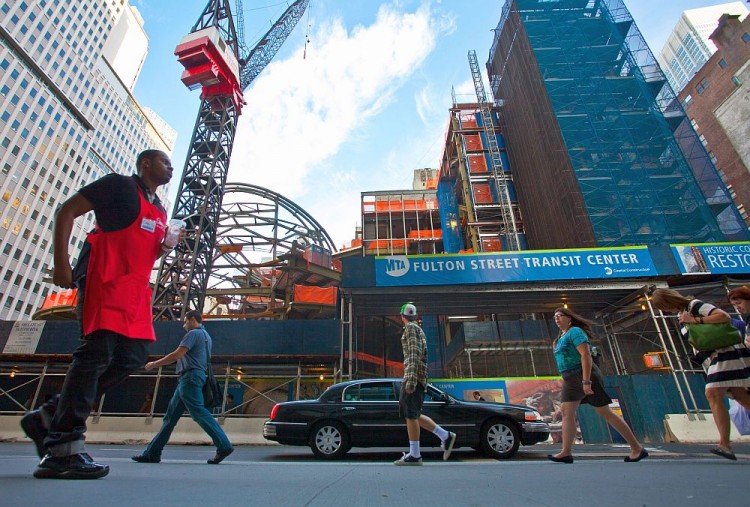
The federal government did invest quite a sum in improving Lower Manhattan’s connectivity. Approximately $4.5 billion went into transportation—the new Fulton Street subway station and the transportation hub that is due to open around 2015 at the World Trade Center site are two of the projects fed by this grant.
Not included in the $20.5 billion that, according to the IBO, the federal government provided in aid are the billions spent on the Victim Compensation Fund (VCF).
Victim Compensation Fund
Congress awarded $7 billion to survivors, relatives, and businesses affected by losses on 9/11. The fund closed in 2003, but was reopened in December of last year with the passage of the James Zadroga 9/11 Health and Compensation Act.
Victims now have access to an additional $2.8 billion, and first responders suffering adverse health effects from the aftermath of the tragedy have access to an additional $1.6 billion.
However, the bill requires for the city to pay 10 percent of the program’s expenditures.
The city budgeted $8.4 billion based on 9/11 health programs previously in place. If federal estimates are correct, with the new program under the Zadroga Act, the costs could exceed the budgeted amount by $25 million each year through 2015, reported IBO.