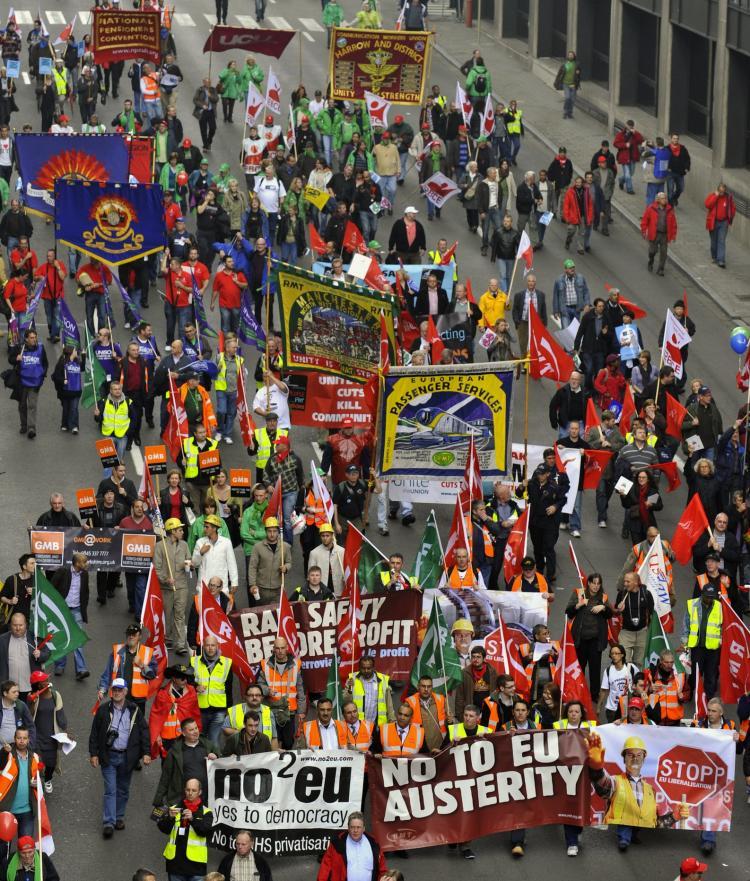
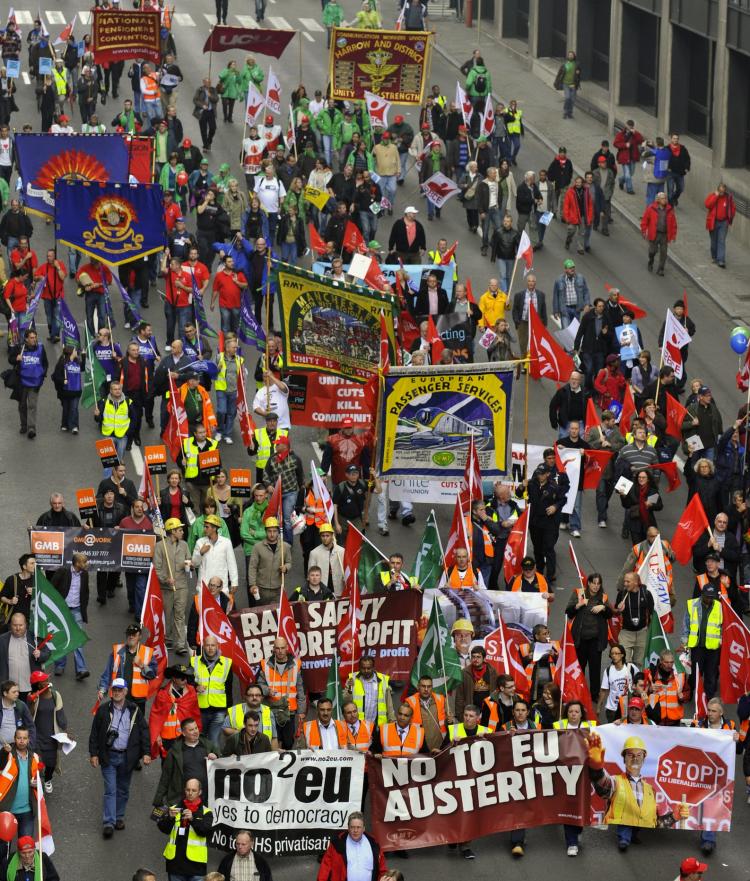
Thousands of people took to the streets across Europe on Wednesday to protest various austerity measures adopted by European Union (EU) countries, to diminish their deficits and debts.
According to the European Trade Union Confederation (ETUC), large demonstrations occurred in Brussels with about 100,000 people coming from all over Europe, as EU officials did the usual. They discussed the situations in the countries struggling with budget deficits.
However, Brussels’s police have put figures at 56,000 people involved and said that more than 200 were detained for minor administrative offenses, according to Reuters.
Marchers passed by the EU headquarters of political and economic institutions to show their disagreement with the adopted measures.
The ETUC reported that the demonstrations and strikes had also taken place in Spain, Italy, France, Portugal, Lithuania, Latvia, and Germany, among others.
Some EU parliamentarians from the European United Left/Nordic Green Left group joined the protests.
“We are unhappy with the government’s reforms. There needs to be more support for the unemployed,” a textile worker from Denmark told EU-Observer.
EU’s measures of reducing budget deficits have brought about wage cuts in the public sector and a rising retirement age.
European trade unions called on EU leaders to put public spending into the investment of jobs for young people who are particularly affected by unemployment and insecure work, instead of adopting austerity measures to seal budget deficits.
“There is still time not to choose austerity; still time to change direction,” ETUC said in a statement.
The hefty deficits carried by some European countries, particularly Greece, have had a large impact on financing. Analysts say that this has resulted in a decline in credit activity in Europe.
According to the trade unions, the 2008 financial crisis left more than 20 million people across Europe unemployed. The current measures could lead to higher unemployment. While France’s plans to raise the retirement age have led to public demonstrations.
According to the European Trade Union Confederation (ETUC), large demonstrations occurred in Brussels with about 100,000 people coming from all over Europe, as EU officials did the usual. They discussed the situations in the countries struggling with budget deficits.
However, Brussels’s police have put figures at 56,000 people involved and said that more than 200 were detained for minor administrative offenses, according to Reuters.
Marchers passed by the EU headquarters of political and economic institutions to show their disagreement with the adopted measures.
The ETUC reported that the demonstrations and strikes had also taken place in Spain, Italy, France, Portugal, Lithuania, Latvia, and Germany, among others.
Some EU parliamentarians from the European United Left/Nordic Green Left group joined the protests.
“We are unhappy with the government’s reforms. There needs to be more support for the unemployed,” a textile worker from Denmark told EU-Observer.
EU’s measures of reducing budget deficits have brought about wage cuts in the public sector and a rising retirement age.
European trade unions called on EU leaders to put public spending into the investment of jobs for young people who are particularly affected by unemployment and insecure work, instead of adopting austerity measures to seal budget deficits.
“There is still time not to choose austerity; still time to change direction,” ETUC said in a statement.
The hefty deficits carried by some European countries, particularly Greece, have had a large impact on financing. Analysts say that this has resulted in a decline in credit activity in Europe.
According to the trade unions, the 2008 financial crisis left more than 20 million people across Europe unemployed. The current measures could lead to higher unemployment. While France’s plans to raise the retirement age have led to public demonstrations.