Euro Bailouts Legal, Rules German High Court

September 7, 2011 Updated: October 1, 2015
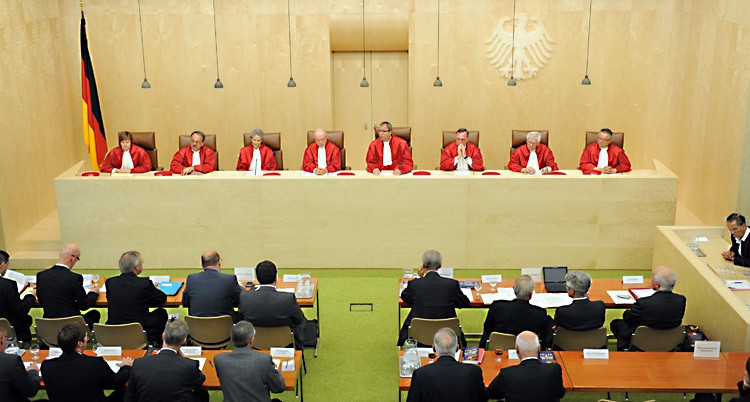
Germany's top court ruled that aid for Greece and rescues for other eurozone countries is legal but said parliament must have greater say in any future bailouts. (Uli Deck/AFP/Getty Images)

Germany's Federal Constitutional Court ruled on Wednesday that Germany's contributions to the bailout fund for debt-stricken eurozone countries are constitutional.

A group of economy professors and a senior politician from the Christian Social Union, Chancellor Merkel's sister party in Bavaria, had filed constitutional complaints, challenging the aid packages.

The plaintiffs argued that the acts quickly pushed through the German Bundestag in May 2010 authorizing financial aid to Greece, violated Parliament's budget autonomy.

The court rejected claims that the loans infringed on Parliament's right to control the spending of taxpayer money, or exceeded budget capacity.

Germany promised $173 billion in commitments to the European bailout fund, the European Financial Stability Facility (EFSF)—the biggest share of any country. The EFSF was created in 2010 to help debt-stricken countries of the eurozone, like Greece, avoid default and prevent instability for European economies.

Last week, Merkel pledged to raise that contribution to $297 billion.

In its ruling, the court stressed that for any future contribution to the bailout fund, Parliament must have a greater say. The Bundestag's Budget Committee has to give approval prior to any decision made by the government on the European level.

"As representative of the people, the elected members of the German Bundestag need to keep the control of basic decisions on budgetary policy when acting in the framework of the European Union," said presiding Judge Andreas Vosskuhle in handing down the ruling televised on DW-TV.

Supporters of eurozone bailouts interpreted the decision as a victory and a confirmation of their policies.

A vote in Bundestag expected in late September authorizing the extension of the EFSF will be a test for Merkel's coalition. Several members of her party, the Christian Democratic Union, have already announced that they will vote against it, according to media reports.

While Merkel has been a staunch defender of Germany’s commitment to the euro, survey data shows that many Germans are ambivalent about it. According to a poll by infratest dimap (experts in electoral and political research) conducted for the public broadcaster ARD in September, half of respondents believe that Germany as the biggest economy would fare better outside the eurozone.