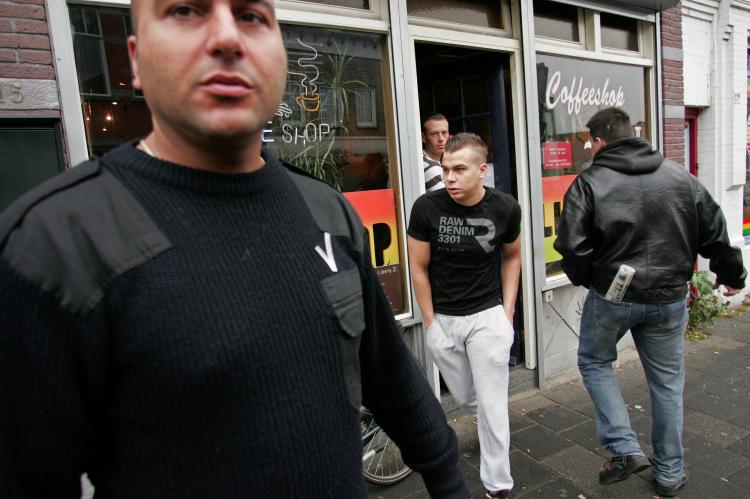
A Netherlands cafe with a sign saying “Coffee Shop” may look like a normal place to get a good cup of joe. Inside, however, people are often smoking, and the counter will display a wide variety of cannabis products for sale.
Some tourists come to Holland specifically for such shops, as they are permitted to smoke marijuana without fear of being arrested. A new ruling may change this, as the European Court in Luxembourg stated last week that nonresidents might be denied access to such coffee shops in accordance with European law.
In an attempt to fight public nuisance and the illegal market attributed to drug tourism, the city of Maastricht adopted a local order in 2005 to ban foreigners from access to coffee shops. One closed coffee shop claimed the ban is discriminatory. The Dutch Council of State requested the European Court to rule in this matter, and is expected to proceed in the spring of 2011.
Maastricht Mayor Onno Hoes told The Epoch Times that 14 coffee shops in the center of the city were visited by 1.4 million foreigners in 2008. This was 70 percent of the total visitors.
Hoes said the number of drug tourists is high in border towns such as Maastricht, which is near Belgium and Germany.
The number of visitors is much lower further into the Netherlands, with the exception of Amsterdam with its more than 220 coffee shops. In the town of Eindhoven, only 2 percent of the customers are foreigners, he said.
The “nuisance” caused by the drug tourists can be seen at the town center, where numerous cars are improperly parked. Another is drug dealers.
A side effect of the large number of drug tourists in Maastricht, according to Hoes, is “foreign seekers.” Hoes refers to them as young men from large cities that come to illegally sell soft and hard drugs on the streets.
Senior researcher at the Tilburg University, Nicole Maalsté said the perceived nuisance partly originates from the fact that foreigners who use cannabis mainly belong to a subculture and stand out, whereas in the Netherlands, users that frequent coffee shops belong to all levels of society. Maalsté has researched Dutch drug regulations for 20 years.
Since 2002, police have increasingly taken large-scale action against professional cannabis growers. Maalsté said, “They are the largest actions taken against cannabis cultivators in the world.”
Although the coffee shops seem to attract an illegal market and create public disturbance, according to Maalsté, things are a bit more complicated. She said the main cause is Dutch regulations that were never followed through.
According to Maalsté, since the ’60s and ’70s, in the time of the Beatles and free love, the Netherlands already had a large stream of foreigners visiting popular festivals. During the festivals, large groups of people used imported cannabis, and police could not cope with the situation and held discussions on whether it was worthwhile to prosecute the cannabis users.
The Ministry of Health then began research on the health risks of cannabis, and found they were low. Cannabis use was placed at the same level as alcohol and tobacco.
As a result, Dutch law on opium was restructured in 1976. This change aimed to separate hard drugs, such as cocaine, from soft drugs. It was then that personal use of cannabis was permitted, and its use was decriminalized.
This also meant that police were not obligated to arrest cannabis users. The regulation of supply, however, was left as a future matter, according to Maalsté. The production, import, export, and possession of cannabis remained illegal, and violators are subject to prosecution.
Regulations on supply were never formed, and the number of coffee shops grew to 1,500 in the ’80s. By the ’90s, officials began to get worried and started regulating coffee shops. The AHOJ-G criteria was introduced in 1992, and currently prohibits coffee shops from advertising, selling hard drugs, causing public nuisance, and allowing entry to youth below the age of 18. It also prohibits the selling of more than five grams of cannabis to one person per day, and limits store supply to 500 grams.
Police then began taking action against cannabis growers, and this, combined with increasingly tough regulations, caused a drop in coffee shops to 666 across the country, according to a periodical research performed by an interval research agency in combination with the University of Groningen.
This then led to customer growth for the remaining coffee shops, according to Maalsté, which led to more traffic on the supply and demand side.
In order to fight the nuisance, many cities took matters into their own hands. Roosendaal and Bergen-op-Zoom, near the Belgium border, simply closed the coffee shops in February 2010. According to Maalsté this would not immediately solve the problem of the illegal market, as it will take an estimated 15 years before the changes will affect visits from drug tourists.
This same issue may affect whether or not measures taken in Maastricht are effective, as refusing foreigners from coffee shops doesn’t stop drug tourists from coming.
One coffee shop owner, M. Mazid told The Epoch Times, “There will be somebody waiting on the corner of the street.” His implication being that illegal drug traffickers are happy to provide the desired soft and hard drugs to drug tourists.
On the national level, the government is intending to ban foreigners from coffee shops across the country. A factor being considered is the possible economic effect the move would have in bringing tourists to large cities. In 2008, drug tourists spent 119 million euros (US$156.04 million) on items including food and clothes, according to the local government in Maastricht.
In Amsterdam, tourist revenue is even higher, and is 15 times the amount spent at the coffee shops, as tourists there may spend a couple days enjoying the city, as opposed to a single day visit to the border cities.
When the European Court announced its ruling, the Maastricht council held a meeting where it was proposed removing the ban of foreigners from coffee shops. It was also proposed to relocate half of the coffee shops to the outskirts of town, as this would reduce the strain of the coffee shops on the city center. The final decision, however, remains to be seen.