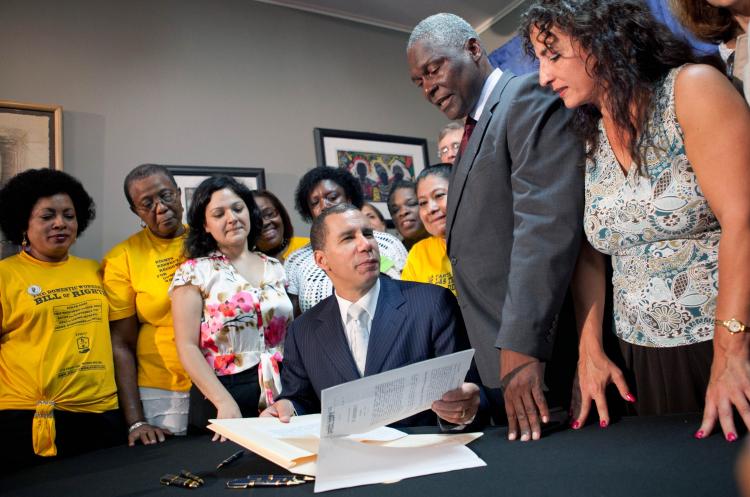
NEW YORK—Amid the tremendous emotion and heartfelt celebration of over 200 people at Harlem’s Dwyer Cultural Center Tuesday, Gov. Paterson signed the nation’s first Bill of Rights for domestic workers.
The law corrects what the governor calls an historic injustice: when workers first gained the right to a minimum wage, among other basic rights, in 1937, farm and domestic workers were exempted because Southern Democrats who were needed to pass the law disagreed with paying minimum wage to the “hired help.”
“I wonder if President Roosevelt ever dreamed that it would take until 2010, 75 years until after he died, for there to be action taken by even one state on this issue,” said Gov. Paterson.
There are 200,000 nannies, maids, and elderly caregivers in New York, who, until now, have worked in American homes while receiving no legal protection.
The workers, most of whom are women of color, have been subject to unregulated wages, long hours without overtime, no right to holidays, benefits, or legal protection against harassment, and firing without notification or severance, even after long years of service.
“We have totally disrespected them until today,” said the governor.
The Domestic Workers’ Bill of Rights, sponsored by Sen. Diane J. Savino (D-N.Y.), gives recognition to domestic workers under the law, and includes basic labor regulations such as a right to minimum wage, days off for rest, paid days off, and protection from discrimination. A Department of Labor Task Force will begin to look into the possibility of collective bargaining.
“We owe this great moment to the thousands of domestic workers who sacrificed their time, their wages, their energy, attending meetings, vigils, marching, telling their stories many times over, so that this workforce could have a new beginning,” says Priscilla González, director of the Domestic Workers United, the group that lobbied the government to enact the changes.
“It is an example of what can happen when people come together with patience, determination, and love, and see the power of others to be capable of more,” she added.
The domestic workers bill passed with democratic majority support and without any organized opposition, says González.
“There hasn’t been anybody to come out in an organized way to say this is not what should happen,” she said.
Attending the press conference was Donna Schneiderman, representing 100 employers of domestic worker who are part of the Jews for Racial and Economic Justice, advocating under Employers for Justice Network.
Schneiderman, who has employed the same nanny for 12 years, described how she used to talk to friends and others at the park, and in chat rooms, where they would consult each other about what should constitute fair wages, and dignified treatment of their support workers.
“Although we believe that we have been fair in our employment practices, after all these years, we are not entirely sure that what we deem to be fair, is, in fact, fair,” she said.
“It has been difficult to know without standards in place,” she added.
Ms. Deloris Wright, representing the 200,000 domestic workers belonging to Domestic Workers United, said, “We give our hearts and health to the families that we work for, forming special bonds with these children that we raise, the elderly, and the sick that we attend to.”
“We make homes function. This city, this state, would not run without us,” said Ms. Wright as a cheer went up in the room.
Today we are seen as providing a critical service, and we are seen as the professionals we are, she said, because we are recognized and protected by the law.
The law corrects what the governor calls an historic injustice: when workers first gained the right to a minimum wage, among other basic rights, in 1937, farm and domestic workers were exempted because Southern Democrats who were needed to pass the law disagreed with paying minimum wage to the “hired help.”
“I wonder if President Roosevelt ever dreamed that it would take until 2010, 75 years until after he died, for there to be action taken by even one state on this issue,” said Gov. Paterson.
There are 200,000 nannies, maids, and elderly caregivers in New York, who, until now, have worked in American homes while receiving no legal protection.
The workers, most of whom are women of color, have been subject to unregulated wages, long hours without overtime, no right to holidays, benefits, or legal protection against harassment, and firing without notification or severance, even after long years of service.
“We have totally disrespected them until today,” said the governor.
The Domestic Workers’ Bill of Rights, sponsored by Sen. Diane J. Savino (D-N.Y.), gives recognition to domestic workers under the law, and includes basic labor regulations such as a right to minimum wage, days off for rest, paid days off, and protection from discrimination. A Department of Labor Task Force will begin to look into the possibility of collective bargaining.
“We owe this great moment to the thousands of domestic workers who sacrificed their time, their wages, their energy, attending meetings, vigils, marching, telling their stories many times over, so that this workforce could have a new beginning,” says Priscilla González, director of the Domestic Workers United, the group that lobbied the government to enact the changes.
“It is an example of what can happen when people come together with patience, determination, and love, and see the power of others to be capable of more,” she added.
The domestic workers bill passed with democratic majority support and without any organized opposition, says González.
“There hasn’t been anybody to come out in an organized way to say this is not what should happen,” she said.
Attending the press conference was Donna Schneiderman, representing 100 employers of domestic worker who are part of the Jews for Racial and Economic Justice, advocating under Employers for Justice Network.
Schneiderman, who has employed the same nanny for 12 years, described how she used to talk to friends and others at the park, and in chat rooms, where they would consult each other about what should constitute fair wages, and dignified treatment of their support workers.
“Although we believe that we have been fair in our employment practices, after all these years, we are not entirely sure that what we deem to be fair, is, in fact, fair,” she said.
“It has been difficult to know without standards in place,” she added.
Ms. Deloris Wright, representing the 200,000 domestic workers belonging to Domestic Workers United, said, “We give our hearts and health to the families that we work for, forming special bonds with these children that we raise, the elderly, and the sick that we attend to.”
“We make homes function. This city, this state, would not run without us,” said Ms. Wright as a cheer went up in the room.
Today we are seen as providing a critical service, and we are seen as the professionals we are, she said, because we are recognized and protected by the law.