A standoff between presidential candidates in the Côte d'Ivoire (Ivory Coast) on Nov. 28 led to two men being sworn in as president on Saturday. Both the incumbent president and the opposition leader claim to have won the elections as tensions in the country are on the rise.
According to the Côte d'Ivoire’s Independent Electoral Commission, the opposition leader, Alassane Ouattara, is the official winner of the elections. The internationally composed commission to make sure the elections proceed according to internationally acknowledged principles of democracy, announced Thursday Ouattara won with 54.1 percent of the votes.
The commission ruled that reported irregularities surrounding the vote did not invalidate the results.
A United Nations envoy also recognized Ouattara as the rightful winner, calling the elections “transparent and credible,” in a statement.
“The secretary-general stresses that the outcome of the presidential election as certified by his special representative, has been recognized by the broad international community, demonstrating the firm resolve and commitment of the international community toward Côte d'Ivoire,” said a statement issued by U.N. Secretary-General Ban Ki-moon’s spokesperson.
However, Côte d'Ivoire’s Constitutional Council declared incumbent President Laurent Gbagbo the winner on Friday, because of the invalidation of vote results from four regions in the north.
Côte d'Ivoire’s is divided sharply between the country’s Muslim north, the main support base for Ouattara’s Rally of the Republicans party, and a largely Christian south that support’s Gbagbo’s Popular Front.
Hours later, the military closed the country’s land borders and air space.
The rising tensions are giving rise to concerns over a possible armed conflict in the country. International organizations like Human Rights Watch (HRW) have appealed to people in the country to remain calm.
“If ever there was a time for cool heads to prevail in Côte d'Ivoire, this is it,” said Corinne Dufka, senior West Africa researcher at Human Rights Watch in a statement.
HRW has also called upon the U.N. peacekeepers already stationed there under the U.N. Operation in the Ivory Coast (UNOIC) to be prepared to protect the local population.
According to HRW, on Dec. 1, paramilitary forces raided Ouattara’s offices in Abidjan, opening fire and leaving at least four dead and many others wounded.
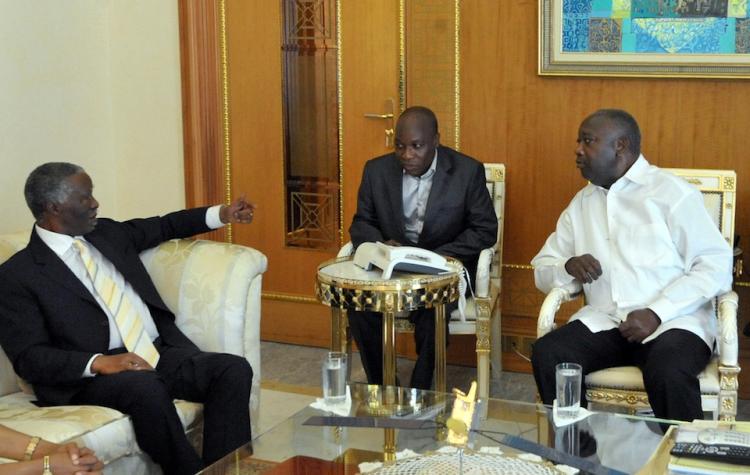
On Sunday, former South African President Thabo Mbeki arrived in the Ivory Coast to try to mediate a resolution to the stalemate.
The Nov. 28 poll was a runoff election after the Oct. 31 vote failed to produce an absolute majority for either candidate. The elections were postponed several times and are only the third time Ivoirians have gone to the polls since the first multiparty elections in 1995. The last election was in 2000.
The 2000 vote was also hotly contested. Gbagbo claimed victory, as did Robert Guéï who came to power in a coup less than a year before. However, a revolt in Gbagbo’s favor after the election forced his rival to flee the country and Gbagbo has been the disputed president ever since. There was also a failed coup attempt on Gbagbo in 2002.
According to the Côte d'Ivoire’s Independent Electoral Commission, the opposition leader, Alassane Ouattara, is the official winner of the elections. The internationally composed commission to make sure the elections proceed according to internationally acknowledged principles of democracy, announced Thursday Ouattara won with 54.1 percent of the votes.
The commission ruled that reported irregularities surrounding the vote did not invalidate the results.
A United Nations envoy also recognized Ouattara as the rightful winner, calling the elections “transparent and credible,” in a statement.
“The secretary-general stresses that the outcome of the presidential election as certified by his special representative, has been recognized by the broad international community, demonstrating the firm resolve and commitment of the international community toward Côte d'Ivoire,” said a statement issued by U.N. Secretary-General Ban Ki-moon’s spokesperson.
However, Côte d'Ivoire’s Constitutional Council declared incumbent President Laurent Gbagbo the winner on Friday, because of the invalidation of vote results from four regions in the north.
Côte d'Ivoire’s is divided sharply between the country’s Muslim north, the main support base for Ouattara’s Rally of the Republicans party, and a largely Christian south that support’s Gbagbo’s Popular Front.
Hours later, the military closed the country’s land borders and air space.
The rising tensions are giving rise to concerns over a possible armed conflict in the country. International organizations like Human Rights Watch (HRW) have appealed to people in the country to remain calm.
“If ever there was a time for cool heads to prevail in Côte d'Ivoire, this is it,” said Corinne Dufka, senior West Africa researcher at Human Rights Watch in a statement.
HRW has also called upon the U.N. peacekeepers already stationed there under the U.N. Operation in the Ivory Coast (UNOIC) to be prepared to protect the local population.
According to HRW, on Dec. 1, paramilitary forces raided Ouattara’s offices in Abidjan, opening fire and leaving at least four dead and many others wounded.
On Sunday, former South African President Thabo Mbeki arrived in the Ivory Coast to try to mediate a resolution to the stalemate.
The Nov. 28 poll was a runoff election after the Oct. 31 vote failed to produce an absolute majority for either candidate. The elections were postponed several times and are only the third time Ivoirians have gone to the polls since the first multiparty elections in 1995. The last election was in 2000.
The 2000 vote was also hotly contested. Gbagbo claimed victory, as did Robert Guéï who came to power in a coup less than a year before. However, a revolt in Gbagbo’s favor after the election forced his rival to flee the country and Gbagbo has been the disputed president ever since. There was also a failed coup attempt on Gbagbo in 2002.