A forum in New York featuring Taiwan’s opposition chairwoman was briefly brought to a halt when an audience member identifying himself as a Chinese national challenged her over communist China’s intentions toward Taiwan.
On June 8, Cheng outlined her vision for future cross-strait relations and discussed ways to maintain peace across the Taiwan Strait during an hour-long conversation hosted by the New York-based think tank Asia Society. The conversation was followed by a roughly 30-minute question-and-answer session.
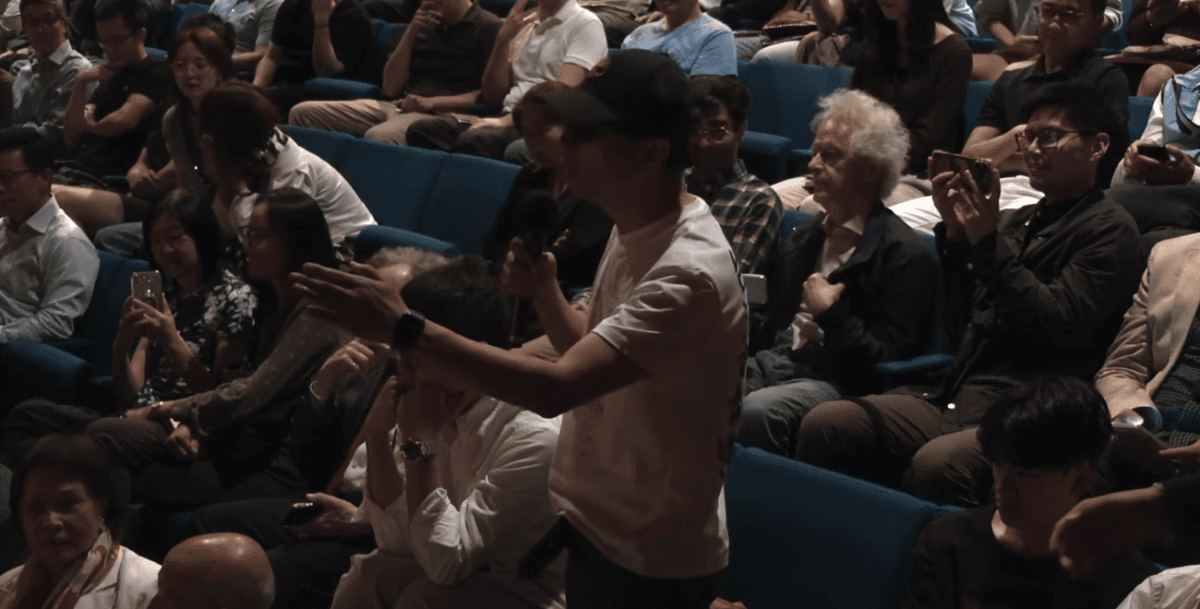
Before allowing Cheng to answer, the man goes on to share his own views.
“As someone from mainland China, I’d like to explain why Xi Jinping is preparing to take Taiwan by force,” the man can be heard saying.
“As a mainland Chinese, I am very clear on this,” the man said. “Because China is an authoritarian society, and Xi Jinping is a dictator.”
His remarks drew a response from the crowd.
One of the event’s hosts then said: “Please, sit down. ... I think you’ve had your 30 seconds. Please surrender the microphone.”
The video recording published by the Asia Society on YouTube did not capture what the man said next. However, additional footage of the incident, reported by multiple Taiwanese media outlets, shows the man turning toward the audience and saying, “Can you let me finish?” twice. He then turns toward Cheng and the hosts and says, “Can you let me finish?”
“Xi Jinping wants to take over Taiwan because Taiwan is a democratic society, while China is an authoritarian society. Authoritarian societies do not allow democratic societies to exist,” the man says.
The man eventually surrendered his microphone and was escorted away. Before leaving, he pointed to the Chinese text on the back of his white T-shirt, which read: “Embrace the Communist Party” and “Taiwan will become Hong Kong.”
In the footage aired by Taiwanese outlets, the man can be heard saying, “for you” three times while pointing to the back of his shirt and directing the remark toward Cheng, who was onstage.
“Embrace the Chinese Communist Party, [and] Taiwan will become Hong Kong next,” the man says in English before he is escorted out.
Wang Ting-yu, a lawmaker of Taiwan’s ruling DPP, also shared a video of the incident on his Facebook page on June 10, suggesting that, in his view, those critical of the Chinese Communist Party (CCP) would not be welcome at KMT overseas events.
The CCP, which regards the democratically governed Taiwan as a Chinese province, seeks to seize Taiwan to achieve what it calls “national rejuvenation.” The regime has labeled Taiwanese President Lai Ching-te a “separatist” and has refused to engage with his administration since he took office in May 2024.
Should the KMT win the presidential race in 2028 and govern Taiwan for the subsequent four years, Cheng said through a translator at the Asia Society conversation that she hoped that the current hostility would be turned into “goodwill expectation and mutual trust” through cross-strait exchanges and dialogue.
Cheng said China and Taiwan could coexist under what she called a “one China framework,” arguing that neither side “needs to destroy the other side.”
“So based on my understanding, the existence of Taiwan will not challenge the CCP’s legitimacy and legality,” Cheng said.
However, some China experts have previously contended that Taiwan’s success directly undermines the CCP’s rule.
“So long as this example exists, it severely undermines the credibility and authority of the CCP, especially with the Chinese people who are under their thumb,” Pompeo said at the time.
Taiwan’s economic success and freedoms “show the Chinese people that the CCP’s claim that its leadership is the sole path for Chinese economic development is a fraud,” Gorrie said.
Should Xi open to dialogue with Taiwan, Cheng was asked about Beijing’s known tactics of relying on “coercive power even when dialogue is underway.”
In response, Cheng said that even countries considered “neutral” maintain their own military forces.
“It is simply impossible for mainland China to give up on a strong national defense,” Cheng said. “So here in Taiwan, we need to take a very pragmatic attitude.”
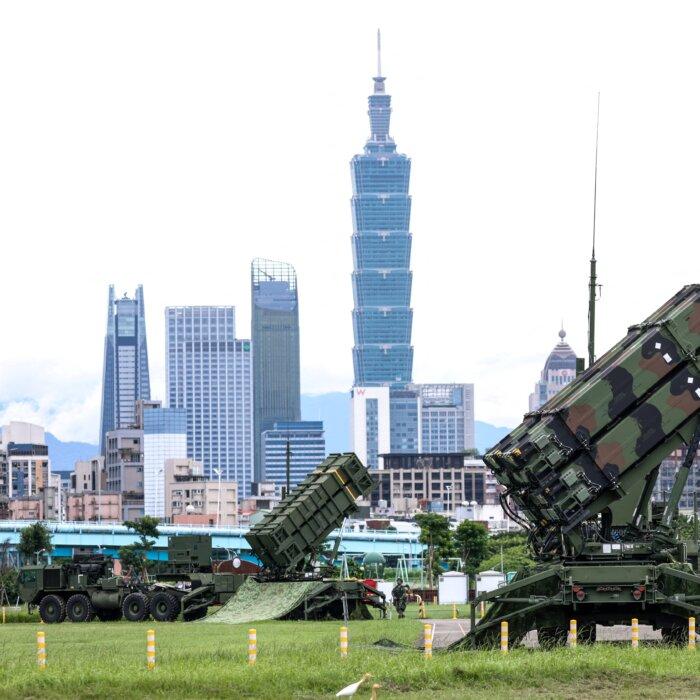
Cheng said that ultimately she would like to turn the first island chain into an “island chain of peace and prosperity,” and to see governments in East Asia integrate their technologies and supply chains.
The first island chain—which stretches from the southern Japanese island of Kyushu, Taiwan, and the Philippines to the Malay Peninsula—is considered a strategic barrier that prevents China from gaining easy access to the Pacific Ocean for its naval and air forces.