A bipartisan group of seven senators is pressing Apple to rule out using memory from two companies designated by the Pentagon as Chinese military companies, citing reports that Apple was testing chips from one of the suppliers and seeking federal clearance to buy them.
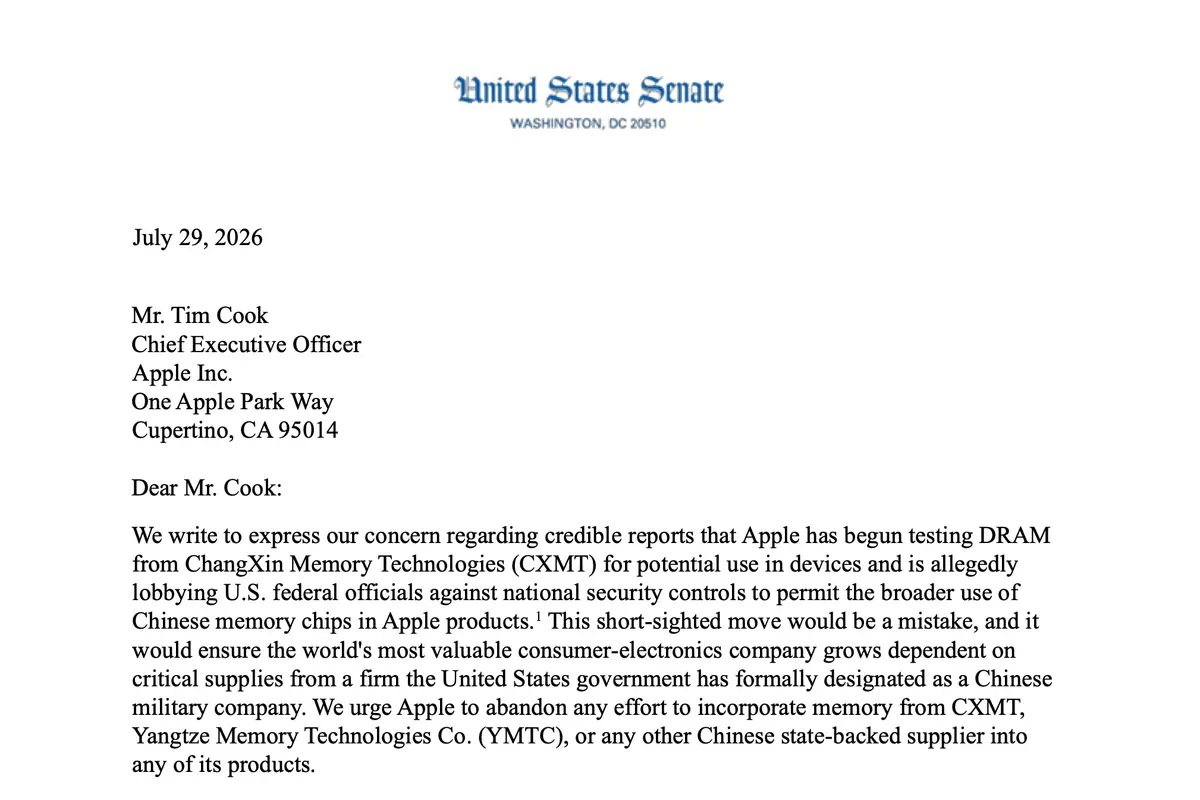
Sens. Jim Banks (R-Ind.) and Chuck Schumer (D-N.Y.) led the lawmakers in writing a July 29 letter to Apple CEO Tim Cook, urging the company to abandon any effort to use memory made by ChangXin Memory Technologies, known as CXMT, or Yangtze Memory Technologies Co., known as YMTC.
The letter cited two Financial Times reports. A June 27 report, based on six people familiar with the matter, said Apple was lobbying the Trump administration for clearance to buy CXMT memory. A July 7 report, citing two people familiar with the matter, said Apple had begun testing CXMT’s dynamic random-access memory, or DRAM, for devices sold in China.
Neither Apple nor CXMT has publicly confirmed the reported testing or lobbying.
There is no public evidence that Apple has approved CXMT chips, placed a purchase order, or incorporated them into a shipped product.
Apple did not immediately respond to a request for comment.


The senators gave Apple until Aug. 21 to disclose the status of any testing or qualification and to answer whether it would commit not to using memory from either supplier in products sold in the United States or abroad.
“We urge Apple to abandon any effort to incorporate memory from CXMT, YMTC, or any other Chinese state-backed supplier into any of its products,” the senators wrote.
The letter was also signed by Sens. Mike Crapo (R-Idaho), Jeanne Shaheen (D-N.H.), Andy Kim (D-N.J.), James Risch (R-Idaho), and Pete Ricketts (R-Neb.).
Banks said Apple should not reward companies the Pentagon has linked to China’s military-industrial system.
“Communist China has made stealing American technology and dominating critical supply chains their national strategy,” Banks said in a statement. “American companies shouldn’t reward Chinese military-linked firms with their business.”
Reported Testing, No Confirmed Orders
DRAM is the short-term working memory used while a phone, computer, or other device is operating. It is distinct from NAND flash, which stores applications, photographs, and other information after a device is turned off.
Testing samples is an early step in evaluating a new component. Qualification involves more extensive reliability, compatibility, and durability reviews. Neither step necessarily leads to a purchase order or production use.
Apple told the Financial Times in September 2022 that it was evaluating YMTC’s NAND memory for potential use in some iPhones sold in China, while saying it was not using YMTC chips in any of its products.
Nikkei Asia reported the following month, citing multiple sources, that Apple had completed a monthslong certification process for YMTC’s 128-layer 3D NAND but froze plans to use the chips amid U.S. political pressure. The report did not quote Apple or YMTC confirming the certification.
The senators argued that even an arrangement initially limited to devices sold in China could later be expanded.
“Once a part clears qualification for Apple production, extending it worldwide is a single procurement decision away,” they wrote.
Separate US Restrictions
The Defense Department’s June list identifies both CXMT and YMTC as Chinese military companies under Section 1260H of the 2021 National Defense Authorization Act.
The Pentagon said CXMT is directly affiliated with China’s Ministry of Industry and Information Technology and indirectly affiliated with that ministry and the state-owned Assets Supervision and Administration Commission.
It said YMTC is indirectly owned by the state-owned Assets Supervision and Administration Commission and indirectly affiliated with the industry ministry and the State Administration of Science, Technology, and Industry for National Defense.
The Commerce Department added YMTC to its Entity List in December 2022. The listing subjects exports, reexports, and transfers of items covered by U.S. export controls to licensing requirements.
Section 5949 of the fiscal 2023 National Defense Authorization Act, enacted in 2022, will prohibit federal agencies, beginning Dec. 23, 2027, from procuring or obtaining certain electronic products or services that include covered semiconductor products or services designed, produced, or provided by CXMT, YMTC, Semiconductor Manufacturing International Corp., and other covered entities.
The Federal Acquisition Regulatory Council published a proposed rule on Feb. 17 to implement the prohibition. The measure remained a proposed rule as of July 30.
None of those measures amounts to a blanket prohibition on Apple purchasing finished CXMT or YMTC chips for its commercial products.
Lawmakers Seek Supply-Chain Details
The senators asked Apple to identify which product lines and memory types are involved in any testing, including DRAM, NAND, or high-bandwidth memory.
They also asked whether Apple had shared—or might share—product specifications, technical information, or future product road maps with the Chinese suppliers during qualification.
The senators asked whether CXMT or YMTC personnel would receive access to Apple facilities, whether Apple had reviewed possible intellectual property exposure, and whether the company had sought additional supply from American or allied manufacturers in response to what the letter described as a memory shortage.
The senators said Apple’s choice could influence other electronics companies that follow its component and supplier decisions.
The letter pointed to memory and semiconductor investments in Indiana, Idaho, New York, and Virginia, including an advanced-packaging plant SK Hynix is building near Purdue University in West Lafayette, Indiana.
Schumer framed the dispute as both a manufacturing and national security issue.
“Using Chinese-made chips produced by companies allied with the Chinese Communist Party regime undermines American manufacturing and national security,” he said in a statement.
The senators requested Apple’s answers by Aug. 21, including the status of any testing or qualification and whether the company will rule out CXMT and YMTC memory across its global product line.